\n
## Line Chart: Surprisal vs. Training Steps for Match and Mismatch Conditions
### Overview
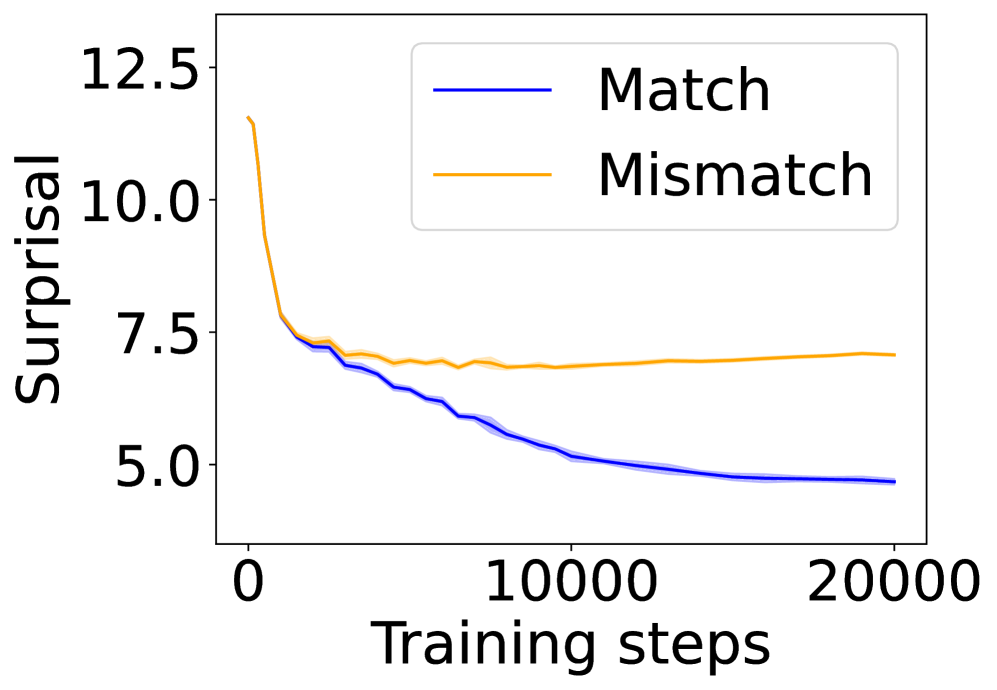
The image displays a line chart comparing the "Surprisal" metric over the course of "Training steps" for two distinct conditions: "Match" and "Mismatch." The chart illustrates how this metric evolves during a training process, showing a clear divergence in performance between the two conditions.
### Components/Axes
* **Chart Type:** Line chart with shaded confidence bands.
* **X-Axis:**
* **Label:** "Training steps"
* **Scale:** Linear scale.
* **Markers:** Major ticks at 0, 10000, and 20000.
* **Y-Axis:**
* **Label:** "Surprisal"
* **Scale:** Linear scale.
* **Markers:** Major ticks at 5.0, 7.5, 10.0, and 12.5.
* **Legend:**
* **Position:** Top-right corner of the plot area.
* **Entry 1:** A solid blue line labeled "Match".
* **Entry 2:** A solid orange line labeled "Mismatch".
* **Data Series:**
1. **Match (Blue Line):** Represents the surprisal for the "Match" condition.
2. **Mismatch (Orange Line):** Represents the surprisal for the "Mismatch" condition.
* Both lines are accompanied by a semi-transparent shaded band of the same color, likely indicating standard deviation, standard error, or a confidence interval.
### Detailed Analysis
**Trend Verification & Data Points:**
* **Match (Blue Line):**
* **Visual Trend:** The line exhibits a steep, monotonic downward slope initially, which gradually flattens but continues to decrease throughout the displayed range.
* **Approximate Data Points:**
* Step 0: ~12.5
* Step ~2500: ~7.5
* Step 10000: ~5.5
* Step 20000: ~4.8 (just below the 5.0 marker)
* **Shaded Band:** The blue shaded area is relatively narrow, suggesting lower variance or higher confidence in the measurement for this condition.
* **Mismatch (Orange Line):**
* **Visual Trend:** The line also starts with a steep downward slope but flattens out much earlier, reaching a plateau. After approximately step 7500, it shows a very slight upward trend.
* **Approximate Data Points:**
* Step 0: ~12.5 (similar starting point to Match)
* Step ~2500: ~7.5
* Step 10000: ~7.0
* Step 20000: ~7.2
* **Shaded Band:** The orange shaded area is wider than the blue one, particularly in the later steps, indicating greater variance or uncertainty in the "Mismatch" condition measurements.
### Key Observations
1. **Initial Convergence:** Both conditions start at nearly identical high surprisal values (~12.5) at step 0 and follow a very similar rapid descent for the first ~2500 steps.
2. **Divergence Point:** The lines begin to clearly separate around step 3000-4000. The "Match" line continues its steady descent, while the "Mismatch" line's rate of decrease slows significantly.
3. **Plateau vs. Continued Improvement:** The most significant observation is the plateau of the "Mismatch" line after ~7500 steps, hovering between 7.0 and 7.5, while the "Match" line continues to improve (lower surprisal) steadily.
4. **Final State:** By step 20000, there is a substantial gap of approximately 2.4 units in surprisal between the two conditions (Match ~4.8 vs. Mismatch ~7.2).
5. **Variance Indicator:** The wider confidence band for the "Mismatch" condition suggests its performance is less stable or consistent than the "Match" condition.
### Interpretation
This chart likely visualizes the learning curve of a machine learning model, where "Surprisal" is a loss or error metric (lower is better). The "Match" and "Mismatch" conditions probably refer to the alignment between training data distribution and evaluation data distribution, or between a model's architecture and a task.
* **What the data suggests:** The model learns effectively and continuously improves on data that "Matches" its training paradigm or distribution. However, when faced with a "Mismatch," initial learning occurs, but the model hits a performance ceiling relatively early and fails to improve further, even stagnating or slightly degrading.
* **Relationship between elements:** The divergence of the lines is the core story. It demonstrates that the model's capacity to reduce surprisal is fundamentally limited by the mismatch condition. The shaded bands reinforce that the "Match" condition yields more reliable and consistent results.
* **Notable implications:** This pattern is classic evidence of a model's difficulty with generalization or out-of-distribution data. The plateau indicates that additional training steps beyond ~10,000 are not beneficial for the "Mismatch" scenario and may even lead to slight overfitting to the mismatched characteristics. The investigation would focus on why the mismatch creates an insurmountable barrier to further learning after the initial phase.