## Question and Explanations Regarding Gate-Control Theory
### Overview
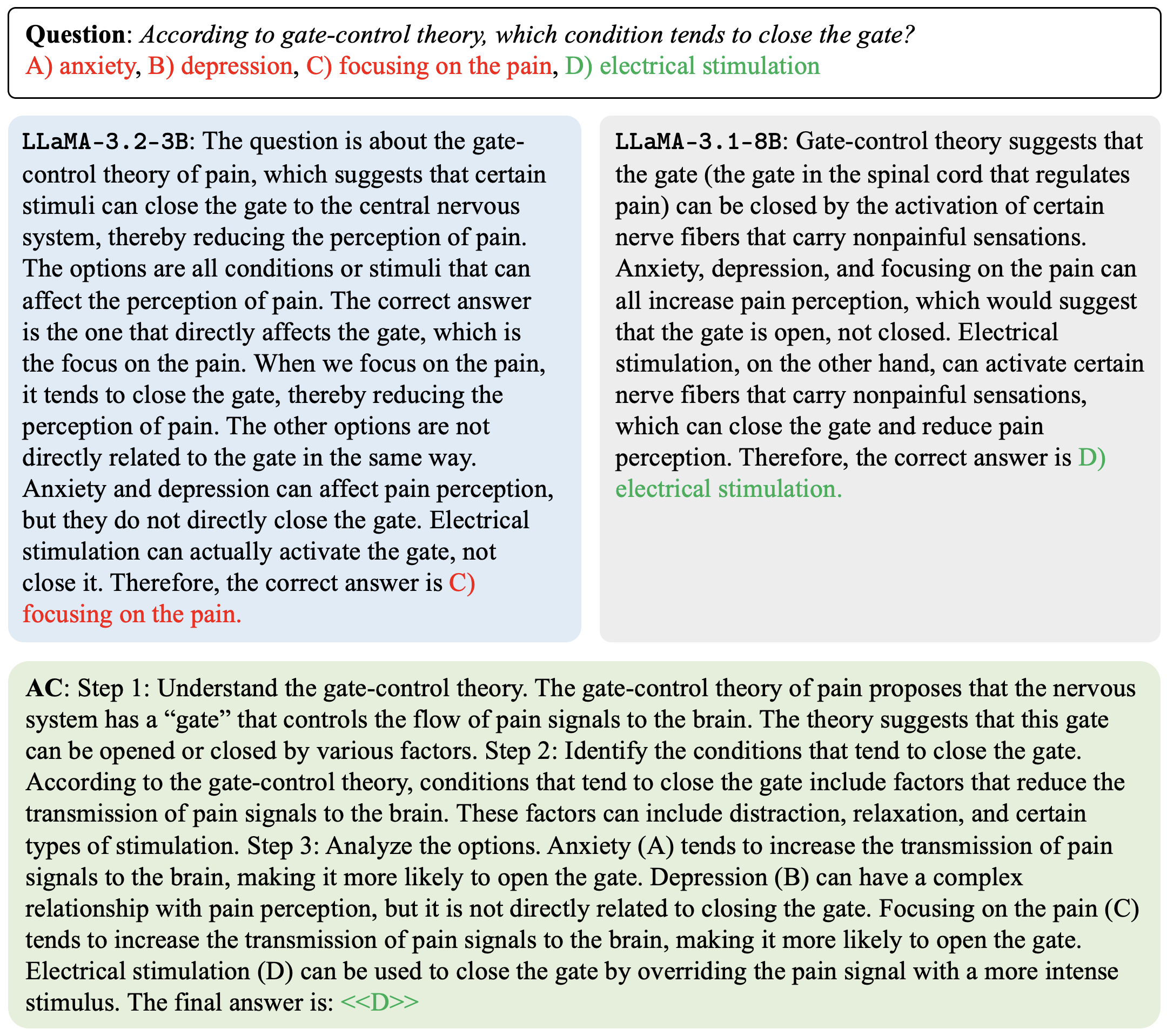
The image presents a question about gate-control theory and its possible answers, followed by three different explanations (LLaMA-3.2-3B, LLaMA-3.1-8B, and AC) that attempt to justify the correct answer.
### Components/Axes
* **Question:** "According to gate-control theory, which condition tends to close the gate?"
* **Options:** A) anxiety, B) depression, C) focusing on the pain, D) electrical stimulation
* **LLaMA-3.2-3B Explanation:** A text block providing an explanation based on focusing on the pain.
* **LLaMA-3.1-8B Explanation:** A text block providing an explanation based on electrical stimulation.
* **AC Explanation:** A text block providing a step-by-step analysis of the options.
### Detailed Analysis or Content Details
* **Question:** The question asks which condition, according to gate-control theory, tends to close the gate. The options are anxiety, depression, focusing on the pain, and electrical stimulation.
* **LLaMA-3.2-3B:** This explanation argues that focusing on the pain (C) is the correct answer because it directly affects the gate, reducing the perception of pain. It states that anxiety and depression affect pain perception but do not directly close the gate, and electrical stimulation activates the gate, not closes it.
* **LLaMA-3.1-8B:** This explanation argues that electrical stimulation (D) is the correct answer. It states that anxiety, depression, and focusing on the pain increase pain perception, suggesting the gate is open. Electrical stimulation, on the other hand, activates nerve fibers that close the gate and reduce pain perception.
* **AC:** This explanation provides a step-by-step analysis. It states that anxiety (A) tends to open the gate, depression (B) has a complex relationship, focusing on the pain (C) tends to open the gate, and electrical stimulation (D) can close the gate. The final answer is <<D>>.
### Key Observations
* The LLaMA-3.2-3B explanation contradicts the other two explanations.
* LLaMA-3.1-8B and AC both agree that electrical stimulation tends to close the gate.
* The explanations provide different rationales for the effects of anxiety, depression, and focusing on the pain.
### Interpretation
The image highlights a discrepancy in the understanding and application of gate-control theory. While two explanations (LLaMA-3.1-8B and AC) converge on electrical stimulation as the condition that tends to close the gate, one explanation (LLaMA-3.2-3B) suggests focusing on the pain. This suggests a potential ambiguity or varying interpretations within the framework of gate-control theory itself, or perhaps errors in the reasoning of the models. The step-by-step analysis in the AC explanation provides a more structured and arguably more convincing argument for electrical stimulation as the correct answer.