## Textual Comparison Diagram: Gate-Control Theory Question Analysis
### Overview
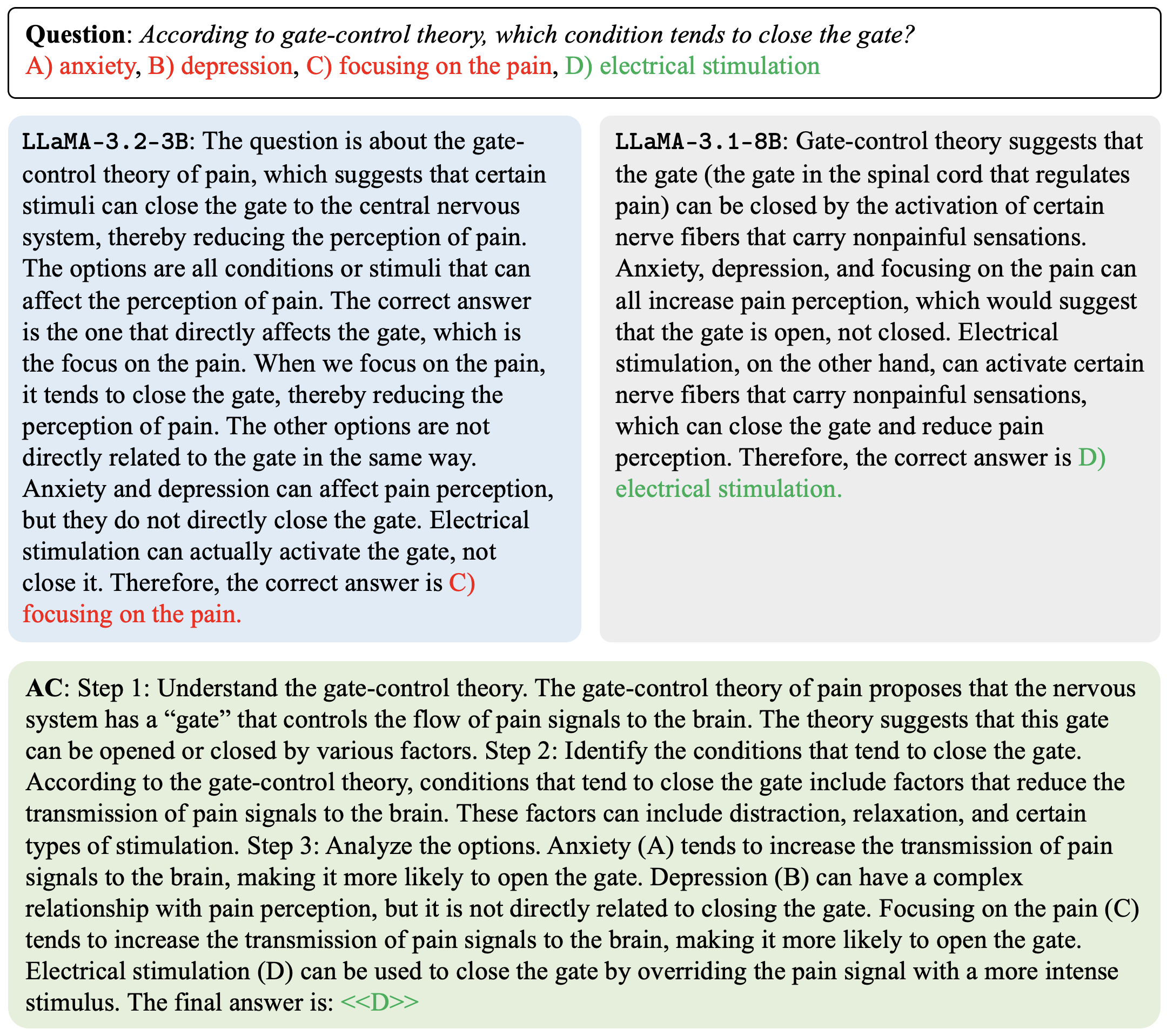
The image is a structured comparison of responses from two AI models (LLaMA-3.2-3B and LLaMA-3.1-8B) to a multiple-choice question about the gate-control theory of pain, followed by a step-by-step analysis labeled "AC" that provides a final answer. The layout is divided into three distinct horizontal sections: a top question box, two side-by-side response boxes in the middle, and a single analysis box at the bottom.
### Components/Axes
1. **Top Section (Question Box):**
* **Label:** "Question:"
* **Question Text:** "According to gate-control theory, which condition tends to close the gate?"
* **Options:** Four options are listed horizontally, color-coded.
* A) anxiety (text in red)
* B) depression (text in red)
* C) focusing on the pain (text in red)
* D) electrical stimulation (text in green)
2. **Middle Section (Model Responses):**
* **Left Box (Light Blue Background):**
* **Label:** "LLaMA-3.2-3B:"
* **Content:** A paragraph explaining the gate-control theory and arguing that the correct answer is **C) focusing on the pain**. The final answer "C) focusing on the pain." is highlighted in red.
* **Right Box (Light Gray Background):**
* **Label:** "LLaMA-3.1-8B:"
* **Content:** A paragraph explaining the gate-control theory and arguing that the correct answer is **D) electrical stimulation**. The final answer "D) electrical stimulation." is highlighted in green.
3. **Bottom Section (AC Analysis Box - Light Green Background):**
* **Label:** "AC:"
* **Content:** A three-step analysis.
* **Step 1:** Explains the gate-control theory.
* **Step 2:** Identifies conditions that close the gate (distraction, relaxation, certain stimulation).
* **Step 3:** Analyzes each option, concluding that anxiety (A) and focusing on pain (C) open the gate, depression (B) has a complex relationship, and electrical stimulation (D) can close the gate.
* **Final Answer:** "The final answer is: <<D>>" (with "D" in green).
### Detailed Analysis
* **Text Transcription & Color Coding:** The image uses color as a key informational cue. Red text (options A, B, C in the question; the final answer in the LLaMA-3.2-3B box) indicates incorrect choices according to the final analysis. Green text (option D in the question; the final answer in the LLaMA-3.1-8B and AC boxes) indicates the correct choice.
* **Model Response Discrepancy:** The core of the image is the direct contradiction between the two AI models.
* **LLaMA-3.2-3B** incorrectly identifies "focusing on the pain" as the gate-closing condition, reasoning it reduces pain perception.
* **LLaMA-3.1-8B** correctly identifies "electrical stimulation" as the gate-closing condition, reasoning it activates non-painful nerve fibers.
* **AC Analysis:** This section provides a definitive, step-by-step rationale that aligns with the standard interpretation of gate-control theory, supporting the answer given by LLaMA-3.1-8B.
### Key Observations
1. **Direct Contradiction:** The two primary model responses provide opposite answers to the same question, highlighting potential inconsistencies in AI reasoning on specialized scientific topics.
2. **Color as a Guide:** The color coding (red/green) is used consistently to signal incorrect/correct answers across the different sections, guiding the viewer's interpretation.
3. **Structured Refutation:** The bottom "AC" section acts as an authoritative refutation of the incorrect model response (LLaMA-3.2-3B) by providing a logical, stepwise breakdown that validates the other model's answer (LLaMA-3.1-8B).
### Interpretation
This image serves as a comparative case study in AI model performance and reasoning on a specific neuroscience concept. It demonstrates that:
* **Model Variance:** Different versions or instances of AI models can produce conflicting answers to factual questions, underscoring the importance of verification.
* **Pedagogical Tool:** The layout is designed to educate. By presenting a wrong answer, a right answer, and then a detailed explanation, it walks the viewer through the common misconception (that focusing on pain reduces it) and reinforces the correct mechanism (that non-painful stimulation like electrical signals can inhibit pain transmission via the spinal "gate").
* **Gate-Control Theory Clarification:** The content itself clarifies a key point of the theory: conditions that *close* the gate (reduce pain signal transmission) are typically those that activate large-diameter, non-nociceptive nerve fibers (e.g., electrical stimulation, rubbing the area), not cognitive states like anxiety or focused attention, which are more associated with *opening* the gate or modulating pain perception through different pathways. The "AC" analysis correctly notes that focusing on pain tends to increase, not decrease, the transmission of pain signals.