## Screenshot: Gate-Control Theory Question Analysis
### Overview
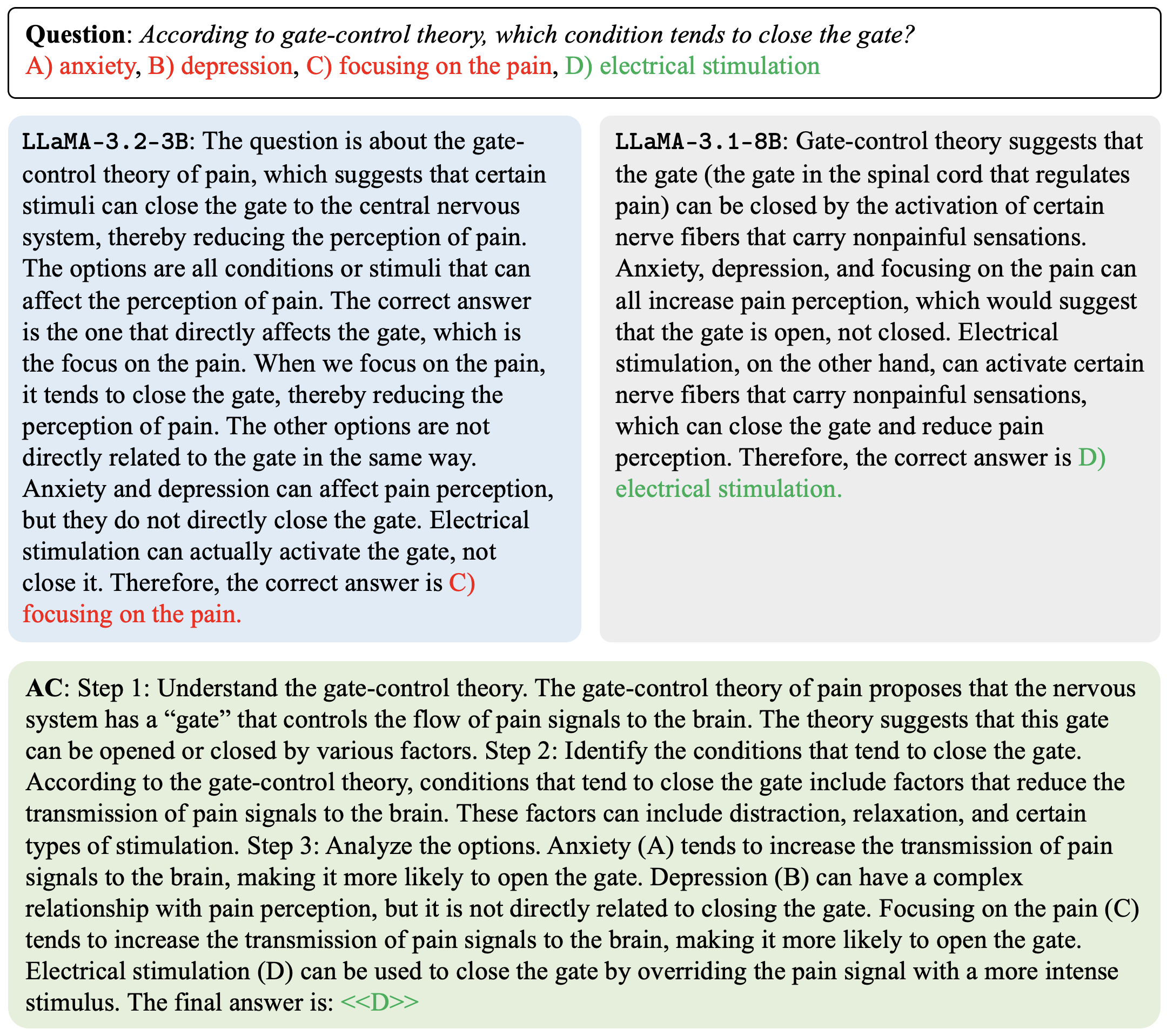
The image contains a multiple-choice question about the gate-control theory of pain, followed by explanations from two AI models (LLaMA-3.2-3B and LLaMA-3.1-8B) and a step-by-step analysis (AC). The question asks which condition "tends to close the gate" in the nervous system, with options A–D.
---
### Components/Axes
- **Question**: "According to gate-control theory, which condition tends to close the gate?"
- **Options**:
- A) anxiety
- B) depression
- C) focusing on the pain
- D) electrical stimulation
- **Correct Answer Highlight**: D) electrical stimulation (green text).
- **Model Explanations**:
1. **LLaMA-3.2-3B**:
- Argues that focusing on the pain (C) closes the gate, reducing pain perception.
- States anxiety and depression affect pain perception but do not directly close the gate.
- Claims electrical stimulation activates the gate, increasing pain.
- Final answer: C) focusing on the pain (red text).
2. **LLaMA-3.1-8B**:
- Explains that electrical stimulation (D) activates nonpainful nerve fibers, closing the gate.
- Notes anxiety, depression, and focusing on pain increase pain perception (gate open).
- Final answer: D) electrical stimulation (green text).
- **Step-by-Step Analysis (AC)**:
- **Step 1**: Describes the gate-control theory’s mechanism.
- **Step 2**: Identifies conditions that close the gate (e.g., distraction, relaxation).
- **Step 3**: Analyzes options:
- Anxiety (A) and depression (B) increase pain transmission (gate open).
- Focusing on pain (C) increases transmission (gate open).
- Electrical stimulation (D) overrides pain signals (gate closed).
- **Final Answer**: D) electrical stimulation (green text).
---
### Detailed Analysis
- **Textual Content**:
- The question and options are presented in bold red text.
- Model explanations use black text with key terms highlighted (e.g., "focusing on the pain" in red, "electrical stimulation" in green).
- The AC analysis uses numbered steps with bold headings (e.g., "Step 1: Understand the gate-control theory").
- **Key Observations**:
- Both models agree that **D) electrical stimulation** is the correct answer, but their reasoning differs:
- LLaMA-3.2-3B incorrectly claims focusing on pain (C) closes the gate.
- LLaMA-3.1-8B and AC correctly attribute gate closure to electrical stimulation (D).
- Discrepancies in explanations highlight model-specific interpretations of the theory.
---
### Interpretation
- **Theoretical Context**:
- The gate-control theory posits that nonpainful stimuli (e.g., electrical stimulation) can close the "gate" in the spinal cord, reducing pain perception.
- Anxiety, depression, and focusing on pain are associated with increased pain perception (gate open).
- **Model Behavior**:
- LLaMA-3.2-3B’s error in selecting C) suggests a potential misunderstanding of the theory’s emphasis on nonpainful stimuli.
- LLaMA-3.1-8B and AC align with the theory’s core principle that electrical stimulation (a nonpainful stimulus) closes the gate.
- **Implications**:
- The question tests understanding of how specific stimuli modulate pain perception via the gate-control mechanism.
- The AC analysis provides a structured breakdown of the theory, reinforcing the correct answer (D).
---
### Final Answer
The correct answer is **D) electrical stimulation**, as it directly activates nonpainful nerve fibers to close the gate, reducing pain perception.