## Text Block: Instructional Paragraph Generation Rules
### Overview
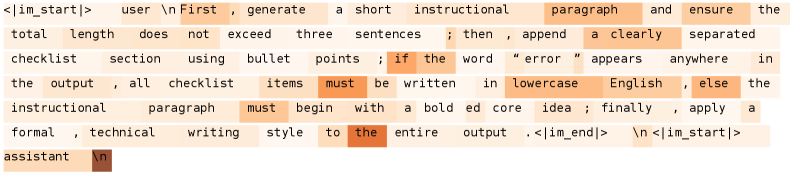
This image contains a technical instruction set for generating a formatted instructional paragraph. The text includes conditional logic, formatting requirements, and output specifications, with certain keywords highlighted in orange and brown.
### Components/Axes
- **Text Structure**: A single block of text with line breaks separating clauses.
- **Highlighted Elements**:
- **Orange**: "paragraph", "does not", "then", "error", "lowercase", "must", "bold", "the", "assistant".
- **Brown**: "assistant \n".
- **Key Phrases**:
- "generate a short instructional paragraph"
- "total length does not exceed three sentences"
- "append a clearly separated checklist section"
- "if the word 'error' appears anywhere in the output, all checklist items must be written in lowercase English"
- "instructional paragraph must begin with a bolded core idea"
- "apply a formal, technical writing style to the entire output"
### Content Details
1. **Primary Objective**: Generate a concise instructional paragraph (<3 sentences) with:
- A bolded core idea at the beginning
- A clearly separated checklist section (bullet points)
- Formal/technical writing style throughout
2. **Conditional Logic**:
- If "error" appears in the output → All checklist items must be lowercase English
- Else → Standard formatting applies
3. **Output Constraints**:
- No mention of "error" in the final output
- Checklist items must be lowercase if error condition triggers
- Assistant name followed by newline (`\n`) at the end
### Key Observations
- The text uses imperative phrasing ("must", "ensure", "apply") to enforce strict formatting rules.
- Color highlights emphasize critical components:
- Orange: Structural elements ("paragraph", "checklist", "error")
- Brown: Metadata ("assistant \n")
- The conditional logic creates a binary output format depending on error presence.
### Interpretation
This appears to be a prompt engineering instruction set, likely for an AI assistant. The color highlights suggest:
1. **Orange** marks core formatting rules and structural elements
2. **Brown** denotes metadata (assistant identifier)
3. The conditional logic implies two possible output variants:
- Standard format (no error)
- Error-triggered format (lowercase checklist)
The requirement to avoid mentioning "error" in the output while conditionally formatting based on its presence suggests a hidden state management system, possibly for error handling in technical documentation generation. The strict three-sentence limit emphasizes conciseness, while the bolded core idea ensures immediate clarity of purpose.