## Screenshot: Code Editor with Mathematical Theorems
### Overview
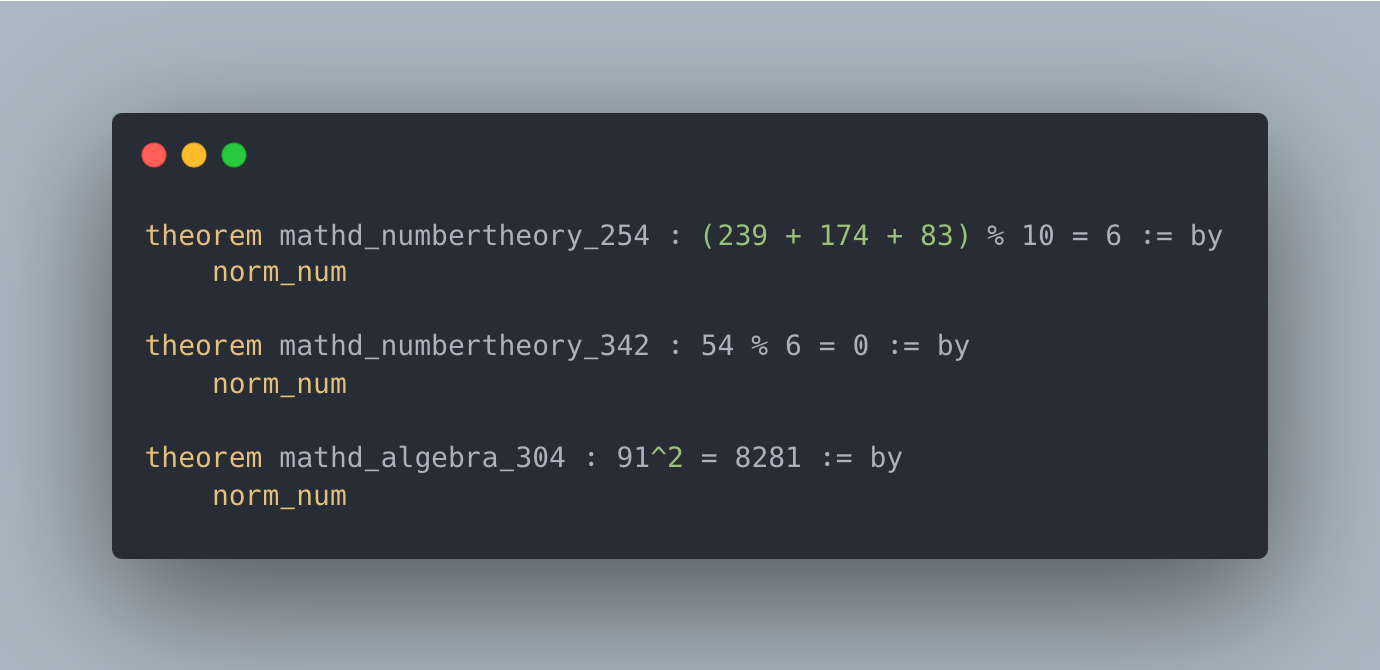
The image is a screenshot of a dark-themed code editor or terminal window, displaying three lines of formal mathematical statements written in a proof assistant language (likely Lean). Each line defines a theorem with a name, a mathematical equation, and a proof tactic. The window has a minimalist design with macOS-style window controls in the top-left corner.
### Components/Axes
* **Window Frame**: A dark gray rectangular window with rounded corners, centered on a lighter gray background.
* **Window Controls**: Three colored circles in the top-left corner of the window:
* Red (left)
* Yellow (center)
* Green (right)
* **Text Content**: Three distinct theorem statements, each formatted on a single line with syntax highlighting. The text is in a monospaced font.
* **Syntax Highlighting**:
* The keyword `theorem` is in a yellow/gold color.
* Theorem names (e.g., `mathd_numbertheory_254`) are in a light gray/white color.
* Mathematical expressions and numbers are in a light green color.
* The proof tactic `:= by norm_num` is in a muted, darker gray color.
### Detailed Analysis / Content Details
The image contains three precise mathematical statements. All text is in English, using standard mathematical notation.
1. **Theorem 1 (Top Line)**
* **Full Text**: `theorem mathd_numbertheory_254 : (239 + 174 + 83) % 10 = 6 := by norm_num`
* **Mathematical Statement**: The sum of 239, 174, and 83, modulo 10, equals 6.
* **Verification**: (239 + 174 + 83) = 496. 496 % 10 = 6. The statement is arithmetically correct.
2. **Theorem 2 (Middle Line)**
* **Full Text**: `theorem mathd_numbertheory_342 : 54 % 6 = 0 := by norm_num`
* **Mathematical Statement**: 54 modulo 6 equals 0.
* **Verification**: 54 ÷ 6 = 9 with a remainder of 0. The statement is arithmetically correct.
3. **Theorem 3 (Bottom Line)**
* **Full Text**: `theorem mathd_algebra_304 : 91^2 = 8281 := by norm_num`
* **Mathematical Statement**: 91 squared equals 8281.
* **Verification**: 91 * 91 = 8281. The statement is arithmetically correct.
### Key Observations
* **Structure**: Each theorem follows an identical syntactic pattern: `theorem [name] : [equation] := by norm_num`.
* **Naming Convention**: The theorem names suggest they are part of a structured dataset (`mathd`), categorized by field (`numbertheory`, `algebra`) and numbered (`254`, `342`, `304`).
* **Proof Tactic**: The repeated use of `:= by norm_num` indicates that each proof is completed by an automated tactic designed to verify numerical computations.
* **Visual Layout**: The text is left-aligned with consistent indentation for the proof tactic on the following line (though in this screenshot, the tactic appears on the same line for all three). The syntax highlighting creates a clear visual separation between keywords, identifiers, and mathematical content.
### Interpretation
This screenshot captures a snippet from a formal mathematics or automated theorem-proving environment. The content demonstrates the verification of basic arithmetic and algebraic facts within a rigorous, computer-checked framework.
* **Purpose**: These theorems are likely entries from a benchmark dataset (such as the `mathd` dataset) used to train or evaluate the capabilities of AI systems in formal reasoning and mathematics. The `norm_num` tactic is a common component in proof assistants like Lean for handling routine numerical calculations.
* **Significance**: The image illustrates how foundational mathematical truths are encoded and verified computationally. It highlights the intersection of computer science and pure mathematics, where logical statements are not just asserted but formally proven by machine.
* **Context**: The clean, focused presentation suggests this is a view from a developer or researcher working on formal verification, symbolic AI, or mathematical knowledge bases. The macOS-style window controls hint at the user's operating system environment.