## Screenshot: 3DGS Method Comparison Across Memory Levels and Time Steps
### Overview
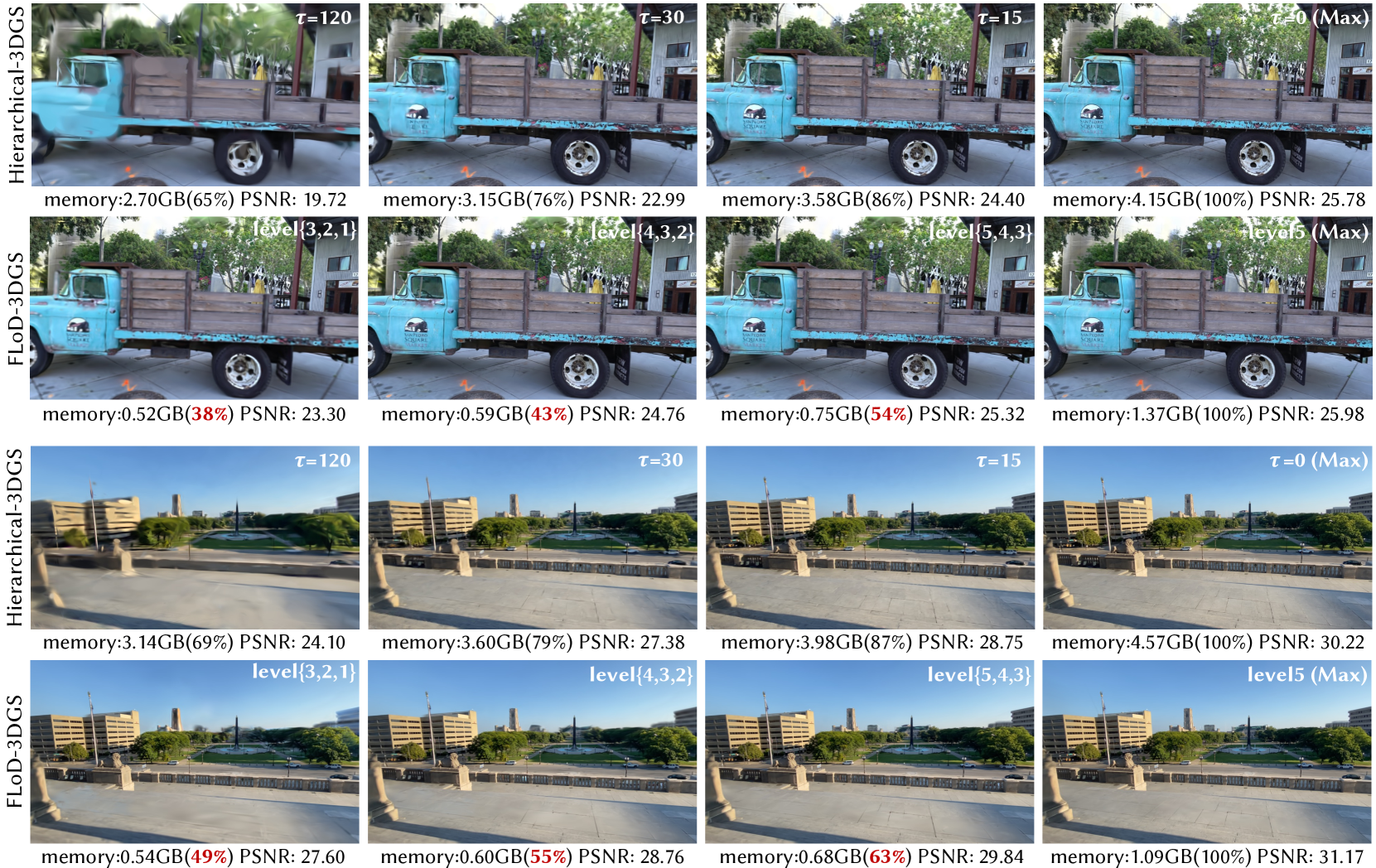
The image compares two 3D Gaussian Splatting (3DGS) methods—**Hierarchical-3DGS** and **FloD-3DGS**—across varying memory usage levels and time steps (τ). Each method is visualized in a 4x4 grid, with annotations for memory consumption (in GB), Peak Signal-to-Noise Ratio (PSNR), and temporal resolution (τ). The comparison highlights trade-offs between memory efficiency, image quality, and temporal consistency.
---
### Components/Axes
1. **Methods**:
- **Hierarchical-3DGS** (top two rows)
- **FloD-3DGS** (bottom two rows)
2. **Time Steps (τ)**:
- τ=120 (lowest quality, longest duration)
- τ=30
- τ=15
- τ=0 (Max quality, shortest duration)
3. **Memory Levels**:
- **Hierarchical-3DGS**:
- τ=120: 2.70GB (65%)
- τ=30: 3.15GB (76%)
- τ=15: 3.58GB (86%)
- τ=0: 4.15GB (100%)
- **FloD-3DGS**:
- Level {3,2,1}: 0.52GB (38%)
- Level {4,3,2}: 0.59GB (43%)
- Level {5,4,3}: 0.75GB (54%)
- Level 5 (Max): 1.37GB (100%)
4. **PSNR Values** (higher = better quality):
- Hierarchical-3DGS: 19.72 → 25.78
- FloD-3DGS: 23.30 → 25.98
- Max levels: 30.22 (Hierarchical) vs. 31.17 (FloD)
---
### Detailed Analysis
#### Hierarchical-3DGS
- **τ=120**:
- Memory: 2.70GB (65%)
- PSNR: 19.72
- Image: Blurry truck with visible motion artifacts.
- **τ=30**:
- Memory: 3.15GB (76%)
- PSNR: 22.99
- Image: Slightly sharper, reduced motion blur.
- **τ=15**:
- Memory: 3.58GB (86%)
- PSNR: 24.40
- Image: Clearer details, minimal motion artifacts.
- **τ=0 (Max)**:
- Memory: 4.15GB (100%)
- PSNR: 25.78
- Image: Highest quality, sharpest details.
#### FloD-3DGS
- **Level {3,2,1}**:
- Memory: 0.52GB (38%)
- PSNR: 23.30
- Image: Moderate quality, some motion blur.
- **Level {4,3,2}**:
- Memory: 0.59GB (43%)
- PSNR: 24.76
- Image: Improved clarity, reduced artifacts.
- **Level {5,4,3}**:
- Memory: 0.75GB (54%)
- PSNR: 25.32
- Image: Near-maximum quality.
- **Level 5 (Max)**:
- Memory: 1.37GB (100%)
- PSNR: 25.98
- Image: Highest quality, comparable to Hierarchical-3DGS at τ=0.
---
### Key Observations
1. **Memory Efficiency**:
- FloD-3DGS uses **~70% less memory** than Hierarchical-3DGS at equivalent PSNR levels (e.g., 0.52GB vs. 2.70GB for similar PSNR ~23).
2. **Quality vs. Memory Trade-off**:
- Hierarchical-3DGS achieves marginally higher PSNR at Max (25.78 vs. 25.98) but requires **3x more memory**.
3. **Temporal Consistency**:
- Lower τ values (e.g., τ=0) show sharper images but higher memory usage.
4. **Level Progression**:
- FloD-3DGS improves PSNR by ~2.7 points when increasing from Level {3,2,1} to Level 5, with memory doubling.
---
### Interpretation
The data demonstrates that **FloD-3DGS** optimizes memory efficiency without sacrificing quality, making it suitable for resource-constrained applications. Hierarchical-3DGS prioritizes absolute quality at the cost of higher memory, ideal for high-fidelity scenarios. The τ=0 (Max) images for both methods reveal that FloD-3DGS achieves near-parity in PSNR with significantly lower memory overhead, suggesting architectural advantages in compression or rendering. Notably, the Max level for FloD-3DGS (1.37GB) outperforms Hierarchical-3DGS at τ=15 (3.58GB) in both memory and quality, highlighting its scalability. This comparison underscores the importance of method selection based on application-specific constraints (e.g., real-time rendering vs. archival storage).