## Diagram: Logical Reasoning and Automated Theorem Proving (MATP) Check
### Overview
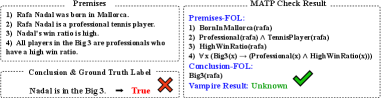
The image displays a comparative analysis of a logical reasoning problem. It contrasts a set of natural language premises and a human-assigned "Ground Truth" label against a formal First-Order Logic (FOL) representation and the output of an automated theorem prover (Vampire). The diagram highlights a discrepancy between the human-labeled "True" conclusion and the machine's inability to prove the statement.
### Components/Axes
The image is divided into two primary vertical sections, each enclosed in a dashed border:
* **Left Section (Natural Language):**
* **Header:** "Premises"
* **Content:** A numbered list (1-4) of natural language statements.
* **Footer:** "Conclusion & Ground Truth Label" containing a statement and a truth value.
* **Right Section (Formal Logic):**
* **Header:** "MATP Check Result"
* **Content:**
* "Premises-FOL": A numbered list (1-4) of formal logic statements.
* "Conclusion-FOL": The formal representation of the conclusion.
* "Vampire Result": The output of the theorem prover.
### Detailed Analysis
#### Left Section: Natural Language
* **Premises:**
1. Rafa Nadal was born in Mallorca.
2. Rafa Nadal is a professional tennis player.
3. Nadal's win ratio is high.
4. All players in the Big 3 are professionals who have a high win ratio.
* **Conclusion & Ground Truth Label:**
* Text: "Nadal is in the Big 3. -> True"
* Visual Marker: A red 'X' icon is positioned to the right of the "True" label.
#### Right Section: Formal Logic (MATP Check Result)
* **Premises-FOL:**
1. `BornInMallorca(rafa)`
2. `Professional(rafa) ∧ TennisPlayer(rafa)`
3. `HighWinRatio(rafa)`
4. `∀x (Big3(x) → (Professional(x) ∧ HighWinRatio(x)))`
* **Conclusion-FOL:**
* `Big3(rafa)`
* **Vampire Result:**
* Text: "Unknown"
* Visual Marker: A green checkmark icon is positioned to the right of the "Unknown" text.
### Key Observations
* **Logical Fallacy:** The premises provided on the left do not logically entail the conclusion "Nadal is in the Big 3." The premises establish that all Big 3 members are professionals with high win ratios, but they do not state that *all* professionals with high win ratios are in the Big 3. This is a classic "affirming the consequent" fallacy.
* **Discrepancy:** There is a clear conflict between the human-provided "Ground Truth" (labeled "True") and the automated theorem prover's result ("Unknown").
* **Visual Indicators:** The red 'X' next to the "True" label suggests that the human-provided ground truth is incorrect or invalid. The green checkmark next to "Unknown" suggests that the Vampire prover correctly identified that the conclusion cannot be proven from the given premises.
### Interpretation
This image serves as an educational or diagnostic example in the field of Artificial Intelligence, specifically regarding **Automated Theorem Proving (ATP)**.
1. **The Logic Gap:** The image demonstrates why a machine cannot prove the conclusion. The formal logic in the right column correctly models the premises. Premise 4 (`∀x (Big3(x) → (Professional(x) ∧ HighWinRatio(x)))`) creates a one-way implication. Because the premises do not state that *only* Big 3 members are professionals with high win ratios, the system cannot logically deduce that Nadal is in the Big 3.
2. **Ground Truth vs. Provability:** The image highlights a common issue in dataset curation: human annotators often provide "Ground Truth" labels based on external knowledge (knowing Nadal is in the Big 3 in reality) rather than strictly adhering to the provided premises. The "Vampire Result: Unknown" is the logically correct output for the given premises, whereas the "True" label on the left is a "hallucination" or an error caused by the annotator using outside information not contained in the premises.
3. **System Evaluation:** The use of the red 'X' and green checkmark implies that the system is evaluating the *correctness* of the human label against the *provability* of the logic. The system is flagging the human label as incorrect because it is not supported by the provided premises.