## Visual Pattern Grid: Geometric Shape Array
### Overview
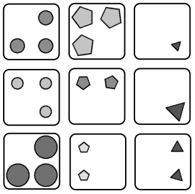
The image displays a 3x3 grid of square cells, each containing a collection of geometric shapes. The shapes are exclusively circles, pentagons, and triangles, presented in varying sizes, quantities, and shading styles (filled dark gray, outlined, or light gray fill). There is no textual information, labels, axes, or numerical data present in the image. The composition appears to be a visual pattern or classification matrix.
### Components/Axes
* **Structure:** A 3x3 grid of nine equally sized square cells with rounded corners and thin black borders.
* **Shapes Present:**
* **Circles:** Appear in the first column (top, middle, bottom cells).
* **Pentagons:** Appear in the second column (top, middle, bottom cells).
* **Triangles:** Appear in the third column (top, middle, bottom cells).
* **Shape Attributes:**
* **Size:** Shapes within a cell can be of two distinct sizes (large and small).
* **Fill/Shading:** Shapes are either filled with a solid dark gray, filled with a light gray, or presented as a black outline only.
* **Quantity:** The number of shapes per cell varies from 1 to 4.
### Detailed Analysis
**Row 1 (Top):**
* **Cell (1,1) - Top-Left:** Contains **4 circles**. All are filled with dark gray. Two are large (top-right and bottom-left positions within the cell), and two are small (top-left and bottom-right positions).
* **Cell (1,2) - Top-Center:** Contains **3 pentagons**. All are filled with light gray. Two are large (top-right and bottom-left), and one is small (top-left).
* **Cell (1,3) - Top-Right:** Contains **1 triangle**. It is small, filled with dark gray, and points toward the bottom-right corner of the cell.
**Row 2 (Middle):**
* **Cell (2,1) - Middle-Left:** Contains **3 circles**. All are presented as black outlines only. Two are large (top-left and bottom-right), and one is small (center-right).
* **Cell (2,2) - Middle-Center:** Contains **2 pentagons**. Both are filled with dark gray and are of medium/small size, positioned side-by-side in the upper half of the cell.
* **Cell (2,3) - Middle-Right:** Contains **1 triangle**. It is large, filled with dark gray, and points toward the bottom-left corner of the cell.
**Row 3 (Bottom):**
* **Cell (3,1) - Bottom-Left:** Contains **4 circles**. All are filled with dark gray. Two are large (top-right and bottom-left), and two are small (top-left and bottom-right). This cell is visually identical to Cell (1,1).
* **Cell (3,2) - Bottom-Center:** Contains **2 pentagons**. Both are presented as black outlines only and are small. They are positioned vertically in the left half of the cell.
* **Cell (3,3) - Bottom-Right:** Contains **2 triangles**. Both are filled with dark gray and are small. They are positioned vertically in the right half of the cell, both pointing upward.
### Key Observations
1. **Columnar Shape Consistency:** Each column is dedicated to a single shape type: Circles (Column 1), Pentagons (Column 2), Triangles (Column 3).
2. **Shading Pattern:** There is no single consistent shading rule across rows or columns. Shading (dark fill, light fill, outline) varies independently of shape type and position.
3. **Size and Quantity Variation:** The number and relative size of shapes within a cell change from cell to cell, even within the same shape column.
4. **Identical Cells:** Cell (1,1) and Cell (3,1) are visually identical in shape type, count, size, and shading.
5. **Triangle Orientation:** The triangles in Column 3 have different orientations: Cell (1,3) points bottom-right, Cell (2,3) points bottom-left, and both triangles in Cell (3,3) point upward.
### Interpretation
This image does not present quantitative data but rather a **visual taxonomy or feature matrix**. The grid likely serves to demonstrate or test the ability to distinguish between object classes (circle, pentagon, triangle) and their attributes (count, size, fill style) in a structured layout.
The lack of a clear, repeating pattern in shading or quantity across the grid suggests it may be designed as a **visual puzzle or a dataset for a pattern recognition task**. An observer or an AI system might be expected to identify the rules governing the distribution of attributes (e.g., "Are all outlined shapes small?" – No, as Cell (2,1) has large outlined circles). The repetition of Cell (1,1) in position (3,1) could be a control element or a deliberate break in a potential sequence.
The primary information conveyed is the **existence of three shape categories and three attribute variables (count, size, fill)**, arranged in a non-random but not immediately obvious matrix. To extract further meaning, one would need additional context about the purpose of this grid—whether it's for cognitive testing, machine learning training data, or a design prototype.