## Article: Myanmar Junta Court Convicts Aung San Suu Kyi
### Overview
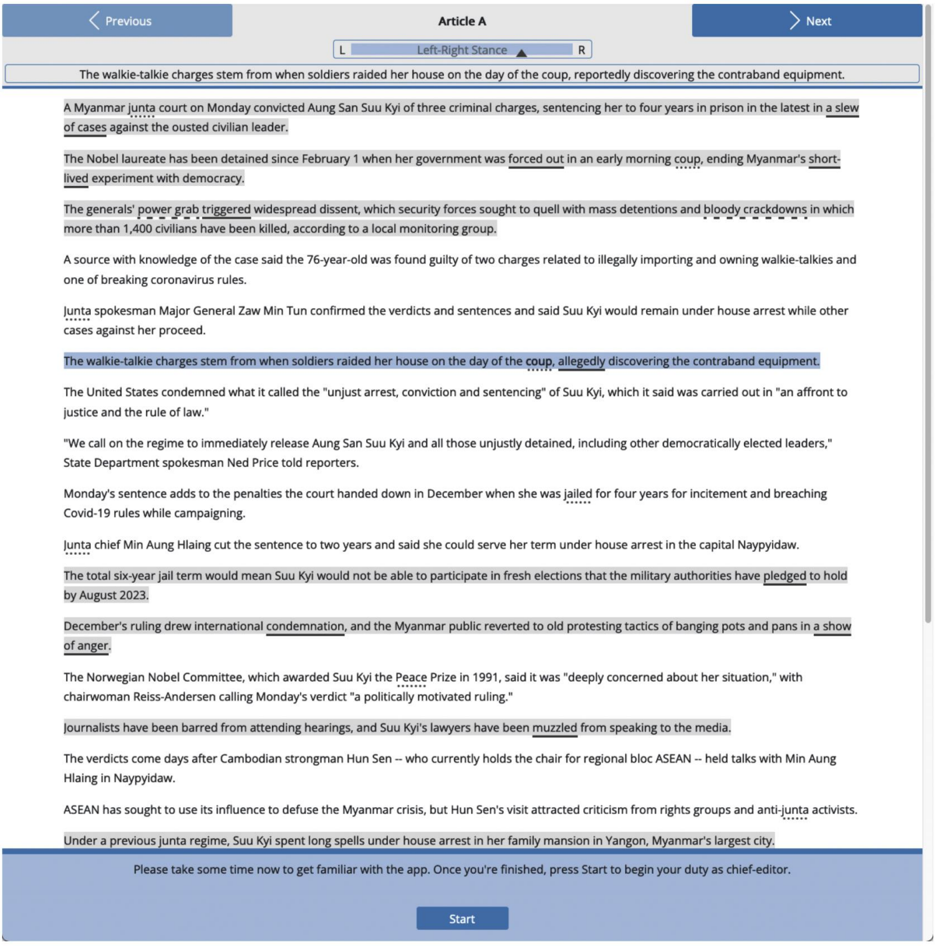
The image presents an article discussing the conviction of Aung San Suu Kyi by a Myanmar junta court. It details the charges, sentences, and international reactions to the event. The article also mentions related events such as the military coup, the suppression of dissent, and the barring of journalists from hearings.
### Components/Axes
* **Header**:
* "Article A"
* Navigation buttons: "< Previous" and "> Next"
* Left-Right Stance selector with "L" and "R" indicators.
* **Body**:
* Text content of the article.
* **Footer**:
* Instructional text: "Please take some time now to get familiar with the app. Once you're finished, press Start to begin your duty as chief-editor."
* "Start" button.
### Detailed Analysis or Content Details
The article contains the following key information:
* Aung San Suu Kyi was convicted by a Myanmar junta court on three criminal charges and sentenced to four years in prison.
* The charges relate to the discovery of contraband equipment after soldiers raided her house on the day of the coup.
* The Nobel laureate has been detained since February 1, when her government was forced out in an early morning coup.
* The generals' power grab triggered widespread dissent, leading to mass detentions and crackdowns in which over 1,400 civilians have been killed.
* A 76-year-old was found guilty of charges related to illegally importing and owning walkie-talkies and breaking coronavirus rules.
* Junta chief Min Aung Hlaing cut the sentence to two years, allowing her to serve her term under house arrest in Naypyidaw.
* The total six-year jail term would prevent Suu Kyi from participating in fresh elections pledged by the military authorities by August 2023.
* December's ruling drew international condemnation, and the Myanmar public protested.
* The Norwegian Nobel Committee expressed deep concern over her situation.
* Journalists have been barred from attending hearings, and Suu Kyi's lawyers have been muzzled.
* Cambodian strongman Hun Sen held talks with Min Aung Hlaing in Naypyidaw.
* ASEAN has sought to use its influence to defuse the Myanmar crisis.
* Suu Kyi previously spent long spells under house arrest in Yangon.
### Key Observations
* The article focuses on the legal and political ramifications of Aung San Suu Kyi's conviction.
* It highlights the international condemnation and the impact on Myanmar's democratic process.
* The article also touches on the broader context of the military coup and the suppression of dissent.
### Interpretation
The article presents a critical view of the Myanmar junta's actions, emphasizing the injustice of Aung San Suu Kyi's conviction and the suppression of democratic processes. The details provided paint a picture of a country in crisis, with international condemnation and internal dissent. The mention of ASEAN's involvement suggests an attempt to mediate the situation, but the overall tone is one of concern and condemnation. The highlighted phrases, such as "forced out in an early morning coup" and "muzzled from speaking to the media," underscore the severity of the situation and the limitations on freedom of expression.