\n
## Article A: Myanmar's Political Situation - News Report
### Overview
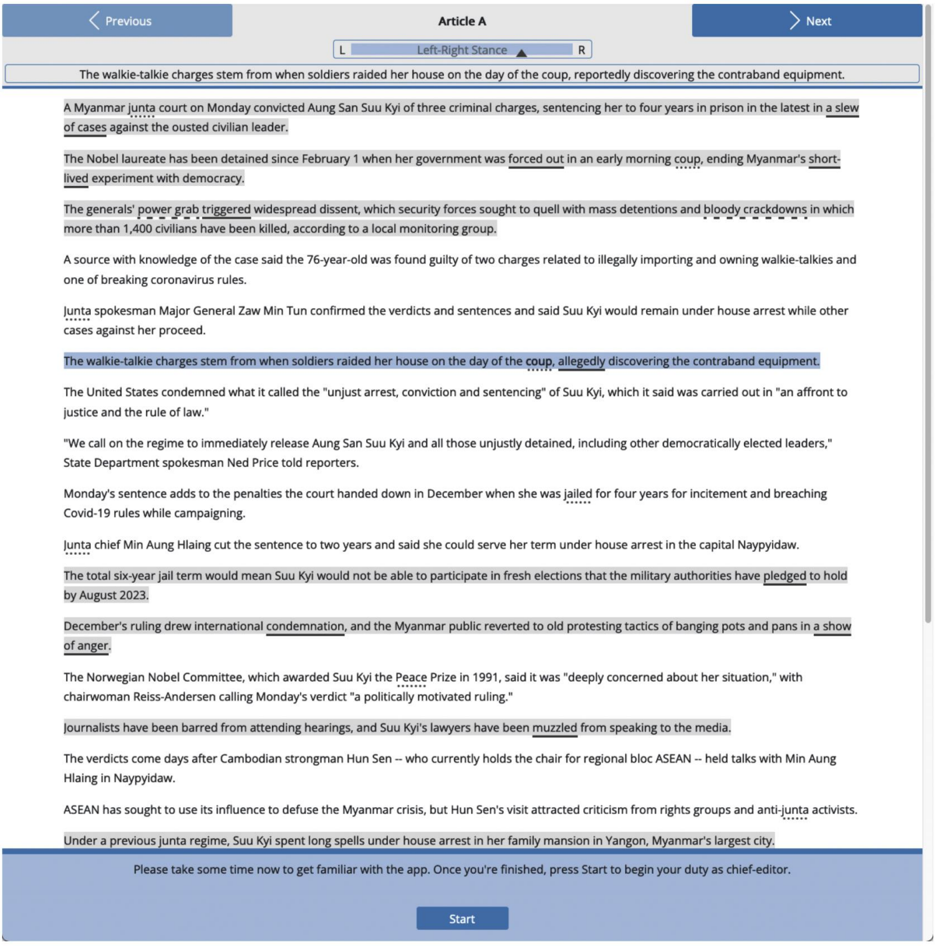
The image presents a screenshot of a news article titled "Article A" concerning the sentencing of Aung San Suu Kyi and the political situation in Myanmar following the coup. The article details the charges, sentencing, and international reactions to the events. The text is formatted as a typical news article with paragraphs and quotes.
### Components/Axes
The image consists primarily of text. There are no axes, charts, or diagrams. The visible elements include:
* **Header:** "Article A" with "Previous" and "Next" navigation arrows.
* **Title:** "Left-Right Stance" (appears to be a section heading).
* **Body:** A series of paragraphs detailing the news report.
* **Footer:** A line indicating the source: "THE ASSOCIATED PRESS" and a copyright notice.
### Detailed Analysis or Content Details
The article details the following information:
* **Charges:** Aung San Suu Kyi received three criminal charges, sentencing her to four years in prison.
* **Date of Sentencing:** Monday.
* **Initial Detention:** Suu Kyi has been detained since February 1, when the government was forced out in a coup.
* **Charges Details:** The charges relate to illegally importing and owning walkie-talkies and breaching coronavirus rules.
* **Official Confirmation:** Spokesman Major General Zaw Min Tun confirmed the verdicts and sentences.
* **International Reaction:** The United States condemned the "unjust arrest, conviction and sentencing" of Suu Kyi, calling it an "affront to justice and the rule of law."
* **Call to Action:** A call for the regime to immediately release Aung San Suu Kyi and others unjustly detained.
* **Additional Sentencing:** Monday’s sentence adds to the penalties the court handed down in December when she was jailed for four years for incitement and breaching Covid-19 rules while campaigning.
* **Further Sentence:** The sentence was increased to two years.
* **Total Sentence:** The total six-year jail term would mean Suu Kyi would not be able to participate in fresh elections that the military authorities have pledged to hold by August 2023.
* **Public Reaction:** December’s ruling drew international condemnation, and the Myanmar public reverted to old protesting tactics of banging pots and pans in a show of anger.
* **Nobel Peace Prize:** The Norwegian Nobel Committee, when awarding Suu Kyi the Peace Prize in 1991, said it was “deeply concerned about her situation.”
* **Journalist Comments:** Journalists have been barred from attending hearings, and Suu Kyi’s lawyers have been muzzled from speaking to the media.
* **Information Source:** Information comes from local monitoring groups, reporters, and the Associated Press.
* **Mentioned Individuals:** Aung San Suu Kyi, Major General Zaw Min Tun, Ned Price, Min Aung Hlaing.
### Key Observations
* The article focuses heavily on the legal proceedings against Aung San Suu Kyi and the increasing length of her imprisonment.
* There is a clear emphasis on the international condemnation of the Myanmar regime's actions.
* The article highlights the suppression of information and restrictions placed on journalists and lawyers.
* The mention of the upcoming elections in 2023 suggests the regime's attempt to legitimize its rule.
### Interpretation
The article paints a grim picture of the political situation in Myanmar following the coup. The sentencing of Aung San Suu Kyi, a symbol of democracy, demonstrates the regime's intent to consolidate power and suppress dissent. The international condemnation, while significant, appears to have limited impact on the regime's actions. The restrictions on information and the suppression of legal representation further underscore the lack of due process and the erosion of democratic principles. The article suggests a prolonged period of political instability and repression in Myanmar. The reference to the 1991 Nobel Peace Prize serves as a stark contrast to the current situation, highlighting the dramatic reversal of Suu Kyi’s fortunes and the country’s democratic trajectory. The article is a factual report, presenting events without overt editorializing, but the selection of details and the inclusion of quotes from international officials clearly convey a critical stance towards the Myanmar regime.