## Comparison of Memory Usage Across Levels for FLOD-3DGS and FLOD-Scaffold
### Overview
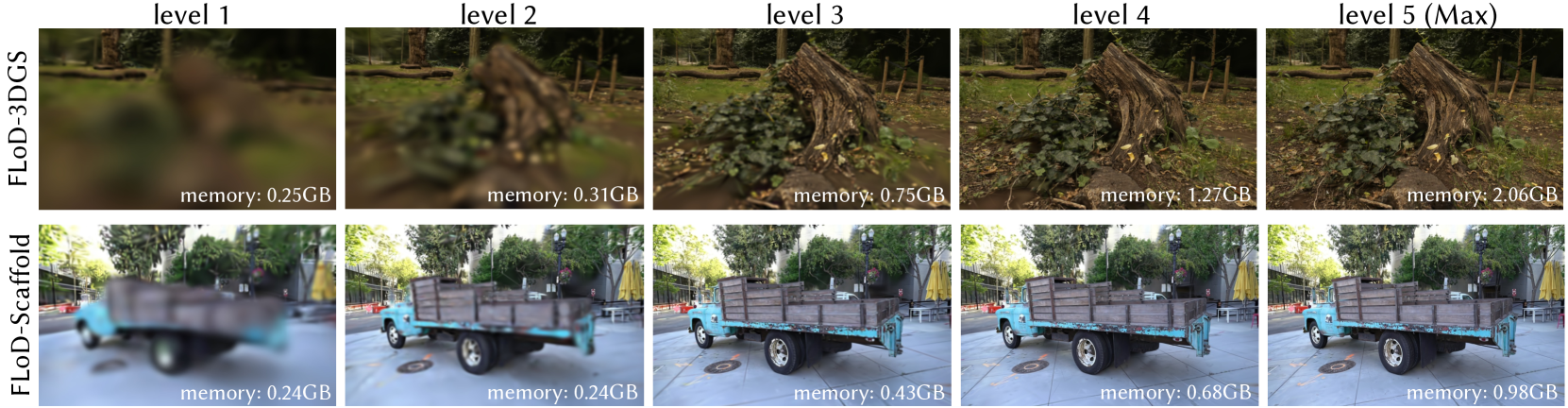
The image presents a side-by-side comparison of two methods (FLOD-3DGS and FLOD-Scaffold) across five hierarchical levels (1 to 5). Each level shows a blurred image of a scene (a tree stump in a forest and a blue truck on a street) alongside a labeled memory consumption value in gigabytes (GB). The memory values increase with higher levels for both methods.
### Components/Axes
- **X-axis**: Hierarchical levels (1 to 5), labeled as "level 1", "level 2", ..., "level 5 (Max)".
- **Y-axis**: Two methods: "FLOD-3DGS" (top row) and "FLOD-Scaffold" (bottom row).
- **Memory Values**: Displayed in GB below each image, with approximate values:
- **FLOD-3DGS**: 0.25GB, 0.31GB, 0.75GB, 1.27GB, 2.06GB.
- **FLOD-Scaffold**: 0.24GB, 0.24GB, 0.43GB, 0.68GB, 0.98GB.
### Detailed Analysis
- **FLOD-3DGS**:
- Level 1: 0.25GB (lowest memory usage).
- Level 2: 0.31GB (slight increase).
- Level 3: 0.75GB (significant jump).
- Level 4: 1.27GB (further increase).
- Level 5 (Max): 2.06GB (highest memory usage).
- **FLOD-Scaffold**:
- Level 1: 0.24GB (lowest memory usage).
- Level 2: 0.24GB (no change).
- Level 3: 0.43GB (moderate increase).
- Level 4: 0.68GB (steady rise).
- Level 5 (Max): 0.98GB (lower than FLOD-3DGS at max level).
### Key Observations
1. **Memory Trends**:
- FLOD-3DGS exhibits a **non-linear increase** in memory consumption, with a sharp rise between levels 2 and 3.
- FLOD-Scaffold shows a **linear increase** but remains consistently lower than FLOD-3DGS across all levels.
2. **Blurred Images**:
- The images at each level are progressively less blurred, suggesting higher resolution or detail as levels increase.
- At level 5 (Max), both methods show clear images, but FLOD-3DGS uses significantly more memory (2.06GB vs. 0.98GB).
### Interpretation
The data suggests that **FLOD-3DGS** prioritizes higher memory allocation to achieve finer detail or resolution at higher levels, while **FLOD-Scaffold** maintains lower memory usage but still improves clarity. The sharp memory spike in FLOD-3DGS at level 3 may indicate a computational bottleneck or a design choice to allocate resources more aggressively at intermediate levels. The consistent lower memory footprint of FLOD-Scaffold could make it more efficient for applications with strict memory constraints, though it may sacrifice some detail compared to FLOD-3DGS at maximum levels.