TECHNICAL ASSET FINGERPRINT
4a5eb3c472df10f45fa05a9b
Click to view fullscreen
Press ESC or click to close
FOUND IN PAPERS
EXPERT: gemini-2.0-flash VERSION 1
RUNTIME: nugit/gemini/gemini-2.0-flash
INTEL_VERIFIED
## Chart/Diagram Type: Multi-Panel Figure: Programming of ReRAM
### Overview
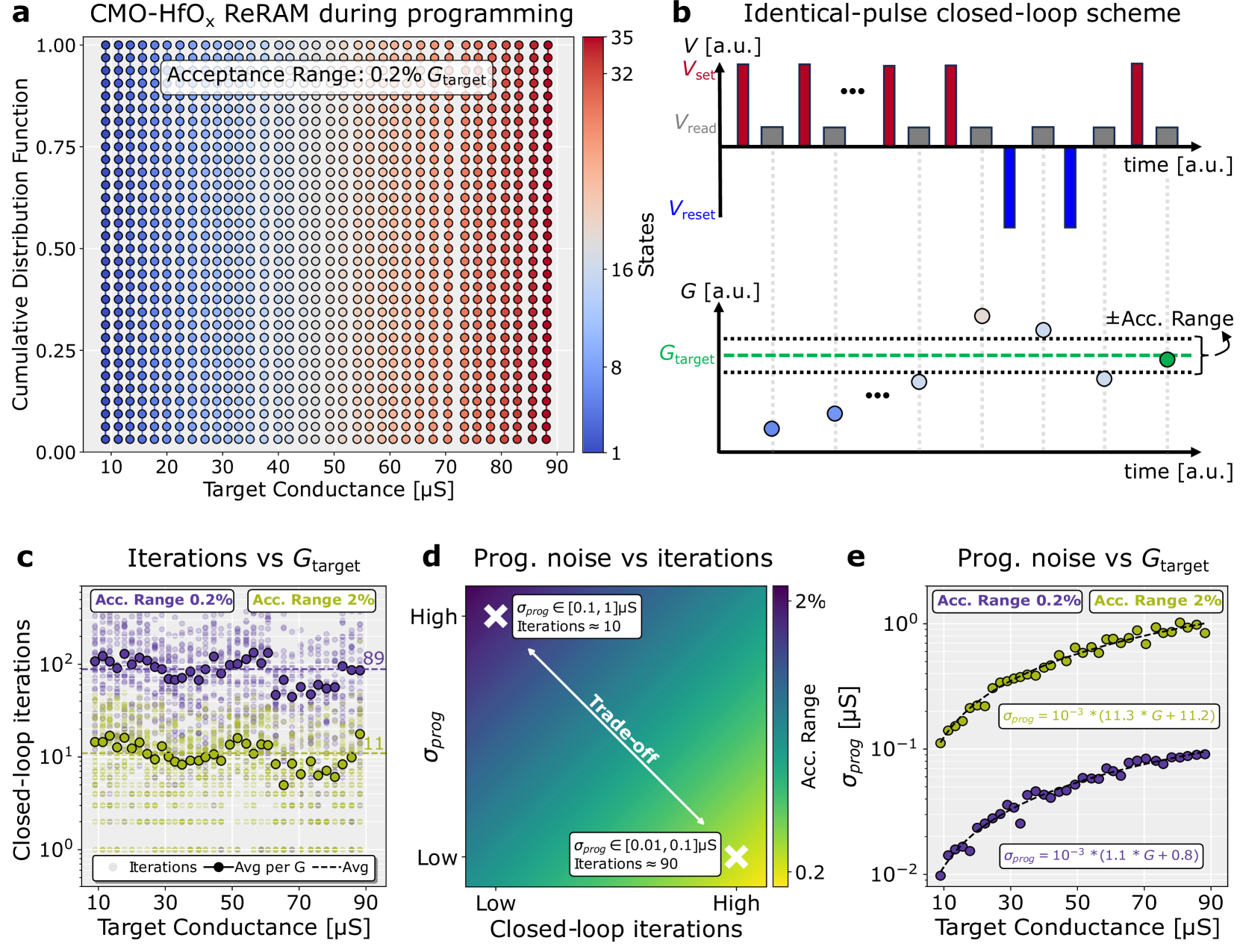
The image presents a multi-panel figure (a-e) illustrating the programming of a CMO-HfOₓ ReRAM (Resistive Random-Access Memory) using a closed-loop scheme. The figure explores the relationship between target conductance, programming noise, and the number of iterations required for programming.
### Components/Axes
**Panel a: Cumulative Distribution Function vs. Target Conductance**
* **Title:** CMO-HfOₓ ReRAM during programming
* **Axes:**
* X-axis: Target Conductance [µS], ranging from 10 to 90 in increments of 10.
* Y-axis: Cumulative Distribution Function, ranging from 0.00 to 1.00 in increments of 0.25.
* **Color Scale:** A color gradient from blue to red, representing the number of states, ranging from 1 to 35.
* **Annotation:** "Acceptance Range: 0.2% Gtarget"
**Panel b: Identical-pulse closed-loop scheme**
* **Title:** Identical-pulse closed-loop scheme
* **Top Subplot Axes:**
* Y-axis: V [a.u.] (Arbitrary Units)
* Annotations: Vset (red), Vread (gray), Vreset (blue)
* X-axis: time [a.u.] (Arbitrary Units)
* **Bottom Subplot Axes:**
* Y-axis: G [a.u.] (Arbitrary Units)
* Annotation: Gtarget (green, dashed line)
* X-axis: time [a.u.] (Arbitrary Units)
* Annotation: ±Acc. Range (green bracket)
**Panel c: Iterations vs Gtarget**
* **Title:** Iterations vs Gtarget
* **Axes:**
* X-axis: Target Conductance [µS], ranging from 10 to 90 in increments of 20.
* Y-axis: Closed-loop iterations (logarithmic scale), ranging from 10⁰ to 10².
* **Data Series:**
* Iterations (gray dots)
* Avg per G (yellow dots)
* Avg (dashed lines):
* Acceptance Range 0.2% (purple, average around 89 iterations)
* Acceptance Range 2% (yellow, average around 11 iterations)
* **Annotations:** "Acc. Range 0.2%", "Acc. Range 2%"
**Panel d: Prog. noise vs iterations**
* **Title:** Prog. noise vs iterations
* **Axes:**
* X-axis: Closed-loop iterations (qualitative, Low to High)
* Y-axis: σprog (qualitative, Low to High)
* **Color Scale:** A color gradient from purple to yellow, representing the Acceptance Range, ranging from 0.2% to 2%.
* **Annotations:**
* "Trade-off" (white arrow)
* "σprog ∈ [0.1, 1] µS, Iterations ≈ 10" (white cross at top-left)
* "σprog ∈ [0.01, 0.1] µS, Iterations ≈ 90" (white cross at bottom-right)
**Panel e: Prog. noise vs Gtarget**
* **Title:** Prog. noise vs Gtarget
* **Axes:**
* X-axis: Target Conductance [µS], ranging from 10 to 90 in increments of 20.
* Y-axis: σprog [µS] (logarithmic scale), ranging from 10⁻² to 10⁰.
* **Data Series:**
* Acceptance Range 0.2% (purple dots): σprog = 10⁻³ * (1.1 * G + 0.8)
* Acceptance Range 2% (yellow dots): σprog = 10⁻³ * (11.3 * G + 11.2)
* **Annotations:** "Acc. Range 0.2%", "Acc. Range 2%"
### Detailed Analysis
**Panel a:** The cumulative distribution function shows how the states are distributed across different target conductance values. The color gradient indicates the density of states, with blue representing lower states and red representing higher states. The distribution shifts towards higher conductance values as the target conductance increases.
**Panel b:** This panel illustrates the identical-pulse closed-loop scheme. The top subplot shows the voltage pulses applied (Vset, Vread, Vreset) over time. The bottom subplot shows the resulting conductance (G) over time, converging towards the target conductance (Gtarget) within an acceptable range (±Acc. Range).
**Panel c:** This graph shows the relationship between the number of closed-loop iterations and the target conductance. The gray dots represent individual iterations, while the yellow dots represent the average number of iterations for each target conductance. The dashed lines indicate the average number of iterations for acceptance ranges of 0.2% (purple, ~89 iterations) and 2% (yellow, ~11 iterations).
**Panel d:** This heatmap illustrates the trade-off between programming noise (σprog) and the number of closed-loop iterations. Lower noise requires more iterations, and vice versa. The color gradient represents the acceptance range, with purple indicating a tighter acceptance range (0.2%) and yellow indicating a wider acceptance range (2%).
**Panel e:** This graph shows the relationship between programming noise (σprog) and target conductance. The purple dots represent an acceptance range of 0.2%, and the yellow dots represent an acceptance range of 2%. The equations provided describe the relationship between σprog and G for each acceptance range.
### Key Observations
* **Panel a:** The distribution of states shifts towards higher conductance values as the target conductance increases.
* **Panel b:** The closed-loop scheme converges towards the target conductance over time.
* **Panel c:** A tighter acceptance range (0.2%) requires significantly more iterations than a wider acceptance range (2%).
* **Panel d:** There is a clear trade-off between programming noise and the number of iterations.
* **Panel e:** Programming noise increases with target conductance for both acceptance ranges.
### Interpretation
The data presented in this figure demonstrates the programming characteristics of a CMO-HfOₓ ReRAM using a closed-loop scheme. The key findings are:
1. **Trade-off between Accuracy and Speed:** A tighter acceptance range (higher accuracy) requires more programming iterations (slower programming).
2. **Programming Noise Increases with Target Conductance:** As the target conductance increases, the programming noise also increases, making it more challenging to achieve precise programming at higher conductance levels.
3. **Closed-Loop Scheme Effectiveness:** The closed-loop scheme effectively converges towards the target conductance, but the number of iterations required depends on the desired accuracy and the target conductance value.
The figure highlights the importance of carefully considering the trade-offs between accuracy, speed, and noise when programming ReRAM devices. The data can be used to optimize programming algorithms and device parameters to achieve the desired performance characteristics.
DECODING INTELLIGENCE...
EXPERT: nemotron-free VERSION 1
RUNTIME: free/nvidia/nemotron-nano-12b-v2-vl:free
INTEL_VERIFIED
## Heatmap: CMO-HfOₓ ReRAM during programming
### Overview
A heatmap visualizing the cumulative distribution function (CDF) of target conductance values during ReRAM programming. The color gradient represents the density of data points, with blue indicating lower values and red higher values.
### Components/Axes
- **X-axis**: Target Conductance [μS] (10–90 μS)
- **Y-axis**: Cumulative Distribution Function (0.00–1.00)
- **Color Scale**: Blue (low density) to Red (high density)
- **Legend**: "Acceptance Range: 0.2% G_target" (annotated in the top-left region)
### Detailed Analysis
- The heatmap shows a gradient from blue (left) to red (right), indicating increasing conductance values.
- The acceptance range (0.2% G_target) is highlighted in the upper-left quadrant, where data points cluster densely.
- No explicit numerical values are provided, but the color intensity suggests higher conductance values (e.g., >70 μS) dominate the red regions.
### Key Observations
- Conductance values below 30 μS are underrepresented (blue regions).
- The acceptance range annotation implies a focus on conductance values near the target threshold.
### Interpretation
The heatmap demonstrates the distribution of target conductance during ReRAM programming, with a concentration of data points near the 0.2% acceptance range. This suggests variability in programming outcomes, particularly at lower conductance values.
---
## Diagram: Identical-pulse closed-loop scheme
### Overview
A schematic of a closed-loop programming process for ReRAM, showing voltage pulses and conductance measurements over time.
### Components/Axes
- **X-axis**: Time [a.u.] (sequential steps)
- **Y-axis**: Voltage States (V_set, V_read, V_reset) and Conductance (G)
- **Key Elements**:
- Red bars: V_set pulses
- Gray bars: V_read measurements
- Blue bars: V_reset pulses
- Green dashed line: G_target threshold
- Acceptance range: ±0.2% G_target (annotated with arrows)
### Detailed Analysis
- The process alternates between V_set (programming), V_read (measurement), and V_reset (reset).
- Conductance (G) is measured after each V_read, with deviations from G_target marked by the acceptance range.
- The green dashed line (G_target) acts as a reference for successful programming.
### Key Observations
- Conductance measurements (G) are tightly controlled within ±0.2% of G_target.
- V_set pulses are consistently applied to adjust conductance toward G_target.
### Interpretation
This closed-loop scheme ensures precise control of ReRAM conductance by iteratively adjusting voltage pulses and measuring deviations from the target. The acceptance range indicates tolerance for minor variations.
---
## Scatter Plot: Iterations vs G_target
### Overview
A log-scale plot comparing closed-loop iterations to target conductance (G_target) for two acceptance ranges (0.2% and 2%).
### Components/Axes
- **X-axis**: Target Conductance [μS] (10–90 μS)
- **Y-axis**: Closed-loop Iterations (10⁰–10²)
- **Legend**:
- Purple: Acceptance Range 0.2%
- Green: Acceptance Range 2%
- Black dashed line: Average iterations per G_target
### Detailed Analysis
- **0.2% Acceptance Range (Purple)**:
- Iterations increase with G_target, peaking at ~100 iterations for G_target ≈ 80 μS.
- Data points cluster densely between 10–50 μS.
- **2% Acceptance Range (Green)**:
- Fewer iterations required (1–10 iterations) across all G_target values.
- Data points are sparser but show a general upward trend.
### Key Observations
- Tighter acceptance ranges (0.2%) require significantly more iterations, especially at higher G_target values.
- The average iterations per G_target (black dashed line) suggests a logarithmic relationship.
### Interpretation
Higher precision (0.2% acceptance) demands more iterations, highlighting the trade-off between accuracy and computational effort in ReRAM programming.
---
## Heatmap: Prog. noise vs iterations
### Overview
A heatmap showing the relationship between programming noise (σ_prog) and closed-loop iterations, with color gradients indicating acceptance ranges.
### Components/Axes
- **X-axis**: Closed-loop Iterations (Low to High)
- **Y-axis**: Programming Noise (σ_prog) [μS]
- **Color Scale**: Blue (low σ_prog) to Yellow (high σ_prog)
- **Annotations**:
- "Trade-off: σ_prog ∈ [0.01, 0.1] μS, Iterations ≈ 90"
- "σ_prog ∈ [0.1, 1] μS, Iterations ≈ 10"
### Detailed Analysis
- Lower σ_prog (blue regions) correlates with higher iterations (right side of the plot).
- Higher σ_prog (yellow regions) aligns with fewer iterations.
- The "trade-off" annotation emphasizes the inverse relationship between noise and iterations.
### Key Observations
- σ_prog values below 0.1 μS require ~90 iterations, while values above 0.1 μS drop to ~10 iterations.
- The acceptance range is not explicitly labeled but inferred from color intensity.
### Interpretation
Reducing programming noise improves precision but increases the number of iterations needed, reflecting a critical balance in ReRAM optimization.
---
## Scatter Plot: Prog. noise vs G_target
### Overview
A log-scale plot of programming noise (σ_prog) against target conductance (G_target), with two acceptance ranges (0.2% and 2%).
### Components/Axes
- **X-axis**: Target Conductance [μS] (10–90 μS)
- **Y-axis**: Programming Noise (σ_prog) [μS] (10⁻²–10⁰)
- **Legend**:
- Purple: Acceptance Range 0.2%
- Green: Acceptance Range 2%
- **Equations**:
- σ_prog = 10⁻³*(11.3*G + 11.2) (0.2% range)
- σ_prog = 10⁻³*(1.1*G + 0.8) (2% range)
### Detailed Analysis
- **0.2% Acceptance Range (Purple)**:
- σ_prog increases linearly with G_target (slope ≈ 11.3*10⁻³).
- Data points form a tight curve from ~0.1 μS (G=10 μS) to ~1.2 μS (G=90 μS).
- **2% Acceptance Range (Green)**:
- σ_prog increases more slowly (slope ≈ 1.1*10⁻³).
- Data points range from ~0.08 μS (G=10 μS) to ~1.0 μS (G=90 μS).
### Key Observations
- Tighter acceptance ranges (0.2%) exhibit higher σ_prog, especially at higher G_target values.
- The 2% range shows a flatter trend, indicating lower noise tolerance.
### Interpretation
Programming noise scales with target conductance, with stricter acceptance ranges amplifying noise effects. This underscores the challenge of maintaining precision in high-conductance ReRAM devices.
DECODING INTELLIGENCE...