## Spectrogram Comparison: Environmental Sounds in Left and Right Ears
### Overview
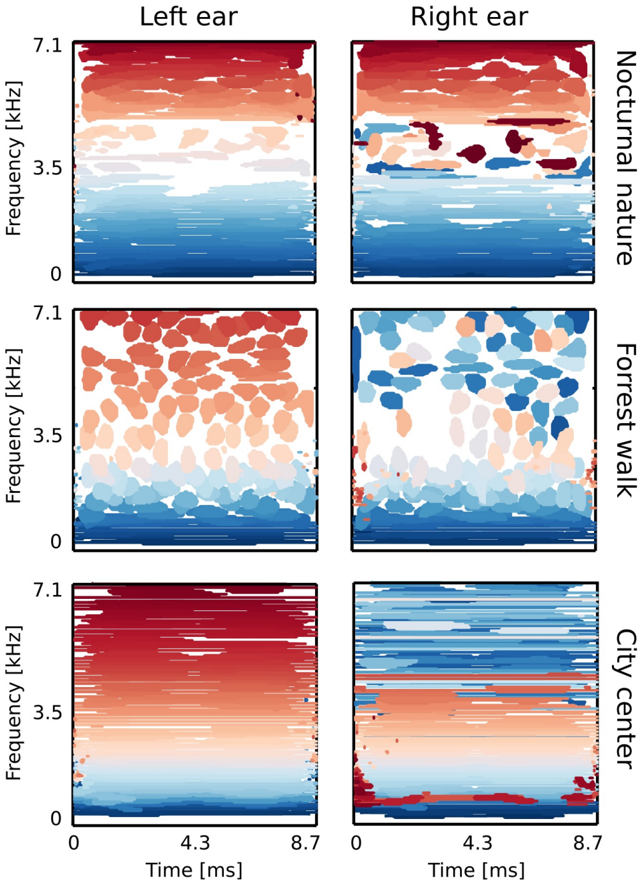
The image presents a series of spectrograms comparing sound frequencies over time for the left and right ears in three different environments: "Nocturnal nature," "Forrest walk," and "City center." Each environment has two spectrograms, one for each ear. The x-axis represents time in milliseconds (ms), and the y-axis represents frequency in kilohertz (kHz). The color intensity indicates the sound intensity at a given frequency and time, with blue representing lower intensity and red representing higher intensity.
### Components/Axes
* **Titles:** "Left ear," "Right ear," "Nocturnal nature," "Forrest walk," "City center."
* **X-axis:** "Time [ms]" with markers at 0, 4.3, and 8.7 ms.
* **Y-axis:** "Frequency [kHz]" with markers at 0, 3.5, and 7.1 kHz.
* **Color Scale:** Blue indicates lower sound intensity, transitioning to red for higher sound intensity.
### Detailed Analysis
**1. Nocturnal Nature:**
* **Left Ear:** High-frequency sounds (above 3.5 kHz) are consistently present throughout the 8.7 ms duration, with varying intensity. Lower frequencies (below 3.5 kHz) show intermittent presence.
* **Right Ear:** Similar to the left ear, high-frequency sounds are present, but with more distinct gaps and variations in intensity. There are patches of high intensity (red) at around 3.5 kHz between 0 and 4.3 ms.
**2. Forrest Walk:**
* **Left Ear:** The spectrogram shows distinct, isolated sound events across all frequencies. The sound events appear as blobs, with higher intensity (red) concentrated in the 3.5-7.1 kHz range.
* **Right Ear:** Similar isolated sound events are present, but with a different distribution. There's a greater presence of lower-frequency sounds (below 3.5 kHz) compared to the left ear.
**3. City Center:**
* **Left Ear:** High-frequency sounds (above 3.5 kHz) are consistently present with high intensity (red) throughout the duration. Lower frequencies show a gradual increase in intensity over time.
* **Right Ear:** A distinct band of high-intensity sound is present around 3.5 kHz. Lower frequencies (below 3.5 kHz) also show significant intensity, particularly at the beginning (0-4.3 ms). High frequencies are present, but less intense than the left ear.
### Key Observations
* **Frequency Range:** All spectrograms show activity across the entire 0-7.1 kHz range, but the distribution and intensity vary significantly between environments and ears.
* **Temporal Patterns:** The "Nocturnal nature" and "City center" environments show more continuous sound patterns, while "Forrest walk" exhibits discrete sound events.
* **Left-Right Differences:** There are noticeable differences in the sound profiles between the left and right ears within each environment, suggesting spatial variations in sound sources.
### Interpretation
The spectrograms provide a visual representation of the soundscapes in different environments, highlighting the frequency and temporal characteristics of the sounds perceived by the left and right ears.
* **Nocturnal Nature:** The continuous presence of high-frequency sounds might indicate the presence of insects or other nocturnal animals. The variations in intensity could reflect changes in their activity or distance.
* **Forrest Walk:** The discrete sound events likely represent individual sounds like birds chirping, leaves rustling, or footsteps. The differences between ears could be due to the directionality of these sounds.
* **City Center:** The continuous presence of both high and low-frequency sounds suggests a complex soundscape with traffic, human voices, and other urban noises. The band of high intensity around 3.5 kHz in the right ear could be related to specific types of vehicles or machinery.
The differences between the left and right ear spectrograms in each environment suggest that the sounds are not uniformly distributed in space, and the listener is experiencing a stereo sound field. This information could be used to analyze the spatial characteristics of different environments and how they are perceived by the auditory system.