## Diagram: Comparison of Chain-of-Thought (CoT) Prompts for Reasoning Tasks
### Overview
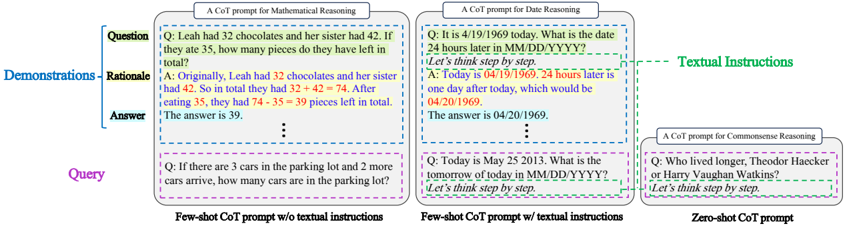
The image compares three types of CoT prompts across reasoning tasks:
1. **Mathematical Reasoning** (few-shot with textual instructions)
2. **Date Reasoning** (few-shot with textual instructions)
3. **Commonsense Reasoning** (zero-shot without textual instructions)
Each section demonstrates how prompts are structured, with color-coded elements (e.g., questions, demonstrations, answers) and textual instructions highlighted in green.
---
### Components/Axes
#### Labels and Structure
- **Legend**:
- "Textual Instructions" (highlighted in green, positioned on the far right).
- **Sections**:
1. **Mathematical Reasoning** (leftmost):
- Title: "A CoT prompt for Mathematical Reasoning"
- Subsections:
- **Demonstrations**: Labeled "Demonstrations" (blue), containing:
- **Rationale** (orange): Step-by-step reasoning.
- **Answer** (blue): Final answer.
- **Query**: Purple box with a new problem.
2. **Date Reasoning** (middle):
- Title: "A CoT prompt for Date Reasoning"
- Subsections:
- **Demonstrations**: Same structure as Mathematical Reasoning.
- **Query**: Purple box with a date-related problem.
3. **Commonsense Reasoning** (rightmost):
- Title: "A CoT prompt for Commonsense Reasoning"
- Subsections:
- **Demonstrations**: Absent (zero-shot).
- **Query**: Purple box with a commonsense question.
#### Color Coding
- **Blue**: Questions, answers, and titles.
- **Green**: Textual instructions (e.g., "Let's think step by step").
- **Orange**: Rationale (step-by-step reasoning).
- **Purple**: Queries (new problems).
- **Yellow/Red**: Highlighted text in examples (e.g., numbers in math problems).
---
### Detailed Analysis
#### Mathematical Reasoning (Few-Shot)
- **Question**: "Leah had 32 chocolates and her sister had 42. If they ate 35, how many pieces do they have left in total?"
- **Demonstration**:
- **Rationale**:
- "Originally, Leah had 32 chocolates and her sister had 42. So in total they had 32 + 42 = 74. After eating 35, they had 74 - 35 = 39 pieces left in total."
- **Answer**: "The answer is 39."
- **Query**: "If there are 3 cars in the parking lot and 2 more cars arrive, how many cars are in the parking lot?"
#### Date Reasoning (Few-Shot)
- **Question**: "It is 4/19/1969 today. What is the date 24 hours later in MM/DD/YYYY?"
- **Demonstration**:
- **Rationale**:
- "Today is 04/19/1969. 24 hours later is one day after today, which would be 04/20/1969."
- **Answer**: "The answer is 04/20/1969."
- **Query**: "Today is May 25 2013. What is the tomorrow of today in MM/DD/YYYY?"
#### Commonsense Reasoning (Zero-Shot)
- **Question**: "Who lived longer, Theodor Haecker or Harry Vaughan Watkins?"
- **Demonstration**: None (zero-shot).
- **Query**: Same as the question above.
---
### Key Observations
1. **Textual Instructions**:
- Green-highlighted phrases like "Let's think step by step" guide reasoning in few-shot examples.
2. **Color Consistency**:
- Blue consistently marks questions/answers, while orange denotes rationale.
3. **Zero-Shot Limitation**:
- The Commonsense Reasoning section lacks demonstrations, relying solely on the query.
4. **Numerical Examples**:
- Math and date examples use explicit arithmetic (e.g., 32 + 42 = 74, 74 - 35 = 39).
---
### Interpretation
- **Purpose**: The diagram illustrates how CoT prompts improve reasoning by providing structured examples (few-shot) versus relying on raw queries (zero-shot).
- **Effectiveness**:
- Few-shot prompts with textual instructions (green) enable step-by-step reasoning, as seen in math and date examples.
- Zero-shot prompts (Commonsense Reasoning) lack scaffolding, potentially reducing accuracy.
- **Design Choice**:
- Color coding enhances readability, separating questions (blue), reasoning (orange), and answers (blue).
- Textual instructions act as a "scaffold" for logical progression.
This visualization emphasizes the importance of guided examples in complex reasoning tasks, while highlighting the limitations of zero-shot approaches.