## Question Answering with Knowledge Graph Reasoning
### Overview
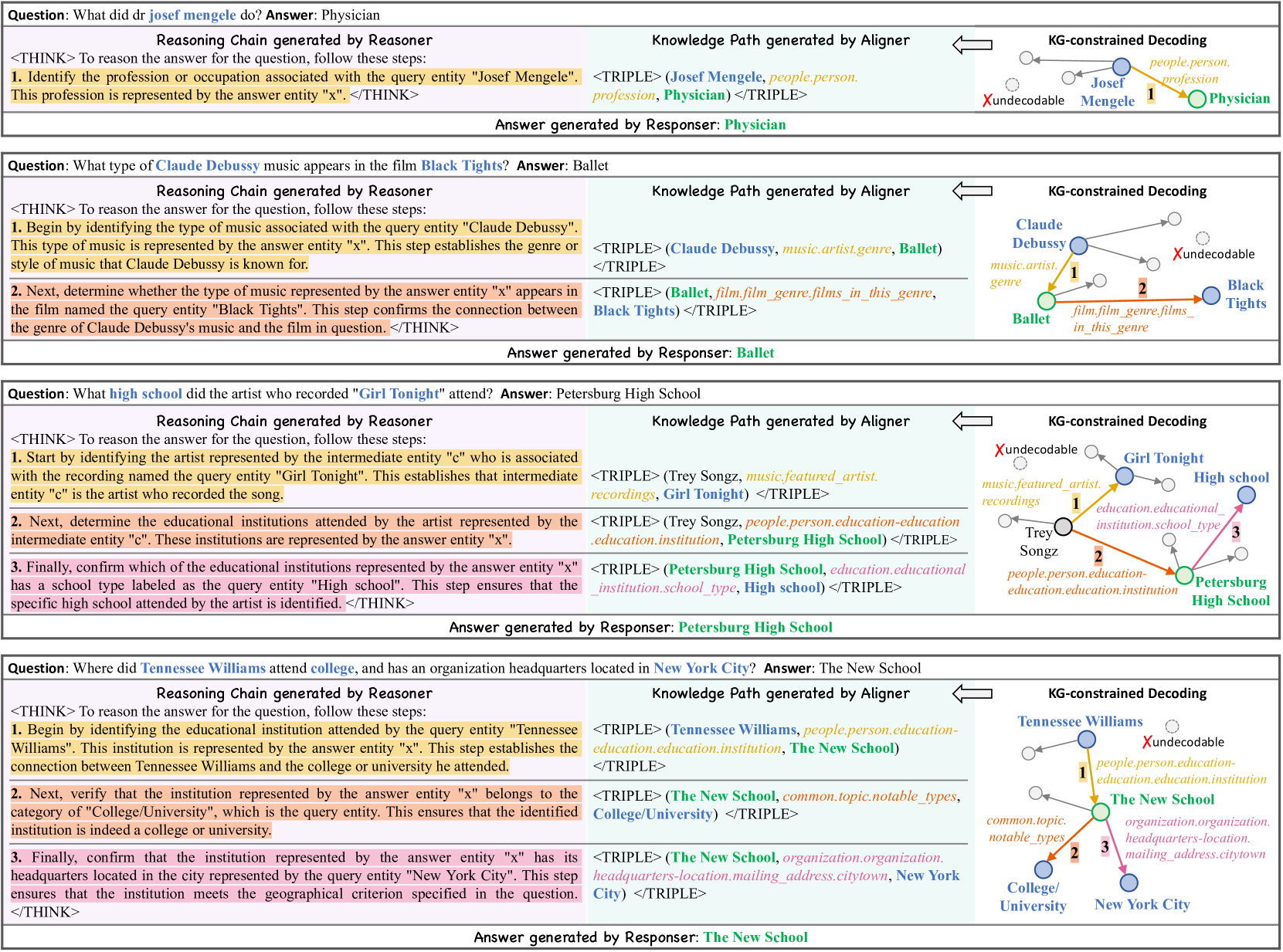
The image presents a series of question-answer examples, each demonstrating a reasoning process using a knowledge graph. For each question, the image shows the question and answer, the reasoning chain generated by a "Reasoner," the knowledge path generated by an "Aligner," and a KG-constrained decoding diagram.
### Components/Axes
Each question-answer example is structured into four main parts:
1. **Question and Answer:** The initial question and the final answer provided.
2. **Reasoning Chain generated by Reasoner:** A textual description of the steps taken to arrive at the answer. This is enclosed within `<THINK>` tags.
3. **Knowledge Path generated by Aligner:** A structured representation of the knowledge used, expressed as a series of triples within `<TRIPLE>` tags.
4. **KG-constrained Decoding:** A diagram visually representing the reasoning path through the knowledge graph. This includes nodes representing entities and edges representing relationships.
### Detailed Analysis
**Example 1:**
* **Question:** What did dr josef mengele do? **Answer:** Physician
* **Reasoning Chain:** Identifies the profession associated with "Josef Mengele."
* **Knowledge Path:** `(Josef Mengele, people.person.profession, Physician)`
* **KG-constrained Decoding:**
* Nodes: Josef Mengele, Physician
* Edge: Connects Josef Mengele to Physician, labeled "1".
* Color: The node "Physician" is green, indicating the correct answer.
**Example 2:**
* **Question:** What type of Claude Debussy music appears in the film Black Tights? **Answer:** Ballet
* **Reasoning Chain:** Identifies the type of music associated with "Claude Debussy" and confirms its presence in the film "Black Tights."
* **Knowledge Path:** `(Claude Debussy, music.artist.genre, Ballet)` and `(Ballet, film.film_genre.films_in_this_genre, Black Tights)`
* **KG-constrained Decoding:**
* Nodes: Claude Debussy, Ballet, Black Tights
* Edges: Claude Debussy to Ballet (labeled "1"), Ballet to Black Tights (labeled "2").
* Color: The node "Ballet" is green, indicating the correct answer.
**Example 3:**
* **Question:** What high school did the artist who recorded "Girl Tonight" attend? **Answer:** Petersburg High School
* **Reasoning Chain:** Identifies the artist associated with "Girl Tonight," determines the educational institutions they attended, and confirms which is a high school.
* **Knowledge Path:** `(Trey Songz, music.featured_artist.recordings, Girl Tonight)`, `(Trey Songz, people.person.education-education.education.institution, Petersburg High School)`, and `(Petersburg High School, education.educational_institution.school_type, High school)`
* **KG-constrained Decoding:**
* Nodes: Girl Tonight, Trey Songz, Petersburg High School, High school
* Edges: Girl Tonight to Trey Songz (labeled "1"), Trey Songz to Petersburg High School (labeled "2"), Petersburg High School to High school (labeled "3").
* Color: The node "Petersburg High School" is green, indicating the correct answer.
**Example 4:**
* **Question:** Where did Tennessee Williams attend college, and has an organization headquarters located in New York City? **Answer:** The New School
* **Reasoning Chain:** Identifies the educational institution attended by "Tennessee Williams," verifies it's a college/university, and confirms its headquarters are in New York City.
* **Knowledge Path:** `(Tennessee Williams, people.person.education-education.education.institution, The New School)`, `(The New School, common.topic.notable_types, College/University)`, and `(The New School, organization.organization.headquarters-location.mailing_address.citytown, New York City)`
* **KG-constrained Decoding:**
* Nodes: Tennessee Williams, The New School, College/University, New York City
* Edges: Tennessee Williams to The New School (labeled "1"), The New School to College/University (labeled "2"), The New School to New York City (labeled "3").
* Color: The node "The New School" is green, indicating the correct answer.
### Key Observations
* Each example follows a similar structure, demonstrating a consistent reasoning process.
* The KG-constrained Decoding diagrams visually represent the knowledge graph traversal.
* The green nodes in the KG-constrained Decoding diagrams indicate the final answer.
* The numbers on the edges in the KG-constrained Decoding diagrams likely represent the order of reasoning steps.
* "Xundecodable" nodes appear in some diagrams, possibly indicating entities that could not be decoded or were irrelevant to the final answer.
### Interpretation
The image illustrates a system for question answering that leverages knowledge graphs. The "Reasoner" generates a chain of reasoning steps, which are then translated into a path through the knowledge graph by the "Aligner." The KG-constrained Decoding diagrams provide a visual representation of this process, making it easier to understand how the system arrives at the correct answer. The use of triples in the Knowledge Path generated by the Aligner provides a structured way to represent the relationships between entities in the knowledge graph. The green highlighting of the answer node in the KG-constrained Decoding diagrams provides a clear indication of the system's final answer. The "Xundecodable" nodes suggest that the system may encounter entities that are not relevant to the question or cannot be decoded, but it is still able to arrive at the correct answer.