\n
## Diagram: Knowledge Graph Reasoning Chain
### Overview
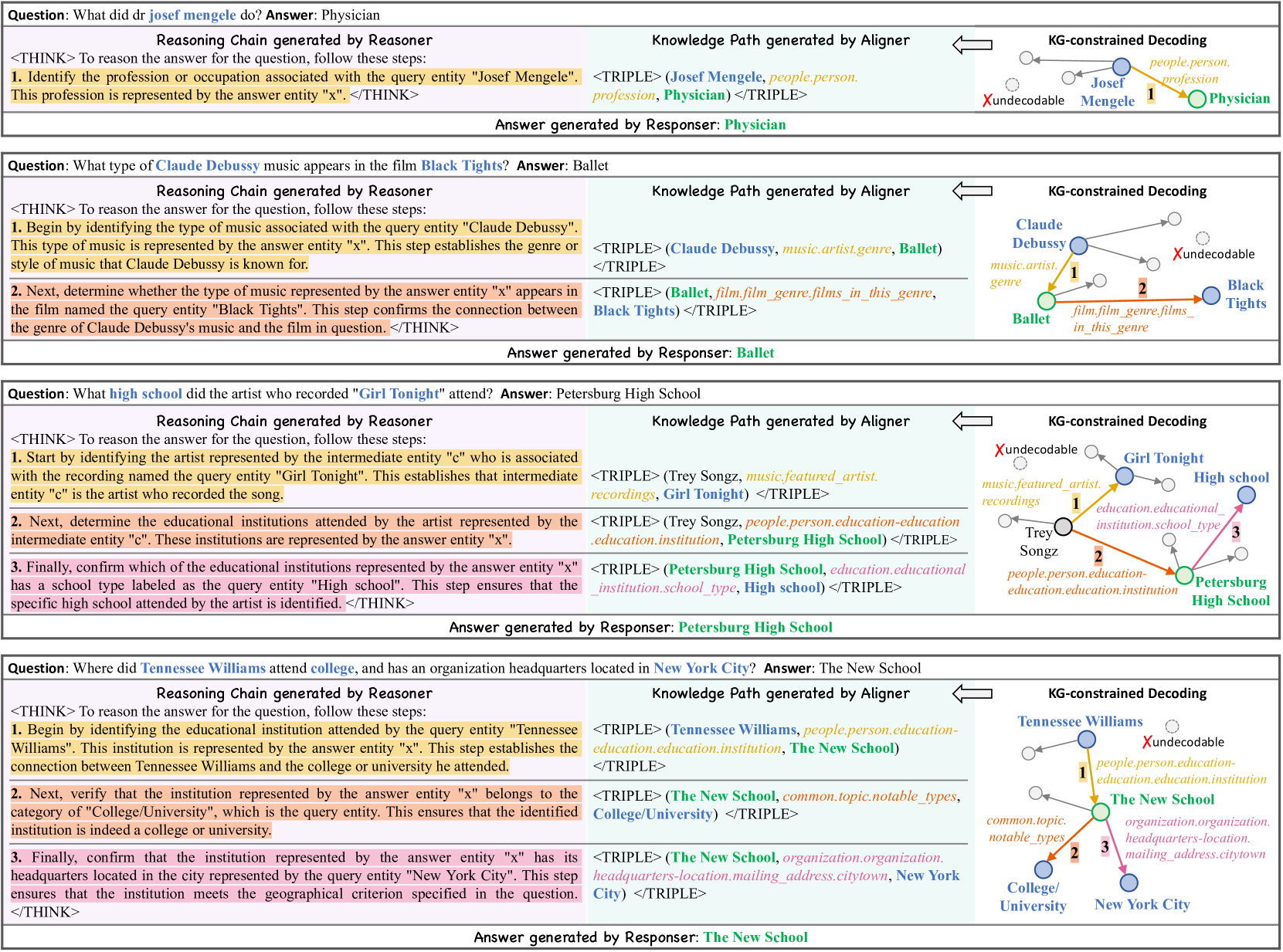
The image presents a diagram illustrating a knowledge graph reasoning chain for answering questions. It depicts three question-answer pairs, each accompanied by a "Reasoning Chain generated by Reasoner" section, a "Knowledge Path generated by Aligner" section, and a "KG-constrained Decoding" section. The diagram uses a combination of text, nodes, and edges to represent the reasoning process.
### Components/Axes
The diagram is structured into three main sections, each representing a question-answer pair. Each section contains:
* **Question:** A natural language question.
* **Answer generated by Reasoner:** The answer to the question.
* **Reasoning Chain generated by Reasoner:** A numbered list of steps outlining the reasoning process.
* **Knowledge Path generated by Aligner:** A triple representing the knowledge path used to arrive at the answer.
* **KG-constrained Decoding:** A visual representation of the knowledge graph, with nodes and edges connecting entities.
The KG-constrained Decoding sections use the following elements:
* **Nodes:** Represent entities (e.g., "Josef Mengele", "Physician", "Claude Debussy", "Ballet", "Trey Songz", "Girl Tonight", "Petersburg High School").
* **Edges:** Represent relationships between entities (e.g., "profession", "genre", "featured artist", "education").
* **Xundecodable:** A circular node with the label "Xundecodable" appears in each KG-constrained Decoding section.
* **Numbers:** Small numbers (1, 2) are placed near edges to indicate the order of reasoning steps.
### Detailed Analysis or Content Details
**Question 1: What did Dr Josef mengele do? Answer: Physician**
* **Reasoning Chain:**
1. Identify the profession or occupation associated with the query entity "Josef Mengele".
2. This profession is represented by the answer entity "x".
* **Knowledge Path:** `TRIPLE (Josef Mengele, people.person, profession, Physician) <TRIPLE>`
* **KG-constrained Decoding:**
* Node 1: "Josef Mengele"
* Edge 1: "profession" (labeled with "1")
* Node 2: "Physician"
* Node 3: "Xundecodable"
**Question 2: What type of music does Claude Debussy appear in the film Black Tights? Answer: Ballet**
* **Reasoning Chain:**
1. Begin by identifying the type of music associated with the query entity "Claude Debussy".
2. Next, determine whether the type of music represented by the answer entity "x" appears in the film named the query entity "Black Tights".
* **Knowledge Path:** `TRIPLE (Claude Debussy, music.artist.genre, Ballet) <TRIPLE> TRIPLE (Ballet, film.genre.films in this genre, Black Tights) <TRIPLE>`
* **KG-constrained Decoding:**
* Node 1: "Claude Debussy"
* Edge 1: "music.artist.genre" (labeled with "1")
* Node 2: "Ballet"
* Edge 2: "film.genre.films in this genre" (labeled with "2")
* Node 3: "Black Tights"
* Node 4: "Xundecodable"
**Question 3: What high school did the artist who recorded "Girl Tonight" attend? Answer: Petersburg High School**
* **Reasoning Chain:**
1. Start by identifying the artist represented by the intermediate entity "x" who is associated with the recording named the query entity "Girl Tonight".
2. Next, is the artist who recorded the song "Girl Tonight" by the represented by the intermediate entity "x"?
* **Knowledge Path:** `TRIPLE (Trey Songz, music.featured.artist, recordings, Girl Tonight) <TRIPLE> TRIPLE (Trey Songz, person.person.education, institution.school, Petersburg High School) <TRIPLE>`
* **KG-constrained Decoding:**
* Node 1: "Trey Songz"
* Edge 1: "music.featured.artist" (labeled with "1")
* Node 2: "Girl Tonight"
* Edge 2: "institution.school" (labeled with "2")
* Node 3: "Petersburg High School"
* Node 4: "Xundecodable"
### Key Observations
* The diagram consistently uses a three-step reasoning process.
* The "Xundecodable" node appears in each KG-constrained Decoding section, suggesting a limitation or unknown element in the reasoning process.
* The Knowledge Paths are represented as TRIPLE statements, indicating a structured knowledge representation.
* The KG-constrained Decoding visually demonstrates how entities are connected through relationships to arrive at the answer.
### Interpretation
The diagram illustrates a method for answering questions using a knowledge graph and a reasoning chain. The process involves identifying relevant entities and relationships within the knowledge graph, and then using these connections to derive the answer. The "Reasoning Chain" provides a step-by-step explanation of the logic used to arrive at the answer, while the "Knowledge Path" specifies the exact knowledge used. The "KG-constrained Decoding" provides a visual representation of the reasoning process, highlighting the key entities and relationships involved. The presence of "Xundecodable" suggests that the system may encounter limitations or uncertainties in its reasoning process, requiring further refinement or additional knowledge. The diagram demonstrates a sophisticated approach to question answering that combines structured knowledge representation with logical reasoning. The use of triples and the visual graph representation are key components of this approach.