## Textual Flowchart: QA Task Examples with Reasoning Chains and Knowledge Paths
### Overview
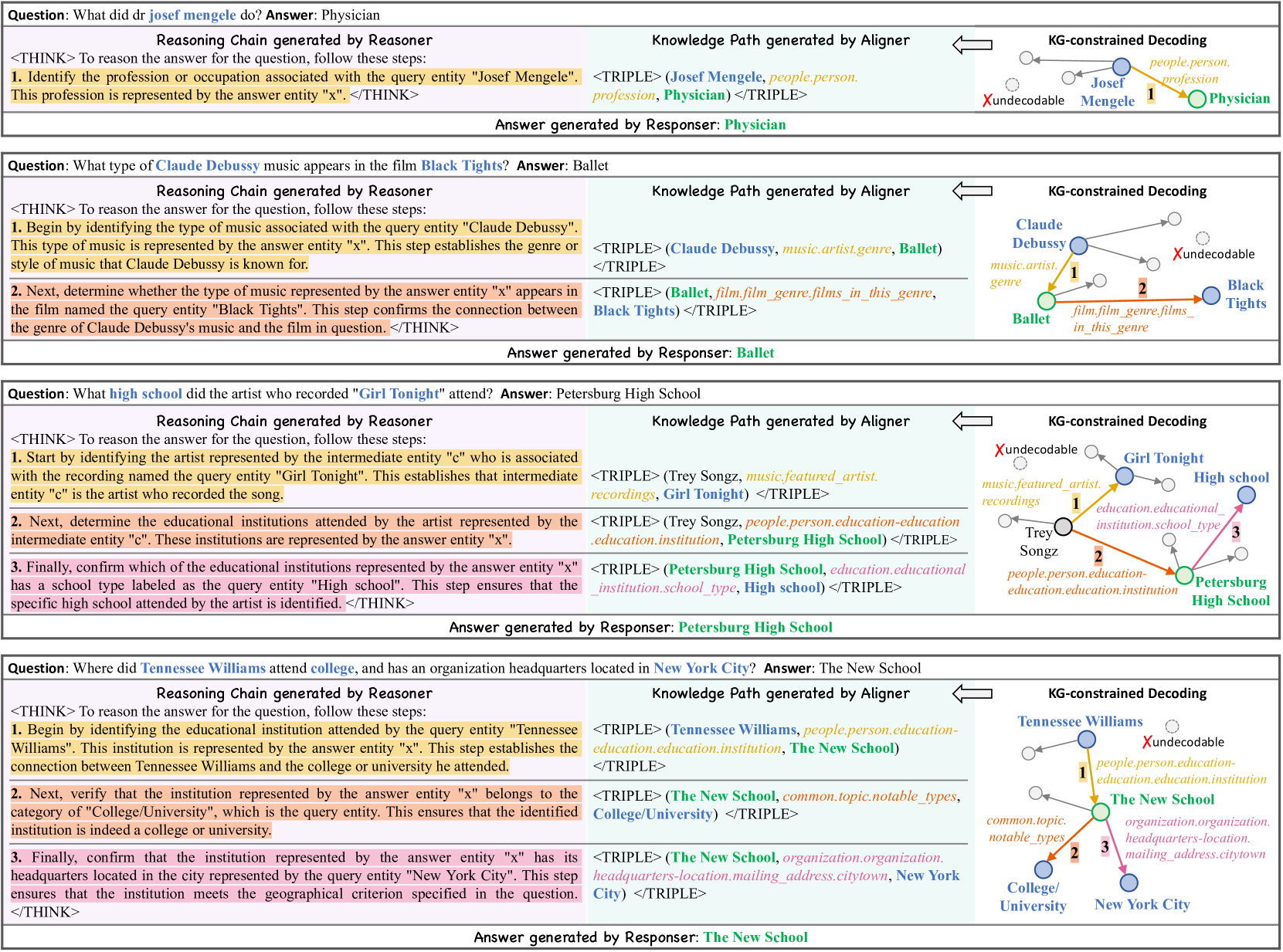
The image presents four QA task examples demonstrating a reasoning framework that combines natural language reasoning, knowledge path generation, and KG-constrained decoding. Each example includes:
1. A question with a highlighted query entity
2. A generated answer
3. A reasoning chain with step-by-step logic
4. A knowledge path visualization
5. KG-constrained decoding steps
### Components/Axes
**Key Elements:**
- **Question Section**: Contains the original question with a highlighted query entity (e.g., "Josef Mengele", "Claude Debussy")
- **Answer Section**: Final answer with color-coded entity labels
- **Reasoning Chain**: Step-by-step logical deductions in <THINK> blocks
- **Knowledge Path**: Triples (subject-predicate-object) with color-coded relationships
- **KG-Constrained Decoding**: Arrows and labels showing entity connections and validation steps
**Color Coding Legend:**
- Yellow: Profession/occupation relationships
- Green: Genre/style relationships
- Blue: Educational institution connections
- Pink: Geographical location ties
- Orange: Notable types/categories
- Red: Undecodable/irrelevant connections
### Detailed Analysis
**Example 1: Josef Mengele**
- **Question**: What did dr Josef Mengele do?
- **Answer**: Physician
- **Reasoning**:
1. Identified profession associated with "Josef Mengele"
2. Established "profession" as the answer entity
- **Knowledge Path**:
`(Josef Mengele, people.person.profession, Physician)`
- **Decoding**:
`1 → Physician` with "Xundecodable" for irrelevant paths
**Example 2: Claude Debussy**
- **Question**: What type of music appears in "Black Tights"?
- **Answer**: Ballet
- **Reasoning**:
1. Identified music genre associated with Debussy
2. Confirmed connection to "Black Tights" film
- **Knowledge Path**:
`(Claude Debussy, music.artist.genre, Ballet)` → `(Ballet, film.film_genre, films_in_this_genre)`
- **Decoding**:
`1 → Ballet` with validation of genre-film connection
**Example 3: "Girl Tonight" Artist**
- **Question**: What high school did the artist who recorded "Girl Tonight" attend?
- **Answer**: Petersburg High School
- **Reasoning**:
1. Identified artist via song recording
2. Mapped to educational institutions
3. Confirmed high school type
- **Knowledge Path**:
`(Trey Songz, music.featured_artist, Girl Tonight)` → `(Petersburg High School, education.institution)`
- **Decoding**:
`1 → Girl Tonight` → `2 → Trey Songz` → `3 → Petersburg High School`
**Example 4: Tennessee Williams**
- **Question**: Where did Tennessee Williams attend college in New York City?
- **Answer**: The New School
- **Reasoning**:
1. Identified educational institution
2. Verified college/university category
3. Confirmed NYC headquarters
- **Knowledge Path**:
`(Tennessee Williams, people.person.education-education.institution, The New School)` → `(The New School, common.topic.notable_types, College/University)`
- **Decoding**:
`1 → The New School` with validation of NYC location
### Key Observations
1. **Entity Disambiguation**: All examples use intermediate entities (e.g., "c" for artist) to resolve ambiguous references
2. **KG Validation**: Red "Xundecodable" markers explicitly reject invalid connections
3. **Step Numbering**: Decoding steps use sequential numbering (1→3) to show logical progression
4. **Color Consistency**: Relationship types maintain consistent color coding across examples
### Interpretation
This framework demonstrates a structured approach to QA that:
1. **Decomposes complex questions** into verifiable knowledge triples
2. **Validates connections** through KG-constrained decoding steps
3. **Maintains traceability** via color-coded relationships and step numbering
4. **Handles ambiguity** through intermediate entity resolution
The system appears designed for biomedical/entertainment domain QA, with explicit handling of:
- Professional roles (Example 1)
- Artistic genres (Example 2)
- Music industry connections (Example 3)
- Educational geography (Example 4)
The KG-constrained decoding acts as a "sanity check" mechanism, ensuring answers align with both linguistic reasoning and knowledge graph constraints. The color-coded triples provide a visual representation of the knowledge graph structure underlying each answer.