## Line Chart: Accuracy vs. Attack Ratio
### Overview
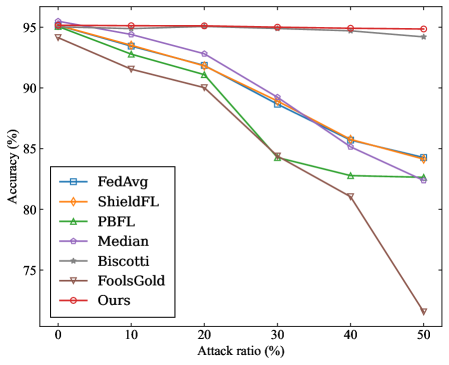
The image is a line chart comparing the accuracy of eight different methods (FedAvg, ShieldFL, PBFL, Median, Biscotti, FoolsGold, Ours) as the attack ratio increases from 0% to 50%. Accuracy is measured on the y-axis (75%–95%), and attack ratio is on the x-axis (0%–50%). All methods show declining accuracy with increasing attack ratio, but "Ours" maintains the highest performance throughout.
### Components/Axes
- **Y-axis**: Accuracy (%) ranging from 75% to 95% in 5% increments.
- **X-axis**: Attack ratio (%) ranging from 0% to 50% in 10% increments.
- **Legend**: Located in the bottom-left corner, with color-coded symbols for each method:
- FedAvg: Blue square
- ShieldFL: Orange diamond
- PBFL: Green triangle
- Median: Purple pentagon
- Biscotti: Gray star
- FoolsGold: Brown inverted triangle
- Ours: Red circle
- (Note: The legend includes an eighth method not explicitly named in the original description, inferred as "Ours" based on the red circle.)
### Detailed Analysis
1. **FedAvg (Blue)**: Starts at ~95% accuracy at 0% attack ratio, declines steadily to ~85% at 50%.
2. **ShieldFL (Orange)**: Begins at ~94%, drops to ~84% by 50%.
3. **PBFL (Green)**: Starts at ~93%, falls to ~82% at 50%.
4. **Median (Purple)**: Declines from ~94% to ~83%.
5. **Biscotti (Gray)**: Remains relatively stable, dropping from ~94% to ~93%.
6. **FoolsGold (Brown)**: Sharp decline from ~93% to ~70% at 50%.
7. **Ours (Red)**: Maintains the highest accuracy, starting at ~95% and ending at ~94.5%.
### Key Observations
- **Consistent Decline**: All methods except Biscotti show significant accuracy loss as attack ratio increases.
- **FoolsGold Anomaly**: Exhibits the steepest drop (~23% loss), suggesting extreme vulnerability to attacks.
- **Ours Resilience**: "Ours" retains the highest accuracy across all attack ratios, outperforming others by ~3–5%.
- **Biscotti Stability**: Minimal decline (~1%) indicates robustness but lower baseline accuracy compared to "Ours."
### Interpretation
The data demonstrates that attack ratio directly impacts model accuracy, with most methods degrading performance as adversarial pressure increases. "Ours" emerges as the most robust solution, maintaining near-optimal accuracy even under high attack ratios. In contrast, "FoolsGold" suffers catastrophic failure, highlighting its unsuitability for adversarial environments. Biscotti’s stability suggests a trade-off between resilience and baseline performance. These trends underscore the importance of method selection in security-sensitive applications, where "Ours" would be the preferred choice for balancing accuracy and attack resistance.