\n
## Control Flow Diagram: CFG G
### Overview
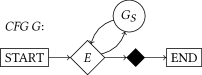
The image displays a simple control flow graph (CFG) labeled "CFG G:". It is a directed graph consisting of four nodes connected by edges, representing the flow of control in a program or process. The diagram uses standard flowchart symbols to denote different types of operations or states.
### Components/Axes
The diagram is composed of the following labeled nodes and connecting edges:
**Nodes (Shapes and Labels):**
1. **START Node:** A rectangle labeled "START". Positioned at the far left of the diagram.
2. **Decision Node (E):** A diamond shape labeled "E". Positioned in the center of the diagram.
3. **Process/Loop Node (G5):** A circle labeled "G5". Positioned directly above the diamond node "E".
4. **END Node:** A rectangle labeled "END". Positioned at the far right of the diagram.
**Edges (Flow Direction):**
* A directed arrow flows from the right side of the "START" node to the left point of the diamond "E" node.
* A directed arrow flows from the right point of the diamond "E" node to the left side of the "END" node.
* A directed arrow flows from the top point of the diamond "E" node upward to the bottom of the circle "G5" node.
* A directed arrow flows from the right side of the circle "G5" node, curves downward, and connects to the top point of the diamond "E" node.
### Detailed Analysis
The graph defines a specific control flow structure:
1. **Entry Point:** Execution begins at the "START" node.
2. **Decision Point:** Control flows unconditionally to node "E". The diamond shape indicates this is a decision or conditional branch point.
3. **Paths from Decision Node "E":**
* **Path 1 (Forward):** One edge leads directly from "E" to the "END" node. This represents the path taken when the condition at "E" evaluates to a certain outcome (e.g., false, exit condition met).
* **Path 2 (Loop):** Another edge leads from "E" to node "G5". An edge then returns from "G5" back to "E". This creates a cycle or loop: `E -> G5 -> E`. This represents a path where a block of code (G5) is executed repeatedly as long as the condition at "E" evaluates to a different outcome (e.g., true, continue condition).
4. **Exit Point:** The only exit from the structure is via the edge from "E" to "END".
### Key Observations
* **Single Entry, Single Exit:** The graph has one entry point ("START") and one exit point ("END"), which is a common and well-structured pattern for a control flow region.
* **Loop Structure:** The cycle `E -> G5 -> E` forms a classic "while" or "repeat-until" loop structure. Node "G5" represents the loop body.
* **Decision Node Centrality:** Node "E" is the central hub of the graph. All control flow passes through it, and it determines whether to exit the structure or execute the loop body (G5).
* **Node Type Conventions:** The shapes follow common conventions: rectangles for start/end terminals, a diamond for a decision, and a circle for a process or basic block within a loop.
### Interpretation
This control flow graph represents a fundamental programming construct: a **loop with a pre-test condition**.
* **What it demonstrates:** The diagram models a process where a condition ("E") is checked. If the condition is met (e.g., a loop counter is within bounds, a flag is set), the process block ("G5") is executed, and the condition is re-evaluated. This cycle repeats until the condition at "E" is no longer met, at which point the process exits to "END".
* **Relationship between elements:** "START" initiates the process. "E" acts as the gatekeeper, controlling iteration. "G5" is the work performed during each iteration. "END" signifies completion. The arrows strictly define the permissible transitions between these states.
* **Notable patterns:** The structure is a canonical representation of a `while (E) { G5 }` loop in imperative programming. The absence of a direct path from "START" to "G5" confirms it is a pre-test loop; the condition is checked before the first execution of the loop body. There are no outliers or anomalies; the graph is a clean, textbook example of a single-exit loop structure.