## Scatter Plot with Linear Fits: Number of Monte Carlo Steps vs. Dimension
### Overview
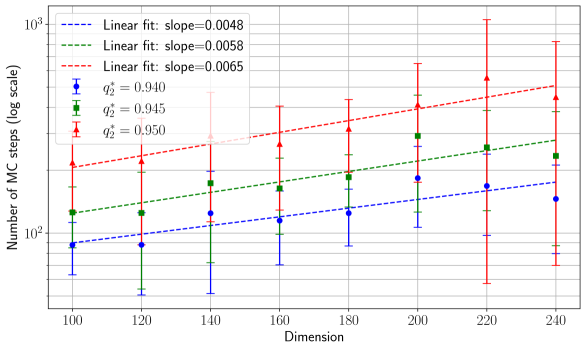
The image is a scatter plot with error bars and overlaid linear regression lines. It displays the relationship between the "Dimension" (x-axis) and the "Number of MC steps" (y-axis, on a logarithmic scale) for three different data series, each corresponding to a different value of a parameter denoted as \( q_2^2 \). The chart includes linear fits for each series, with their slopes reported in the legend.
### Components/Axes
* **Chart Type:** Scatter plot with error bars and linear regression lines.
* **X-Axis:**
* **Label:** "Dimension"
* **Scale:** Linear scale.
* **Range/Ticks:** Major ticks at 100, 120, 140, 160, 180, 200, 220, 240.
* **Y-Axis:**
* **Label:** "Number of MC steps (log scale)"
* **Scale:** Logarithmic scale (base 10).
* **Range/Ticks:** Major ticks at \(10^2\) (100) and \(10^3\) (1000). Minor ticks are present between them.
* **Legend (Position: Top-Left Corner):**
* Contains entries for three linear fits and three data series.
* **Linear Fit Entries:**
1. Blue dashed line: "Linear fit: slope=0.0048"
2. Green dashed line: "Linear fit: slope=0.0058"
3. Red dashed line: "Linear fit: slope=0.0065"
* **Data Series Entries (with markers and error bars):**
1. Blue circle marker: \( q_2^2 = 0.940 \)
2. Green square marker: \( q_2^2 = 0.945 \)
3. Red triangle marker: \( q_2^2 = 0.950 \)
### Detailed Analysis
The chart plots three distinct data series, each showing an upward trend. The data points are accompanied by vertical error bars indicating variability or uncertainty.
**1. Data Series for \( q_2^2 = 0.940 \) (Blue Circles, Blue Dashed Fit Line):**
* **Trend:** The data points show a clear upward trend as Dimension increases. The associated linear fit has the shallowest slope (0.0048).
* **Approximate Data Points (Dimension, Number of MC steps):**
* (100, ~90)
* (120, ~85)
* (140, ~120)
* (160, ~110)
* (180, ~130)
* (200, ~160)
* (220, ~150)
* (240, ~140)
* **Error Bars:** The error bars are substantial, often spanning a range of ±30 to ±50 steps around the central point.
**2. Data Series for \( q_2^2 = 0.945 \) (Green Squares, Green Dashed Fit Line):**
* **Trend:** This series also shows a consistent upward trend, steeper than the blue series. The linear fit slope is 0.0058.
* **Approximate Data Points (Dimension, Number of MC steps):**
* (100, ~120)
* (120, ~120)
* (140, ~160)
* (160, ~150)
* (180, ~170)
* (200, ~200)
* (220, ~210)
* (240, ~190)
* **Error Bars:** Error bars are large, similar in magnitude to the blue series.
**3. Data Series for \( q_2^2 = 0.950 \) (Red Triangles, Red Dashed Fit Line):**
* **Trend:** This series exhibits the steepest upward trend of the three. The linear fit has the highest slope (0.0065).
* **Approximate Data Points (Dimension, Number of MC steps):**
* (100, ~200)
* (120, ~200)
* (140, ~250)
* (160, ~220)
* (180, ~280)
* (200, ~350)
* (220, ~400)
* (240, ~350)
* **Error Bars:** The error bars for this series are the largest, especially at higher dimensions (e.g., at Dimension 220, the error bar spans from ~200 to ~800).
### Key Observations
1. **Positive Correlation:** For all three values of \( q_2^2 \), the number of Monte Carlo (MC) steps increases with the Dimension.
2. **Slope Dependence on \( q_2^2 \):** The rate of increase (slope of the linear fit) is positively correlated with the parameter \( q_2^2 \). A higher \( q_2^2 \) (0.950) results in a steeper slope (0.0065) compared to a lower \( q_2^2 \) (0.940, slope 0.0048).
3. **Magnitude Dependence on \( q_2^2 \):** At any given dimension, a higher \( q_2^2 \) value corresponds to a higher number of MC steps. The red series (\( q_2^2=0.950 \)) is consistently above the green (\( q_2^2=0.945 \)), which is above the blue (\( q_2^2=0.940 \)).
4. **High Variability:** The large error bars across all series indicate significant variability or uncertainty in the measured number of MC steps for each dimension. This variability appears to increase with both dimension and \( q_2^2 \).
5. **Log-Linear Relationship:** The use of a log-scale y-axis and the reporting of linear fits suggest the underlying relationship between Dimension and the *logarithm* of MC steps is approximately linear.
### Interpretation
This chart likely comes from a computational physics or statistics context, analyzing the performance or convergence of a Monte Carlo (MC) simulation algorithm. The "Dimension" probably refers to the dimensionality of the problem space (e.g., number of variables in a system).
* **What the data suggests:** The data demonstrates that the computational cost (measured in MC steps required) scales with the problem's dimensionality. This scaling is not uniform; it depends critically on a system parameter \( q_2^2 \). As \( q_2^2 \) increases towards 1, the algorithm becomes less efficient, requiring more steps to achieve its goal (e.g., convergence, sampling) and this inefficiency worsens more rapidly as the problem size (dimension) grows.
* **Relationship between elements:** The three linear fits model the scaling law for each parameter setting. The slopes (0.0048, 0.0058, 0.0065) quantify the "cost of dimensionality" for each \( q_2^2 \). The error bars highlight the stochastic nature of MC methods, showing that the reported step count for a given condition is an average with considerable spread.
* **Notable implications:** The clear stratification by \( q_2^2 \) indicates it is a key control parameter affecting algorithmic performance. The increasing error bars with dimension and \( q_2^2 \) suggest that simulations become not only more expensive but also less predictable in their runtime as the problem becomes harder (higher dimension) and the parameter \( q_2^2 \) increases. This information is crucial for resource planning and for understanding the limits of the simulated method.