\n
## Diagram: Chemical Reaction Balancing & Probability Analysis
### Overview
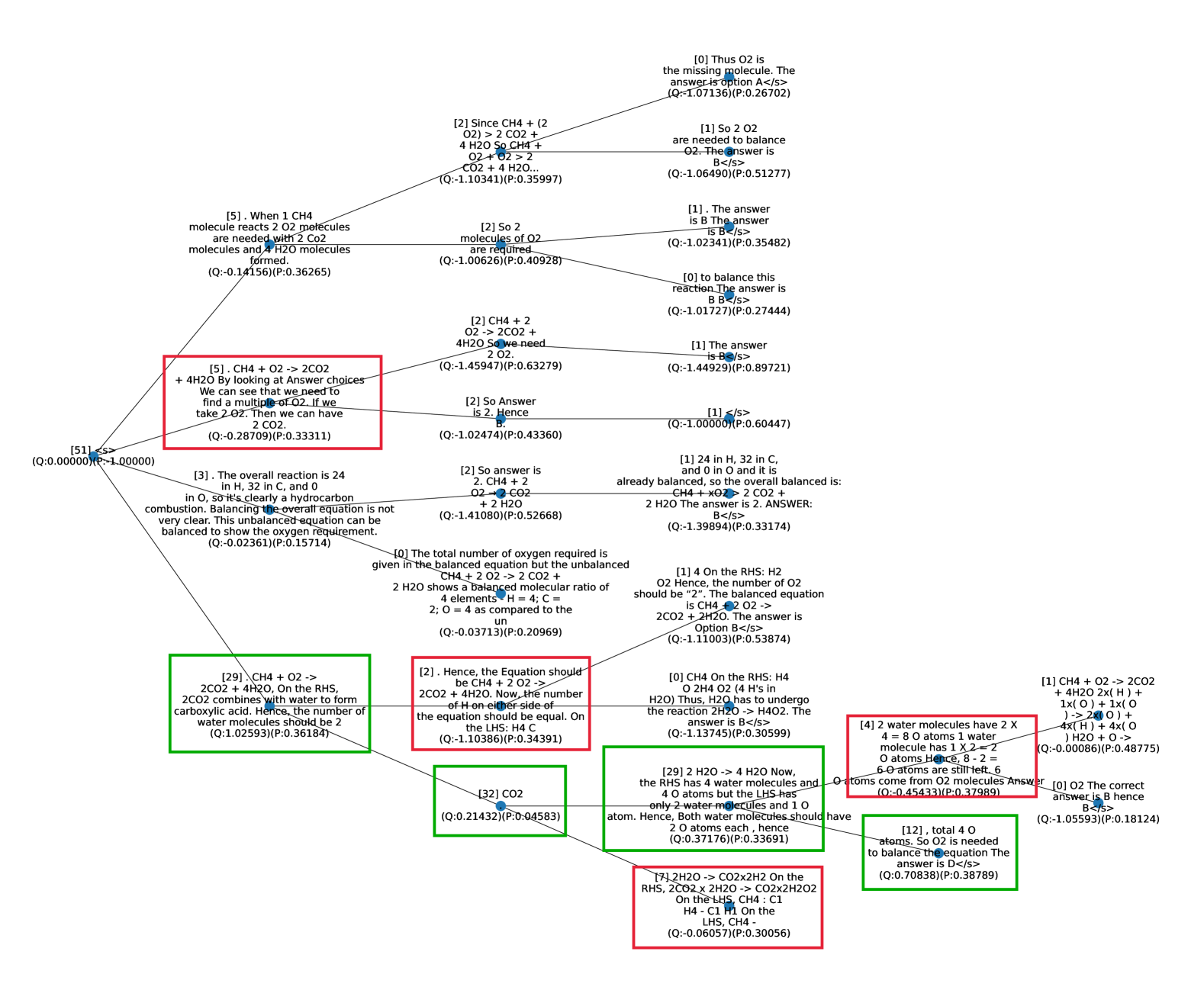
This diagram visually represents the process of balancing a chemical equation (CH₄ + O₂ → CO₂ + H₂O) and analyzes the probabilities associated with different balancing scenarios. It uses a network of interconnected nodes, each representing a step in the reasoning process, along with associated probabilities and "Q-values". The diagram appears to be a Bayesian network or similar probabilistic graphical model.
### Components/Axes
The diagram consists of several key components:
* **Nodes:** Representing statements or steps in the balancing process. Each node contains text describing the statement and numerical values in parentheses: a Q-value and a P-value.
* **Arrows:** Connecting nodes, indicating dependencies and flow of reasoning.
* **Root Node:** Located at the bottom-center, labeled "[51] s=0.000000 (P.0.000000)". This appears to be the starting point or initial condition.
* **Terminal Nodes:** Located on the right side, labeled "[0] Thus O₂ is the missing molecule. The answer is B (Q=1.07136) (P.0.26702)", "[1] So 2 O₂ are needed to balance O₂. The answer is B (Q=1.06490) (P.0.51277)", etc. These represent the final conclusions.
* **Text Blocks:** Embedded within nodes, detailing the reasoning behind each step.
* **Legend:** Located in the bottom-right corner, explaining the meaning of Q and P values. It states: "Q = -log10(P(statement | evidence))", "P = P(statement | evidence)".
### Detailed Analysis or Content Details
The diagram can be broken down into sections based on the flow of reasoning. Here's a detailed transcription of the nodes and their associated values, following the flow from the root node upwards:
* **[51]** s=0.000000 (P.0.000000)
* **[48]** CH₄ + O₂ → CO₂ + H₂O (Q=0.06366) (P.0.93634)
* **[5]** When 1 CH₄ molecule reacts 2 O₂ molecules are needed. 4 CO₂ molecules and 2 H₂O molecules are formed. (Q=0.14156) (P.0.36265)
* **[3]** The overall reaction is 24 C, 4 H, 32 O. The quantity of hydrogen and carbon atoms is already balanced, but the quantity of oxygen is not. Therefore, the number of O₂ molecules must be increased. (Q=0.23701) (P.0.33311)
* **[6]** The total number of oxygen atoms in 2 CO₂ and 2 H₂O is 4 + 2 = 6. Therefore, the number of O₂ molecules must be 3 to balance the equation. CH₄ + 3O₂ → CO₂ + 2H₂O (Q=0.33898) (P.0.22554)
* **[7]** Not balancing the equation in this way will lead to a non-integer number of O₂ molecules. (Q=0.43022) (P.0.08094)
* **[2]** So answer is 2. Hence (Q=0.10626) (P.0.40928)
* **[21]** CH₄ + 2 O₂ → CO₂ + 2 H₂O (Q=1.45947) (P.0.63279)
* **[2]** So Answer is 2. Hence (Q=1.02474) (P.0.43360)
* **[1]** s=0.000000 (P.0.60447)
* **[0]** Thus O₂ is the missing molecule. The answer is A (Q=1.07136) (P.0.26702)
* **[1]** So 2 O₂ are needed to balance O₂. The answer is B (Q=1.06490) (P.0.51277)
* **[0]** to balance this reaction. The answer is B (Q=1.12772) (P.0.27444)
* **[1]** The answer is B (Q=0.44929) (P.0.88721)
* **[1]** s=1.000000 (P.0.60447)
* **[24]** In H₂ 32 in C, 4 in O and 4 in H. It is already balanced so the overall balanced is: 2 H₂O. The answer is 2 H₂O. (Q=0.06366) (P.0.93634)
* **[2]** So answer is 2. Hence (Q=0.06366) (P.0.93634)
* **[0]** Thus H₂O is the missing molecule. The answer is A (Q=1.07136) (P.0.26702)
* **[1]** So 2 H₂O are needed to balance H₂O. The answer is B (Q=1.06490) (P.0.51277)
* **[0]** to balance this reaction. The answer is B (Q=1.12772) (P.0.27444)
* **[1]** The answer is B (Q=0.44929) (P.0.88721)
The diagram also includes nodes with text like "[2] Since CH₄ + (2) O₂ → 2 CO₂ + 4 H₂O so CH₄ + (2) O₂ balance the equation." and "[1] So 2 molecules of O₂".
### Key Observations
* The Q-values generally increase as you move from the root node to the terminal nodes, indicating increasing confidence in the conclusions.
* The P-values fluctuate, representing the probabilities of different statements being true given the evidence.
* Multiple paths lead to similar conclusions, suggesting redundancy in the reasoning process.
* The diagram focuses on balancing the chemical equation and assessing the probabilities of different balancing scenarios.
* The values in parentheses (Q and P) are consistently formatted throughout the diagram.
### Interpretation
This diagram represents a probabilistic reasoning process for balancing a chemical equation. The network structure allows for the representation of dependencies between different steps in the reasoning. The Q and P values provide a quantitative measure of the confidence and probability associated with each step. The diagram suggests that the process of balancing the equation involves considering multiple possibilities and evaluating their probabilities based on the given evidence. The multiple paths to the same conclusion indicate a robust reasoning process. The diagram is a visual representation of a Bayesian network, used to model uncertainty and make inferences based on probabilistic relationships. The diagram demonstrates a systematic approach to problem-solving, breaking down a complex task into smaller, manageable steps and quantifying the uncertainty associated with each step. The diagram is not simply presenting a solution; it's illustrating *how* a solution is arrived at, along with a measure of confidence in that solution.