## Chart: D(S(n,l)) vs l
### Overview
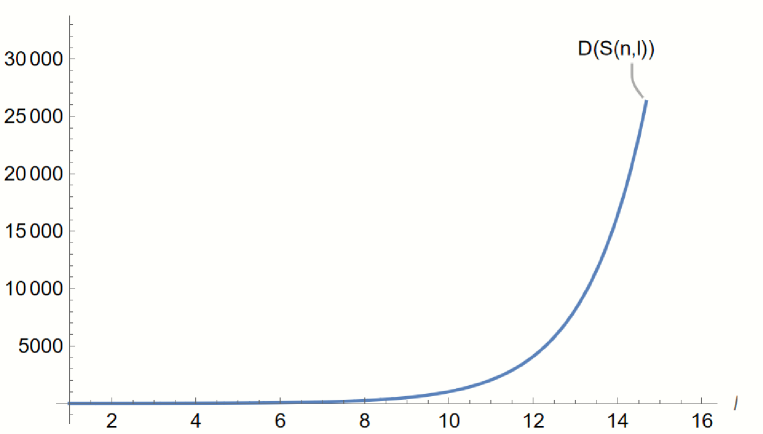
The image is a 2D plot showing the relationship between D(S(n,l)) and l. The x-axis represents 'l' and ranges from 2 to 16. The y-axis represents D(S(n,l)) and ranges from 0 to 30000. A single blue line represents the data, showing an exponential increase as 'l' increases.
### Components/Axes
* **X-axis:**
* Label: l
* Scale: 2 to 16, with tick marks at every integer value.
* **Y-axis:**
* Label: D(S(n,l))
* Scale: 0 to 30000, with tick marks at 5000 intervals (0, 5000, 10000, 15000, 20000, 25000, 30000).
* **Data Series:**
* Color: Blue
* Label: D(S(n,l))
### Detailed Analysis
The blue line, representing D(S(n,l)), exhibits the following behavior:
* For l values between 2 and approximately 10, the value of D(S(n,l)) remains close to 0.
* As l increases beyond 10, the value of D(S(n,l)) begins to increase gradually.
* Beyond l = 12, the increase becomes exponential, rising sharply.
* At l = 15, D(S(n,l)) is approximately 25000.
* The curve ends at approximately l = 15.5, with D(S(n,l)) near 28000.
Specific data points (approximate):
* l = 2, D(S(n,l)) ≈ 0
* l = 4, D(S(n,l)) ≈ 0
* l = 6, D(S(n,l)) ≈ 0
* l = 8, D(S(n,l)) ≈ 0
* l = 10, D(S(n,l)) ≈ 500
* l = 12, D(S(n,l)) ≈ 2000
* l = 14, D(S(n,l)) ≈ 12000
* l = 15, D(S(n,l)) ≈ 25000
### Key Observations
* The function D(S(n,l)) is relatively stable at a value near zero for small values of l.
* There is a sharp exponential increase in D(S(n,l)) as l approaches 16.
### Interpretation
The plot suggests that the function D(S(n,l)) is highly sensitive to changes in 'l' when 'l' is above a certain threshold (around 12). This could indicate a critical point or a phase transition in the underlying system being modeled by D(S(n,l)). The near-zero values for small 'l' suggest a stable or inactive state, while the exponential increase indicates a rapid change or instability as 'l' increases. The relationship between 'n' and 'l' within the function S(n,l) is not explicitly shown, but it likely plays a significant role in determining the behavior of D(S(n,l)).