\n
## Chart: D(S(n,l)) vs. n
### Overview
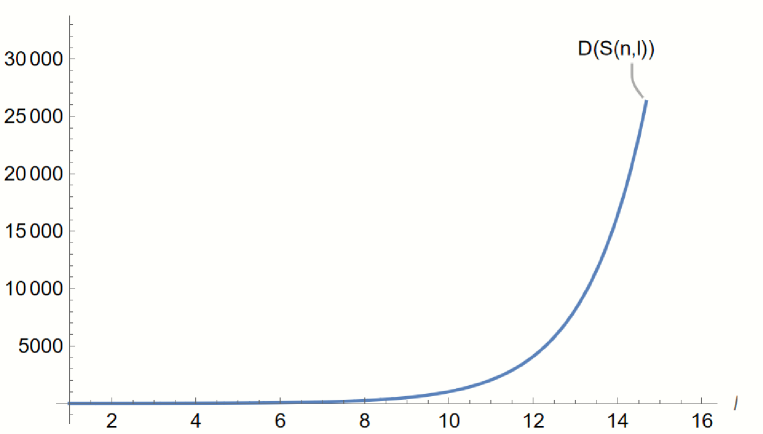
The image displays a line chart illustrating the relationship between a variable 'n' on the x-axis and the function D(S(n,l)) on the y-axis. The chart shows a very slow, almost flat, increase in D(S(n,l)) until approximately n=12, after which it experiences a rapid, exponential-like growth.
### Components/Axes
* **X-axis:** Labeled 'n', ranging from approximately 2 to 16. The scale is linear.
* **Y-axis:** Labeled with numerical values ranging from 0 to 30000. The scale is linear.
* **Data Series:** A single blue line representing the function D(S(n,l)).
* **Label:** "D(S(n,l))" is placed near the end of the line, indicating the function being plotted.
### Detailed Analysis
The blue line representing D(S(n,l)) remains relatively constant at a low value (approximately 100-200) from n=2 to n=12. Around n=12, the line begins to curve upwards sharply.
Here's an approximate reconstruction of data points:
* n = 2: D(S(n,l)) ≈ 100
* n = 4: D(S(n,l)) ≈ 150
* n = 6: D(S(n,l)) ≈ 180
* n = 8: D(S(n,l)) ≈ 200
* n = 10: D(S(n,l)) ≈ 250
* n = 12: D(S(n,l)) ≈ 400
* n = 14: D(S(n,l)) ≈ 10000
* n = 16: D(S(n,l)) ≈ 26000
The trend is nearly flat until n=12, then rapidly increases. The slope of the line becomes increasingly steep as 'n' increases beyond 12.
### Key Observations
The most striking feature is the dramatic change in the rate of increase of D(S(n,l)) around n=12. This suggests a threshold or critical point where the function's behavior changes significantly. The initial flat portion indicates a very slow or negligible change in D(S(n,l)) for small values of 'n'.
### Interpretation
The chart likely represents a function where a small change in 'n' has little effect on D(S(n,l)) until a certain point is reached. After that point, even a small change in 'n' leads to a substantial increase in D(S(n,l)). This could model phenomena exhibiting a delayed or threshold-dependent response.
The function D(S(n,l)) could represent a computational complexity, a growth rate, or a probability that is initially low but increases rapidly as 'n' exceeds a certain value. The 'S(n,l)' part of the function suggests that there are other parameters influencing the behavior, but their specific role isn't revealed by the chart alone. The rapid increase could indicate a phase transition, a cascading effect, or a point of instability. Without further context, it's difficult to determine the precise meaning of the function and its parameters.