## Line Graph: D(S(n,l)) vs l
### Overview
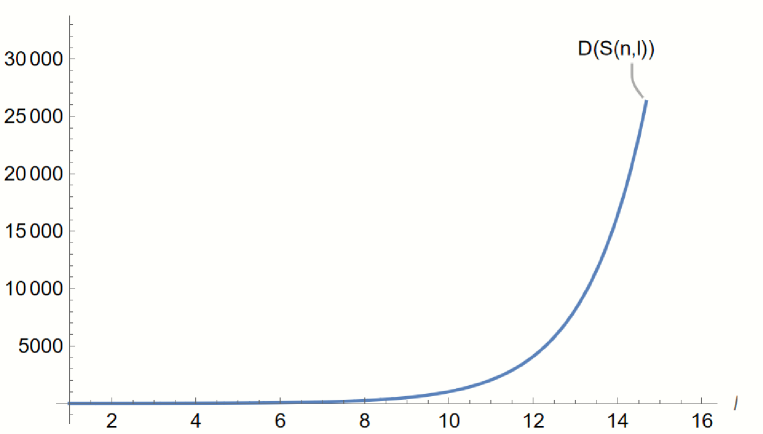
The image depicts a line graph illustrating the relationship between the variable `l` (x-axis) and the function `D(S(n,l))` (y-axis). The graph shows a gradual increase in `D(S(n,l))` for `l` values from 2 to 10, followed by a sharp exponential rise for `l` values from 10 to 14. The y-axis scales from 0 to 30,000, while the x-axis ranges from 2 to 16.
---
### Components/Axes
- **X-axis (Horizontal)**: Labeled `l`, with discrete markers at intervals of 2 (2, 4, 6, ..., 16).
- **Y-axis (Vertical)**: Labeled `D(S(n,l))`, with increments of 5,000 (0, 5,000, 10,000, ..., 30,000).
- **Legend**: Located in the top-right corner, labeled `D(S(n,l))` with a blue line.
- **Line**: A single blue line representing `D(S(n,l))`, plotted across the x-axis range.
---
### Detailed Analysis
1. **Initial Trend (l = 2 to 10)**:
- The line remains nearly flat, with `D(S(n,l))` values close to 0.
- At `l = 10`, the value is approximately **1,000** (estimated from the y-axis scale).
2. **Exponential Rise (l = 10 to 14)**:
- The line steeply ascends, reaching **25,000** at `l = 14`.
- The slope becomes increasingly nonlinear, suggesting a power-law or exponential growth pattern.
3. **Post-14 Behavior**:
- The graph does not extend beyond `l = 14`, but the y-axis suggests potential values up to 30,000.
---
### Key Observations
- **Threshold Effect**: A critical transition occurs at `l = 10`, where `D(S(n,l))` begins to increase rapidly.
- **Data Sparsity**: Only two distinct data points are clearly marked: `(l=10, D≈1,000)` and `(l=14, D=25,000)`.
- **Uncertainty**: Values for `l < 10` are approximated due to the line’s proximity to the baseline.
---
### Interpretation
The graph suggests that `D(S(n,l))` is relatively stable for `l ≤ 10`, possibly indicating a system in equilibrium or a baseline state. Beyond `l = 10`, the function exhibits a dramatic increase, implying a phase transition, critical threshold, or nonlinear dependency on `l`. This could represent phenomena such as:
- **System Instability**: A sudden breakdown or amplification in a physical or computational system.
- **Combinatorial Explosion**: Exponential growth in complexity (e.g., algorithmic or network behavior).
- **Phase Transition**: A material or thermodynamic property changing abruptly at a critical point.
The absence of data beyond `l = 14` leaves the long-term behavior of `D(S(n,l))` ambiguous, but the sharp rise hints at a potential saturation or failure mode. Further data points would clarify whether the growth continues exponentially or plateaus.