\n
## Charts: Training and Test Loss vs. Iteration & Local Learning Coefficient vs. Iteration
### Overview
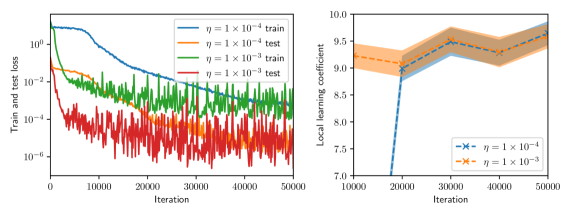
The image presents two charts side-by-side. The left chart displays the training and test loss as a function of iteration for two different learning rates (η = 1 x 10⁻⁴ and η = 1 x 10⁻³). The right chart shows the local learning coefficient as a function of iteration, also for the same two learning rates. Both charts aim to illustrate the training dynamics of a model.
### Components/Axes
**Left Chart:**
* **X-axis:** Iteration (Scale: 0 to 50000, logarithmic scale)
* **Y-axis:** Train and test loss (Scale: 10⁻⁶ to 10⁰, logarithmic scale)
* **Legend:**
* Blue Line: η = 1 x 10⁻⁴ train
* Orange Line: η = 1 x 10⁻⁴ test
* Green Line: η = 1 x 10⁻³ train
* Red Line: η = 1 x 10⁻³ test
**Right Chart:**
* **X-axis:** Iteration (Scale: 0 to 50000)
* **Y-axis:** Local learning coefficient (Scale: 7.0 to 10.0)
* **Legend:**
* Blue Dashed Line: η = 1 x 10⁻⁴
* Orange Dashed Line: η = 1 x 10⁻³
### Detailed Analysis or Content Details
**Left Chart:**
* **η = 1 x 10⁻⁴ (Blue & Orange):** The blue line (train) starts at approximately 1.0 and generally decreases, with significant fluctuations, reaching a value of approximately 0.001 at iteration 50000. The orange line (test) starts at approximately 0.8 and also decreases, but remains consistently higher than the blue line, ending at approximately 0.01 at iteration 50000.
* **η = 1 x 10⁻³ (Green & Red):** The green line (train) starts at approximately 0.9 and decreases more rapidly than the blue line, reaching a value of approximately 0.0005 at iteration 50000. The red line (test) starts at approximately 0.7 and decreases rapidly initially, but then plateaus and fluctuates significantly, ending at approximately 0.05 at iteration 50000.
**Right Chart:**
* **η = 1 x 10⁻⁴ (Blue):** The blue dashed line shows a sharp decrease from approximately 9.6 at iteration 0 to approximately 7.2 at iteration 20000. After this point, it fluctuates and gradually increases, reaching approximately 9.4 at iteration 50000. The shaded area around the line indicates the variance.
* **η = 1 x 10⁻³ (Orange):** The orange dashed line starts at approximately 9.6 at iteration 0 and remains relatively stable until approximately iteration 20000, where it begins to decrease. It reaches a minimum of approximately 8.2 at iteration 30000 and then increases, ending at approximately 9.3 at iteration 50000. The shaded area around the line indicates the variance.
### Key Observations
* The learning rate of 1 x 10⁻³ (red and green lines) results in a faster initial decrease in loss compared to 1 x 10⁻⁴ (blue and orange lines).
* The test loss consistently remains higher than the training loss for both learning rates, indicating potential overfitting.
* The local learning coefficient decreases significantly for both learning rates initially, then stabilizes and fluctuates.
* The shaded areas in the right chart indicate a considerable variance in the local learning coefficient.
### Interpretation
The charts demonstrate the impact of different learning rates on the training process. A higher learning rate (1 x 10⁻³) leads to faster initial learning but also exhibits more significant fluctuations in both loss and the local learning coefficient. The lower learning rate (1 x 10⁻⁴) results in a more stable, albeit slower, learning process. The consistently higher test loss suggests that the model is overfitting to the training data, regardless of the learning rate. The local learning coefficient plot suggests that the adaptive learning rate mechanism is adjusting the learning rate during training, potentially to mitigate the effects of the initial learning rate. The variance in the local learning coefficient indicates that the adaptation process is not uniform across all iterations. The initial drop in the local learning coefficient could be a result of the optimization algorithm reducing the learning rate to avoid overshooting the optimal solution. The subsequent fluctuations suggest that the algorithm is continuously adjusting the learning rate based on the gradient information.