## ASCII Art Diagram: Rocket/Missile Silhouette
### Overview
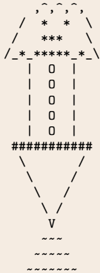
The image is a monochrome ASCII art representation of a stylized rocket or missile, constructed using standard keyboard characters. It is vertically oriented and symmetrical along its central axis. The design is schematic rather than realistic, using abstract shapes and patterns to suggest different sections of the vehicle.
### Components/Axes
The diagram is composed of distinct sections stacked vertically:
1. **Nose Cone (Top):** A pointed, triangular shape formed by forward slashes (`/`) and backslashes (`\`). It contains a decorative pattern of asterisks (`*`) arranged in a diamond or starburst formation.
2. **Upper Body:** A rectangular section defined by vertical bars (`|`). It contains a vertical column of five circles (`O`), evenly spaced, suggesting portholes or windows.
3. **Mid-Body/Interstage:** A horizontal band of hash symbols (`#`), creating a solid, textured divider.
4. **Lower Body/Engine Section:** A trapezoidal shape tapering downward, formed by backslashes (`\`) and forward slashes (`/`).
5. **Nozzle/Exhaust (Bottom):** A series of horizontal dashes (`-`) of decreasing width, representing the engine bell or exhaust plume.
6. **Directional Indicator:** A single letter `V` is centered below the main body, likely indicating "velocity" or the downward direction of thrust.
### Detailed Analysis
* **Nose Cone:** The topmost line is ` / \ `. Below it, lines expand with ` / * \ `, ` / * * \ `, and ` /*****\ `, creating a pointed tip with an embedded asterisk pattern.
* **Upper Body:** This section is 5 lines tall. Each line is `| |` with a single `O` centered between the vertical bars. The `O`s are perfectly aligned vertically.
* **Mid-Body:** A single, solid line of 11 hash symbols: `###########`.
* **Lower Body:** This section tapers over 3 lines. The pattern is `\ /`, `\ /`, and `\ /`, creating a funnel shape.
* **Nozzle/Exhaust:** Four lines of centered dashes: ` --- `, ` ----- `, ` ------- `, and `---------`, widening slightly before the final, widest line.
* **Textual Elements:** The only alphabetic character is the `V` at the bottom. All other elements are symbolic punctuation marks used for graphical effect.
### Key Observations
* The design is perfectly symmetrical.
* It uses a limited set of ASCII characters (`/`, `\`, `|`, `*`, `#`, `O`, `-`, `V`) to create distinct visual textures for different components.
* There is no scale, legend, or quantitative data. It is a purely pictorial representation.
* The `V` is the only element that could be interpreted as a label or annotation.
### Interpretation
This image is not a technical chart or data-rich diagram. It is a piece of **ASCII art**—a form of digital art that uses printable characters from the ASCII standard to create a visual representation.
* **Purpose:** The primary purpose is artistic or illustrative. It could be used as a simple icon, a decorative element in text-based communication (like code comments or plain-text documents), or as a nostalgic reference to early computer graphics.
* **Symbolism:** The components are symbolic. The asterisk pattern in the nose cone suggests a warhead or payload. The column of `O`s is a classic representation of windows on a spacecraft. The `###########` band implies a structural joint or separation plane. The `V` reinforces the concept of motion or vector.
* **Reading Between the Lines:** The choice of a rocket/missile shape is culturally loaded, often symbolizing technology, ambition, exploration, or conflict. The simplicity of the ASCII medium contrasts with the complexity of the real-world object it represents, creating a minimalist, abstract, and somewhat playful rendition. It demonstrates how complex forms can be suggested with minimal, discrete elements.