## Text-Based Diagram: Hierarchical Structure with Symbolic Elements
### Overview
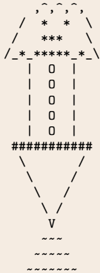
The image depicts a vertically oriented, text-based diagram composed of ASCII characters. It features a triangular top section, a central column of zeros, a horizontal line of `#` symbols, and a V-shaped bottom section with tildes (`~`). A labeled `V` is positioned at the apex of the V-shape. The diagram uses symbols to represent abstract or conceptual elements, with no numerical data or explicit labels beyond the `V`.
### Components/Axes
- **Triangular Top Section**:
- Composed of `*` characters forming a pyramid-like structure.
- Contains a central "smiley face" pattern: `* * *` (three asterisks in a row).
- No explicit labels or axis titles.
- **Central Column**:
- A vertical stack of four `0` characters, centered between vertical bars (`|`).
- Positioned directly below the triangular top.
- **Horizontal Line of `#` Symbols**:
- A row of 12 `#` characters, aligned directly below the central column of zeros.
- **V-Shaped Bottom Section**:
- A V-shaped structure formed by tildes (`~`).
- The apex of the V is labeled with a `V` character.
- The V-shape is flanked by dashed lines (`--`) on either side.
- **Dashed Lines**:
- Two sets of dashed lines (`--`) appear below the V-shape, increasing in length.
### Detailed Analysis
- **Triangular Top**:
- The pyramid of `*` characters suggests a hierarchical or foundational structure.
- The "smiley face" (`* * *`) may symbolize a core component or a key element within the hierarchy.
- **Central Column of Zeros**:
- The `0` characters could represent a baseline, neutral value, or a starting point.
- The vertical bars (`|`) frame the column, emphasizing its centrality.
- **Horizontal `#` Line**:
- The `#` symbols may denote a boundary, threshold, or a foundational layer.
- The length (12 characters) is consistent with the width of the central column.
- **V-Shaped Bottom**:
- The V-shape, labeled `V`, could represent a conclusion, outcome, or directional flow.
- The tildes (`~`) might symbolize uncertainty, variability, or a transitional phase.
- The dashed lines below the V-shape could indicate progression or expansion.
### Key Observations
1. **Hierarchical Structure**: The diagram progresses from a top-down triangular structure to a central column, then to a horizontal base, and finally to a V-shaped conclusion.
2. **Symbolic Use of Characters**:
- `*` (asterisks) for hierarchy or emphasis.
- `0` (zeros) for neutrality or a starting point.
- `#` (hashes) for boundaries or foundations.
- `~` (tildes) for variability or transition.
3. **Labeled `V`**: The explicit label at the V-shape’s apex suggests it is a critical or final element.
4. **No Numerical Data**: The diagram lacks quantitative values, relying on symbolic representation.
### Interpretation
The diagram likely represents a conceptual or process-oriented model. The triangular top may symbolize an initial phase or foundational elements, while the central column of zeros could denote a neutral or baseline state. The horizontal `#` line might represent a critical threshold or boundary, and the V-shape with the labeled `V` could signify a pivotal outcome or directional shift. The tildes and dashed lines below the V-shape may indicate ongoing processes or variability in the final stage.
The absence of numerical data or explicit labels suggests the diagram is abstract, possibly used to illustrate a workflow, system architecture, or symbolic representation of a process. The use of ASCII characters implies a focus on simplicity and clarity, prioritizing structural relationships over quantitative details.