## Flowchart: Information Processing Workflow
### Overview
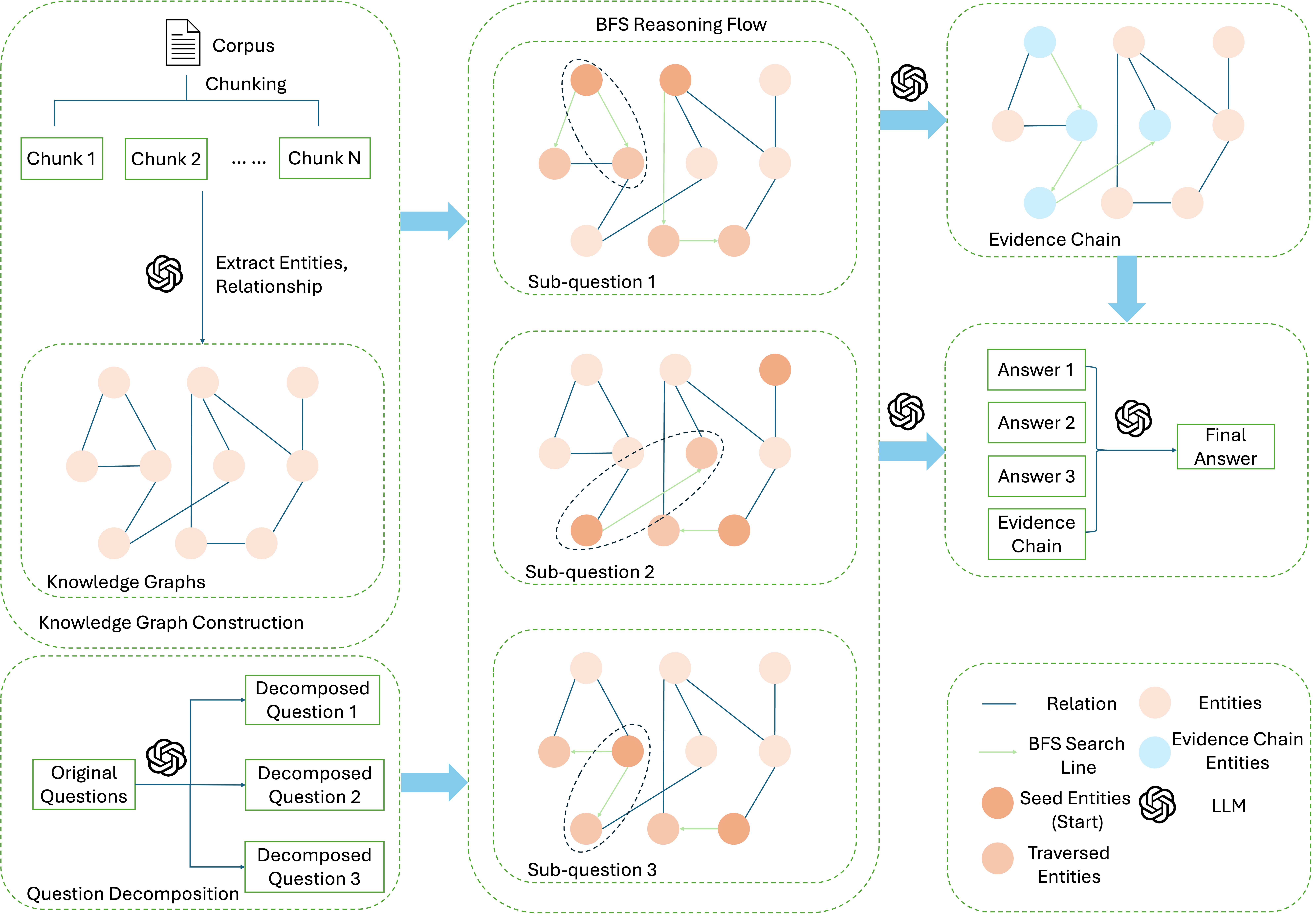
The diagram illustrates a multi-stage information processing system, starting from corpus chunking to final answer generation. It uses color-coded nodes and arrows to represent relationships, evidence chains, and reasoning flows. The process involves decomposing questions, constructing knowledge graphs, and applying BFS (Breadth-First Search) reasoning to derive answers.
---
### Components/Axes
1. **Legend** (bottom-right corner):
- **Blue lines**: Relation
- **Pink nodes**: Entities
- **Green lines**: BFS Search Line
- **Blue nodes**: Evidence Chain Entities
- **Red nodes**: Seed Entities (Start)
- **Light pink nodes**: Traversed Entities
- **Black icon**: LLM (Large Language Model)
2. **Key Sections**:
- **Corpus Chunking**: Splits raw text into "Chunk 1," "Chunk 2," ..., "Chunk N."
- **Knowledge Graph Construction**: Connects entities (pink nodes) via relations (blue lines).
- **BFS Reasoning Flow**: Three sub-questions (1–3) with traversed entities (light pink) and seed entities (red).
- **Question Decomposition**: Breaks "Original Questions" into "Decomposed Question 1–3."
- **Evidence Chain**: Links answers (Answer 1–3) to evidence chains (blue nodes).
---
### Detailed Analysis
1. **Corpus Chunking**:
- Input text is divided into discrete chunks (Chunk 1 to Chunk N).
- Entities and relationships are extracted from these chunks.
2. **Knowledge Graph Construction**:
- Entities (pink nodes) are interconnected via relations (blue lines), forming a graph structure.
3. **BFS Reasoning Flow**:
- **Sub-question 1**: Traversed entities (light pink) and seed entities (red) are highlighted.
- **Sub-question 2**: Similar structure with distinct traversed entities.
- **Sub-question 3**: Final sub-question with updated traversed entities.
4. **Question Decomposition**:
- Original questions are split into three decomposed sub-questions, each processed independently.
5. **Evidence Chain**:
- Final answers (Answer 1–3) are linked to evidence chains (blue nodes), which trace back to traversed entities.
---
### Key Observations
- **Modular Design**: The workflow is segmented into distinct stages (chunking, graph construction, reasoning, decomposition, evidence linking).
- **Entity Traversal**: BFS reasoning iteratively traverses entities, marked by light pink nodes, to explore relationships.
- **Seed Entities**: Red nodes act as starting points for BFS searches in each sub-question.
- **Evidence Linking**: Final answers are explicitly tied to evidence chains, ensuring traceability.
---
### Interpretation
This diagram represents a structured approach to knowledge extraction and question answering:
1. **Corpus Chunking** ensures manageable data segments for processing.
2. **Knowledge Graph Construction** creates a semantic network of entities and relationships.
3. **BFS Reasoning** systematically explores connections between entities to answer sub-questions.
4. **Question Decomposition** breaks complex queries into simpler components for parallel processing.
5. **Evidence Chains** provide transparency by linking answers to their source entities.
The use of color-coding and directional arrows emphasizes the flow of information and the hierarchical nature of the process. The system prioritizes traceability (via evidence chains) and modularity (via decomposition), suggesting an application in AI-driven question answering or semantic search systems.