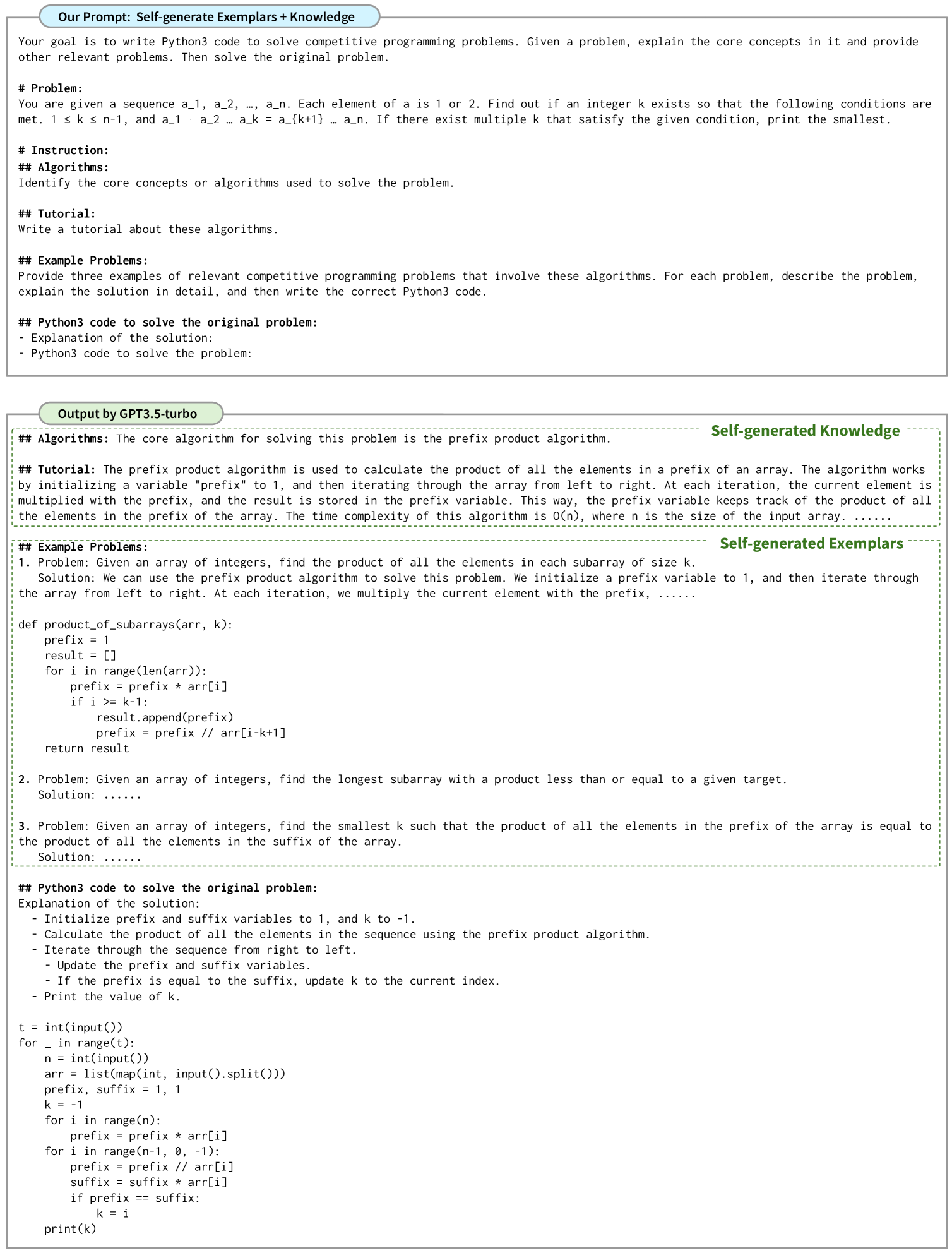
## Textual/Diagrammatic Representation: Self-generated Exemplars + Knowledge Prompt and Response
### Overview
The image displays a structured interaction between a user prompt and an AI model (GPT-3.5-turbo). The content is divided into two distinct, color-coded sections: a blue-header box containing the user's prompt and a green-header box containing the AI's response. The interaction focuses on solving a competitive programming problem using a "Self-generate Exemplars + Knowledge" prompting strategy.
### Components/Axes
The image is organized into two primary blocks:
1. **Top Block (Blue Header):** "Our Prompt: Self-generate Exemplars + Knowledge"
* Contains the instructions for the AI.
2. **Bottom Block (Green Header):** "Output by GPT3.5-turbo"
* Contains the AI's generated response.
* Includes sub-labels: "Self-generated Knowledge" (top right) and "Self-generated Exemplars" (middle right).
### Detailed Analysis
#### 1. The Prompt (Top Block)
The user provides a specific task: "Write Python3 code to solve competitive programming problems."
* **Problem Statement:** Given a sequence $a_1, a_2, ..., a_n$ where each element is 1 or 2. Find an integer $k$ ($1 \le k \le n-1$) such that $a_1 \cdot a_2 \cdot ... \cdot a_k = a_{k+1} \cdot ... \cdot a_n$. If multiple $k$ exist, print the smallest.
* **Required Structure:**
* `## Algorithms`: Identify core concepts.
* `## Tutorial`: Write a tutorial.
* `## Example Problems`: Provide three relevant problems with detailed solutions and Python3 code.
* `## Python3 code to solve the original problem`: Explanation and code.
#### 2. The Response (Bottom Block)
The AI follows the requested structure precisely.
**## Algorithms**
* Identifies the "prefix product algorithm" as the core concept.
**## Tutorial**
* Explains the prefix product algorithm: Initialize `prefix` to 1, iterate left to right, multiply current element with `prefix`. Time complexity is $O(n)$.
**## Example Problems**
1. **Problem:** Product of all elements in each subarray of size $k$.
* **Code:**
```python
def product_of_subarrays(arr, k):
prefix = 1
result = []
for i in range(len(arr)):
prefix = prefix * arr[i]
if i >= k-1:
result.append(prefix)
prefix = prefix // arr[i-k+1]
return result
```
2. **Problem:** Longest subarray with product $\le$ target.
3. **Problem:** Smallest $k$ such that prefix product equals suffix product.
**## Python3 code to solve the original problem**
* **Explanation:** Initialize prefix and suffix to 1, $k$ to -1. Calculate total product. Iterate right to left. Update prefix/suffix. If equal, update $k$.
* **Code:**
```python
t = int(input())
for _ in range(t):
n = int(input())
arr = list(map(int, input().split()))
prefix, suffix = 1, 1
k = -1
for i in range(n):
prefix = prefix * arr[i]
for i in range(n-1, 0, -1):
prefix = prefix // arr[i]
suffix = suffix * arr[i]
if prefix == suffix:
k = i
print(k)
```
### Key Observations
* **Prompt Engineering:** The user is employing a "Chain of Thought" or "Self-Consistency" style prompt by forcing the model to generate knowledge and examples before attempting the final solution. This is a known technique to improve LLM reasoning performance.
* **Code Logic:** The provided solution code is efficient. It first calculates the total product (which acts as the initial prefix product). Then, in the second loop, it iterates backwards, effectively "removing" the current element from the prefix product (using integer division `//`) and adding it to the suffix product, allowing for an $O(n)$ comparison.
### Interpretation
The data demonstrates a successful application of structured prompting. By requiring the model to define the "Algorithms" and "Tutorial" first, the user ensures the model has "warmed up" its internal logic before writing the final code.
The logic used in the final Python code is mathematically sound for the problem constraints (elements are 1 or 2). Since the elements are only 1 or 2, the products can grow very large, but the logic of dividing the prefix product by the current element to update it is a clever way to maintain the prefix product without re-calculating it from scratch, keeping the solution within linear time complexity. The code correctly handles the requirement to find the smallest $k$ by iterating through the array and updating $k$ whenever the condition is met.