## Text Analysis: Self-generate Exemplars + Knowledge
### Overview
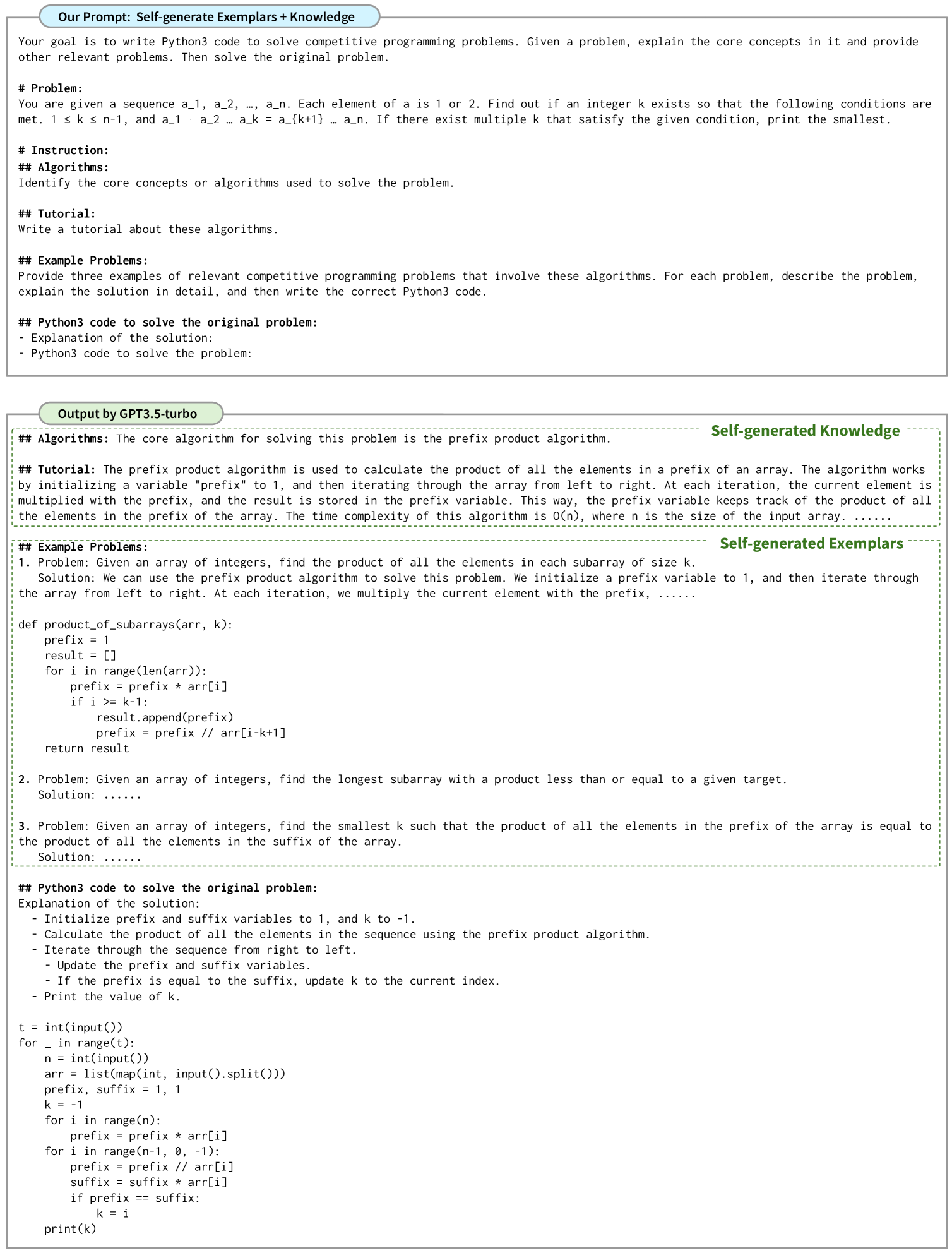
The image presents a prompt and a response generated by GPT3.5-turbo. The prompt asks for Python3 code to solve competitive programming problems, including problem definition, instructions, algorithms, tutorials, example problems, and Python3 code for the original problem. The GPT3.5-turbo response provides algorithms, tutorials, example problems, and Python3 code related to the prompt, focusing on the prefix product algorithm.
### Components/Axes
The image is divided into two main sections:
1. **Our Prompt: Self-generate Exemplars + Knowledge**: This section contains the initial prompt given to the model.
2. **Output by GPT3.5-turbo**: This section contains the response generated by the model.
Each section is further divided into subsections:
* **Problem**: Defines the problem to be solved.
* **Instruction**: Provides instructions on how to approach the problem.
* **Algorithms**: Identifies the core algorithms.
* **Tutorial**: Provides a tutorial on the identified algorithms.
* **Example Problems**: Presents example problems related to the algorithms.
* **Python3 code to solve the original problem**: Includes explanation and Python3 code.
### Detailed Analysis or ### Content Details
**Our Prompt: Self-generate Exemplars + Knowledge**
* **Problem**:
* Given a sequence a\_1, a\_2, ..., a\_n. Each element of *a* is 1 or 2.
* Find an integer *k* such that 1 ≤ *k* ≤ *n*-1, and a\_1 * a\_2 * ... * a\_k = a\_{k+1} ... a\_n.
* If multiple *k* exist, print the smallest.
* **Instruction**:
* **Algorithms**: Identify core concepts/algorithms.
* **Tutorial**: Write a tutorial about the algorithms.
* **Example Problems**: Provide three relevant problems, explain solutions, and provide Python3 code.
* **Python3 code to solve the original problem**:
* Explanation of the solution.
* Python3 code to solve the problem.
**Output by GPT3.5-turbo**
* **Algorithms**: The core algorithm is the prefix product algorithm.
* **Tutorial**:
* The prefix product algorithm calculates the product of all elements in a prefix of an array.
* It initializes a variable "prefix" to 1 and iterates through the array from left to right.
* The current element is multiplied with the prefix, and the result is stored in the prefix variable.
* Time complexity is O(n), where *n* is the size of the input array.
* **Example Problems**:
1. Problem: Find the product of all elements in each subarray of size *k*.
* Solution: Use the prefix product algorithm. Initialize a prefix variable to 1 and iterate through the array, multiplying the current element with the prefix.