## Technical Document: Prompt and GPT3.5-turbo Output for Competitive Programming
### Overview
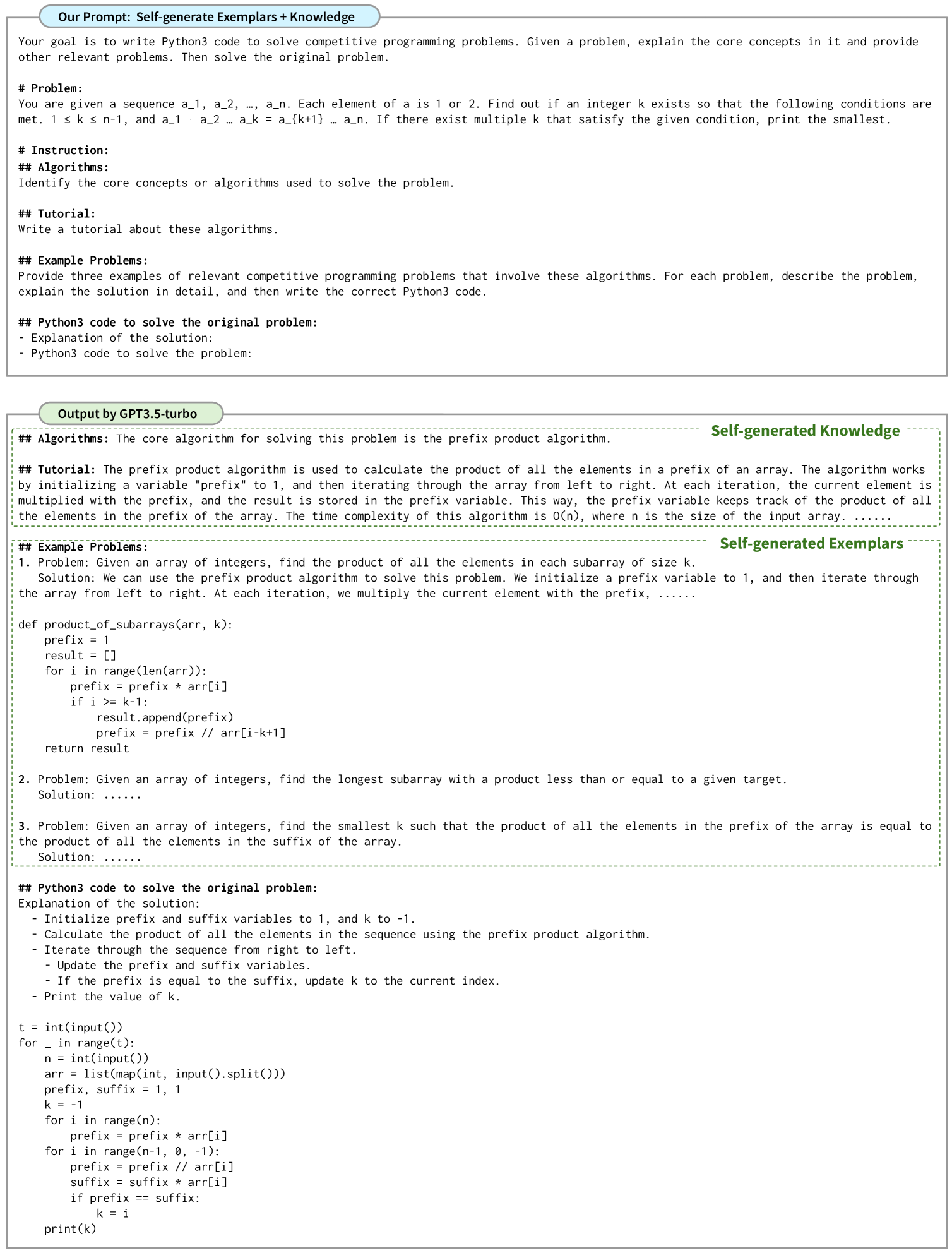
The image displays a **prompt** for generating competitive programming solutions (titled *“Our Prompt: Self-generate Exemplars + Knowledge”*) and the corresponding **output** from GPT3.5-turbo. The prompt outlines a problem involving a sequence of 1s and 2s, and the output includes algorithm explanation, tutorial, example problems, and Python3 code to solve the original problem.
### Components/Sections
The image is divided into two main sections:
#### 1. Top Section: *“Our Prompt: Self-generate Exemplars + Knowledge”* (Blue Header)
- **Problem:** Given a sequence \( a_1, a_2, \dots, a_n \) (each element is 1 or 2), find the smallest integer \( k \) (where \( 1 \leq k \leq n-1 \)) such that \( a_1 \cdot a_2 \cdot \dots \cdot a_k = a_{k+1} \cdot \dots \cdot a_n \).
- **Instruction:** Write Python3 code to solve the problem, explain core concepts, provide relevant problems, and solve the original.
- **Sections:**
- *Algorithms:* Identify core concepts/algorithms.
- *Tutorial:* Write a tutorial about these algorithms.
- *Example Problems:* Provide 3 relevant competitive programming problems (with solutions).
- *Python3 code to solve the original problem:* Explanation + code.
#### 2. Bottom Section: *“Output by GPT3.5-turbo”* (Green Header)
- **Self-generated Knowledge:**
- *Algorithms:* Core algorithm is the **prefix product algorithm**.
- *Tutorial:* Explains the prefix product algorithm (initialize `prefix=1`, iterate left to right, multiply current element, track product; time complexity \( O(n) \)).
- **Self-generated Exemplars:**
3 example problems (first with code, others truncated with `......`):
1. *Problem:* Given an array of integers, find the product of all elements in each subarray of size \( k \).
*Solution:* Uses prefix product (code provided).
2. *Problem:* Given an array of integers, find the longest subarray with a product ≤ a given target.
*Solution:* Truncated (`......`).
3. *Problem:* Given an array of integers, find the smallest \( k \) such that the product of the prefix equals the product of the suffix.
*Solution:* Truncated (`......`).
- **Python3 Code for the Original Problem:**
- *Explanation:* Initialize `prefix`/`suffix=1`, \( k=-1 \); compute prefix product, iterate right to left, update `prefix`/`suffix`, check equality, update \( k \).
- *Code:* Handles \( t \) test cases, reads \( n \) and the array, computes `prefix`/`suffix`, and finds \( k \).
### Detailed Analysis
- **Prompt Content:** The problem requires finding a split point \( k \) in a sequence of 1s/2s where the product of the first \( k \) elements equals the product of the remaining. The prompt instructs to explain algorithms, provide tutorials, example problems, and code.
- **GPT3.5-turbo Output:**
- *Algorithms:* Identifies the “prefix product algorithm” as the core solution.
- *Tutorial:* Concisely explains the prefix product (initialize `prefix=1`, iterate left to right, multiply current element, track product; \( O(n) \) time).
- *Example Problems:*
1. *Product of subarrays of size \( k \):* Code uses prefix product, appends to `result` when \( i \geq k-1 \), and updates `prefix` by dividing by \( arr[i-k+1] \).
2. (Truncated) Longest subarray with product ≤ target.
3. (Truncated) Smallest \( k \) where prefix = suffix product.
- *Original Problem Code:*
- Reads \( t \) test cases.
- For each test case: reads \( n \) and the array, initializes `prefix`/`suffix=1`, \( k=-1 \).
- First loop: Compute total prefix product (all elements).
- Second loop (right to left): Divide `prefix` by the current element (to get the prefix up to \( i-1 \)), multiply `suffix` by the current element (suffix from \( i \) to end). If `prefix == suffix`, update \( k \) to \( i \).
- Prints \( k \) (smallest, as the loop is right to left, so the first match is the smallest).
### Key Observations
- The output uses the **prefix product algorithm**, which is efficient for product-related problems.
- Example problems demonstrate practical applications, though some solutions are truncated (marked with `......`).
- The code for the original problem efficiently computes prefix and suffix products to find the smallest \( k \), handling multiple test cases.
- The tutorial and algorithm explanation are concise but clear, suitable for a competitive programming context.
### Interpretation
The prompt is a structured approach to generating comprehensive competitive programming solutions, emphasizing algorithm explanation, tutorial, and practical examples. GPT3.5-turbo’s output demonstrates its ability to generate such content, using the prefix product algorithm for the given problem. The example problems and code show how the algorithm can be applied to similar tasks, though some solutions are incomplete (truncated). The code for the original problem is efficient, leveraging prefix/suffix products to find the split point \( k \) in linear time, making it suitable for competitive programming constraints. This output illustrates the potential of AI models to assist in competitive programming by generating structured, algorithmic solutions.
(Note: The image contains no charts, diagrams, or non-English text. All content is in English, and the analysis focuses on the text-based prompt and output.)