## Diagram: 10x10 Binary Grid Matrix
### Overview
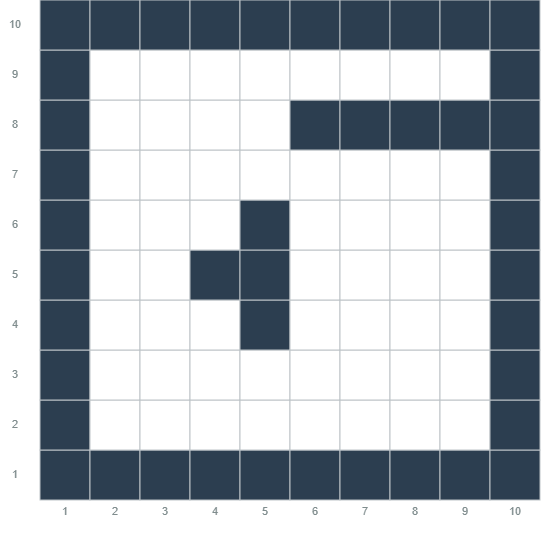
The image displays a 10x10 grid or matrix. Each cell within the grid is in one of two states: filled with a dark, desaturated blue color or left white (unfilled). The grid is bounded by numbered axes on the left (vertical) and bottom (horizontal), both ranging from 1 to 10. The pattern of filled cells creates a specific, non-random configuration within the grid's border.
### Components/Axes
* **Grid Structure:** A 10x10 matrix of square cells.
* **Vertical Axis (Y-axis):** Labeled on the left side with numbers 1 (bottom) through 10 (top). The labels are positioned to the left of their corresponding row.
* **Horizontal Axis (X-axis):** Labeled on the bottom with numbers 1 (left) through 10 (right). The labels are positioned below their corresponding column.
* **Cell States:** Two states are visually present:
* **Dark Fill:** A dark, desaturated blue (#2C3E50 approximate).
* **White/Empty:** The default background color of the cell.
* **Legend:** No explicit legend is provided. The binary nature of the grid (filled/unfilled) is implied by the visual contrast.
### Detailed Analysis
The state (filled or empty) of each cell in the 10x10 grid is as follows. Coordinates are given as (Column, Row), with (1,1) at the bottom-left.
* **Row 10 (Top):** All cells (1,10) through (10,10) are **FILLED**.
* **Row 9:** Cells (1,9) and (10,9) are **FILLED**. Cells (2,9) through (9,9) are **EMPTY**.
* **Row 8:** Cells (1,8), (6,8), (7,8), (8,8), (9,8), and (10,8) are **FILLED**. Cells (2,8) through (5,8) are **EMPTY**.
* **Row 7:** Cells (1,7) and (10,7) are **FILLED**. Cells (2,7) through (9,7) are **EMPTY**.
* **Row 6:** Cells (1,6), (5,6), and (10,6) are **FILLED**. Cells (2,6), (3,6), (4,6), and (6,6) through (9,6) are **EMPTY**.
* **Row 5:** Cells (1,5), (4,5), (5,5), and (10,5) are **FILLED**. Cells (2,5), (3,5), and (6,5) through (9,5) are **EMPTY**.
* **Row 4:** Cells (1,4), (5,4), and (10,4) are **FILLED**. Cells (2,4), (3,4), (4,4), and (6,4) through (9,4) are **EMPTY**.
* **Row 3:** Cells (1,3) and (10,3) are **FILLED**. Cells (2,3) through (9,3) are **EMPTY**.
* **Row 2:** Cells (1,2) and (10,2) are **FILLED**. Cells (2,2) through (9,2) are **EMPTY**.
* **Row 1 (Bottom):** All cells (1,1) through (10,1) are **FILLED**.
### Key Observations
1. **Perimeter Fill:** The entire outer border of the grid (Row 1, Row 10, Column 1, Column 10) is filled, creating a solid frame.
2. **Internal Structure:** Inside the frame, filled cells form two distinct connected components:
* A vertical "bar" or "stem" running from (5,4) up to (5,6), with a single filled cell attached to its left at (4,5).
* A horizontal "bar" or "arm" running from (6,8) to (9,8).
3. **Symmetry:** The pattern is not symmetrical about the vertical or horizontal center lines.
4. **Density:** Out of 100 total cells, 32 are filled and 68 are empty.
### Interpretation
This diagram represents a **binary matrix or bitmap**. The filled cells likely encode specific information, such as:
* **A Pixel Art Glyph:** The pattern strongly resembles a stylized, blocky representation of the numeral **"5"**. The vertical stem (column 5, rows 4-6) and the horizontal top bar (row 8, columns 6-9) are characteristic features of the digit 5, enclosed within a full border.
* **A Configuration Map:** It could define a layout for a game board, a memory map, or a sensor grid where "filled" indicates an active, occupied, or "on" state.
* **A Logical Puzzle State:** The grid might represent the solution or a step in a logic puzzle like "Lights Out" or a cellular automaton.
The primary information conveyed is the **spatial arrangement of the binary states**. The lack of a title or legend means the specific meaning of the "filled" state is context-dependent. The precise, non-random pattern suggests it is a deliberate encoding of a symbol or a specific system configuration.