## Heatmap: All Lengths
### Overview
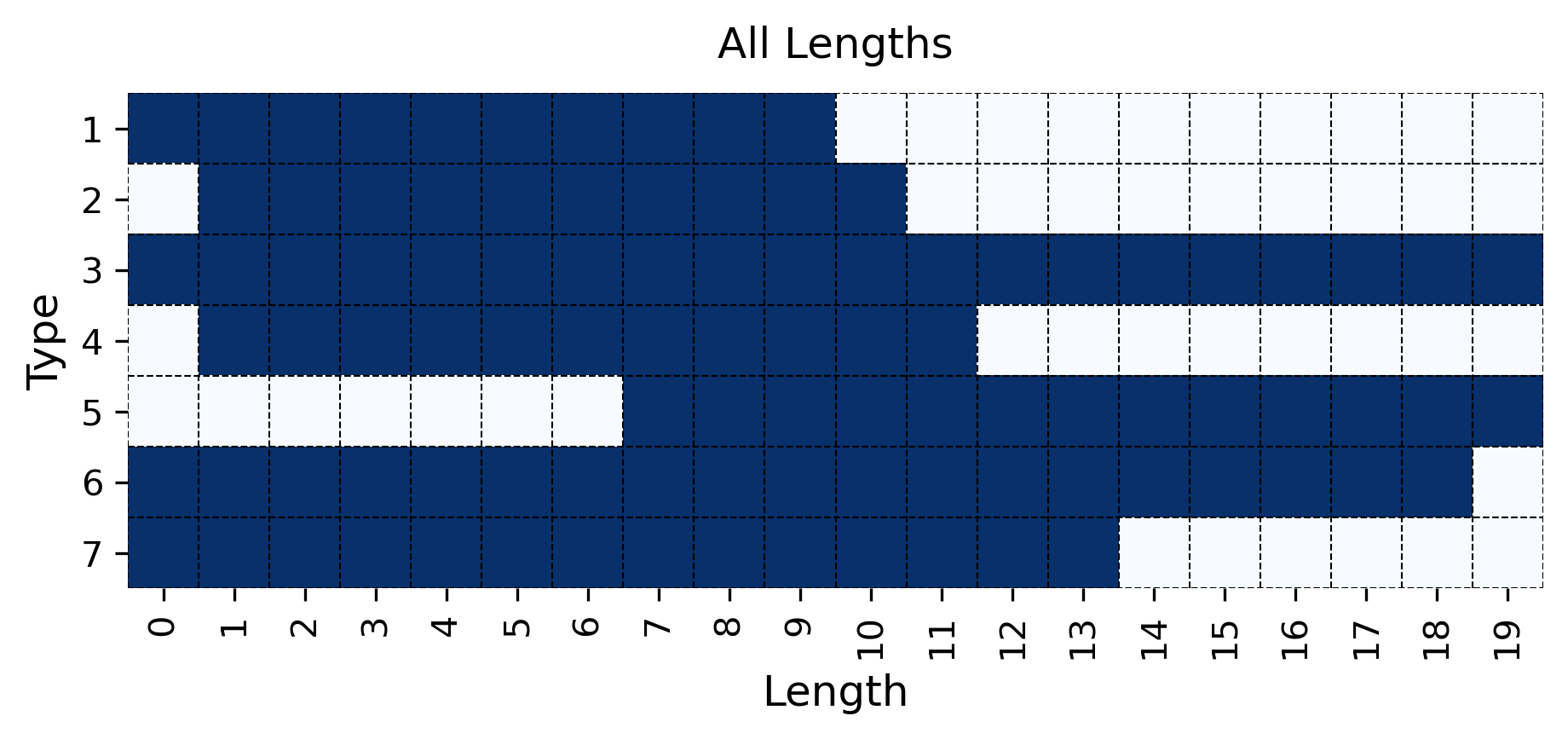
The image displays a heatmap-style grid chart titled "All Lengths." It visualizes the presence or absence of data points across two categorical dimensions: "Type" (y-axis) and "Length" (x-axis). The chart uses a binary color scheme where dark blue cells indicate a data point exists for that specific Type-Length combination, and white cells indicate its absence.
### Components/Axes
* **Title:** "All Lengths" (centered at the top).
* **Y-Axis:** Labeled "Type." It lists 7 discrete categories, numbered 1 through 7 from top to bottom.
* **X-Axis:** Labeled "Length." It lists 20 discrete, equally spaced categories, numbered 0 through 19 from left to right.
* **Grid:** A 7-row by 20-column grid of cells. Each cell corresponds to a unique (Type, Length) pair.
* **Color Legend:** Implicit. Dark blue = Present/True. White = Absent/False. No separate legend box is present; the meaning is inferred from the visual pattern.
### Detailed Analysis
The following table reconstructs the data from the heatmap. A "✓" indicates a dark blue cell (present), and a "—" indicates a white cell (absent).
| Type | Length 0 | 1 | 2 | 3 | 4 | 5 | 6 | 7 | 8 | 9 | 10 | 11 | 12 | 13 | 14 | 15 | 16 | 17 | 18 | 19 |
| :--- | :--- | :--- | :--- | :--- | :--- | :--- | :--- | :--- | :--- | :--- | :--- | :--- | :--- | :--- | :--- | :--- | :--- | :--- | :--- | :--- |
| **1** | ✓ | ✓ | ✓ | ✓ | ✓ | ✓ | ✓ | ✓ | ✓ | ✓ | — | — | — | — | — | — | — | — | — | — |
| **2** | — | ✓ | ✓ | ✓ | ✓ | ✓ | ✓ | ✓ | ✓ | ✓ | ✓ | — | — | — | — | — | — | — | — | — |
| **3** | ✓ | ✓ | ✓ | ✓ | ✓ | ✓ | ✓ | ✓ | ✓ | ✓ | ✓ | ✓ | ✓ | ✓ | ✓ | ✓ | ✓ | ✓ | ✓ | ✓ |
| **4** | — | ✓ | ✓ | ✓ | ✓ | ✓ | ✓ | ✓ | ✓ | ✓ | ✓ | ✓ | — | — | — | — | — | — | — | — |
| **5** | — | — | — | — | — | — | — | ✓ | ✓ | ✓ | ✓ | ✓ | ✓ | ✓ | ✓ | ✓ | ✓ | ✓ | ✓ | ✓ |
| **6** | ✓ | ✓ | ✓ | ✓ | ✓ | ✓ | ✓ | ✓ | ✓ | ✓ | ✓ | ✓ | ✓ | ✓ | ✓ | ✓ | ✓ | ✓ | ✓ | — |
| **7** | ✓ | ✓ | ✓ | ✓ | ✓ | ✓ | ✓ | ✓ | ✓ | ✓ | ✓ | ✓ | ✓ | ✓ | — | — | — | — | — | — |
**Data Point Summary by Type:**
* **Type 1:** Present for Lengths 0 through 9 (10 consecutive points).
* **Type 2:** Present for Lengths 1 through 10 (10 consecutive points, shifted one unit right from Type 1).
* **Type 3:** Present for **all** Lengths 0 through 19 (20 points). This is the only fully populated row.
* **Type 4:** Present for Lengths 1 through 11 (11 consecutive points).
* **Type 5:** Present for Lengths 6 through 19 (14 consecutive points). This row starts the latest.
* **Type 6:** Present for Lengths 0 through 18 (19 consecutive points). This row ends one unit before the maximum.
* **Type 7:** Present for Lengths 0 through 13 (14 consecutive points).
### Key Observations
1. **Complete Coverage:** Type 3 is the only category that has data for every single Length value (0-19).
2. **Contiguous Blocks:** For every Type, the present data points form a single, contiguous block along the Length axis. There are no isolated or scattered points within a row.
3. **Variable Start and End Points:** The starting Length for each Type's data block varies (0, 1, 0, 1, 6, 0, 0). The ending Length also varies (9, 10, 19, 11, 19, 18, 13).
4. **Maximum Span:** Type 6 has the widest span, covering 19 consecutive Lengths (0-18). Type 5 has the latest start (Length 6).
5. **Symmetry/Pattern:** There is no obvious symmetrical or mathematical pattern governing the start and end points of each Type's data block. The distribution appears specific to the underlying dataset.
### Interpretation
This heatmap likely represents the **occurrence or availability of items of different "Types" across a spectrum of "Lengths."** The "Length" axis could represent a physical measurement, a time interval, a sequence position, or a categorical bin.
* **What the data suggests:** The chart answers the question: "For each Type, which Lengths are represented in the dataset?" It shows that Type 3 is ubiquitous, appearing at every measured length. Other types have more restricted ranges. For example, Type 5 is only associated with longer lengths (6 and above), while Types 1, 2, 4, 6, and 7 are absent from the longest lengths (14-19, with the exception of Type 5).
* **Relationships between elements:** The contiguous blocks suggest that each "Type" has a characteristic range of "Lengths." This could indicate a natural property (e.g., different species have different size ranges) or a sampling artifact (e.g., data for certain types was only collected within specific length intervals).
* **Notable anomalies:** The primary anomaly is the perfect, full coverage of Type 3. This makes it a reference or control category against which the more restricted ranges of the other types can be compared. The late start of Type 5 is also notable, suggesting it is exclusively a "long-length" phenomenon in this context.
**Language:** All text in the image is in English.