\n
## Diagram: Combinatorial Optimization Problems and Ising Model Formulation
### Overview
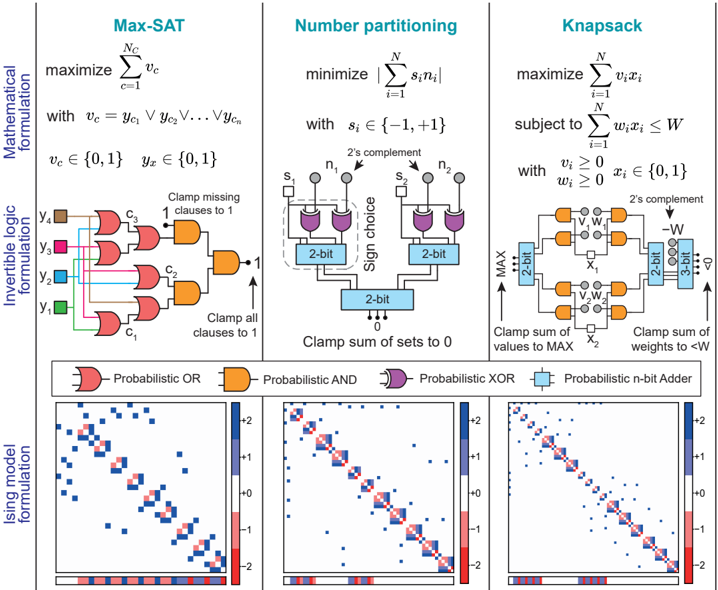
The image presents a comparative analysis of three combinatorial optimization problems – Max-SAT, Number Partitioning, and Knapsack – illustrating their mathematical formulations, invertible logic implementations, and corresponding Ising model formulations visualized as heatmaps. The diagram is structured into three columns, each dedicated to one problem, with two rows: the top row showing the mathematical and logical representation, and the bottom row displaying the Ising model formulation as a heatmap.
### Components/Axes
Each column (problem) is divided into two sections:
* **Mathematical Formulation:** Contains equations defining the optimization problem.
* **Invertible Logic:** Shows a circuit diagram representing the problem's logic.
* **Ising Model Formulation:** Displays a heatmap representing the Ising model, with a color scale ranging from -2 to +2. The x-axis represents the spin configuration, and the y-axis is not explicitly labeled but appears to represent the energy level or state of the system.
The three problems are:
1. **Max-SAT:** Maximizes the number of satisfied clauses.
2. **Number Partitioning:** Minimizes the difference between the sums of two subsets.
3. **Knapsack:** Maximizes the value of items selected within a weight constraint.
### Detailed Analysis or Content Details
**1. Max-SAT (Left Column)**
* **Mathematical Formulation:**
* `maximize Σvc` where `c` ranges from 1 to `Nc`
* `vc = yc1 ∨ yc2 ∨ ... ∨ ycn`
* `vc ∈ {0,1}` and `yc ∈ {0,1}`
* **Invertible Logic:** A circuit with inputs `y1`, `y2`, `y3`, `y4` and clauses `c1`, `c2`, `c3`. The circuit includes OR gates and a final output of 1. Text states "Clamp missing 1 clauses to 1" and "Clamp all clauses to 1".
* **Ising Model Formulation:** The heatmap shows a pattern of red and blue squares. The color intensity varies, with some squares approaching +2 (red) and others -2 (blue). There's a clear diagonal pattern.
**2. Number Partitioning (Middle Column)**
* **Mathematical Formulation:**
* `minimize Σ si*ni` where `i` ranges from 1 to `N`
* `si ∈ {-1, +1}`
* **Invertible Logic:** Includes 2-bit sign choice blocks, 2's complement operations, and a MAX function. Text states "Clamp sum of sets to 0" and "Clamp sum of values to MAX".
* **Ising Model Formulation:** The heatmap shows a more dispersed pattern than Max-SAT, with a mix of red and blue squares. The diagonal pattern is less pronounced.
**3. Knapsack (Right Column)**
* **Mathematical Formulation:**
* `maximize Σ vi*xi` where `i` ranges from 1 to `N`
* `subject to Σ wi*xi ≤ W` where `i` ranges from 1 to `N`
* `vi > 0`, `wi > 0`, `xi ∈ {0,1}`
* **Invertible Logic:** Includes 2-bit adders, 3-5 bit adders, 2's complement operations, and a MAX function. Text states "Clamp sum of weights to <W".
* **Ising Model Formulation:** The heatmap shows a complex pattern with a mix of red and blue squares. The diagonal pattern is visible but less distinct than in Max-SAT.
**Color Scale (Common to all Ising Model Formulations):**
* -2 (Dark Blue)
* -1 (Blue)
* 0 (White)
* +1 (Red)
* +2 (Dark Red)
### Key Observations
* Each problem has a distinct Ising model representation, suggesting that the energy landscape differs for each optimization task.
* The Max-SAT Ising model exhibits the most pronounced diagonal pattern, potentially indicating a simpler energy landscape.
* The Number Partitioning and Knapsack Ising models show more complex and dispersed patterns, suggesting more challenging optimization landscapes.
* The mathematical formulations clearly define the objective function and constraints for each problem.
* The invertible logic diagrams provide a hardware-oriented view of the problems.
### Interpretation
The diagram demonstrates a powerful connection between combinatorial optimization problems, their logical implementations, and their representation as Ising models. The Ising model formulation allows these problems to be tackled using techniques from statistical physics, such as simulated annealing or quantum annealing.
The differences in the Ising model heatmaps suggest that the computational complexity of each problem varies. Max-SAT, with its clear diagonal pattern, might be easier to solve than Number Partitioning or Knapsack, which have more complex energy landscapes.
The use of invertible logic highlights the potential for building specialized hardware to solve these problems efficiently. The diagram suggests that the Ising model provides a unifying framework for understanding and solving a wide range of combinatorial optimization challenges. The clamping operations in the invertible logic diagrams suggest a method for handling constraints within the Ising model framework. The diagram is a conceptual illustration, and does not provide specific numerical data for the Ising model parameters or performance metrics.