## [Technical Diagram]: Comparative Optimization Problem Formulations (Max-SAT, Number Partitioning, Knapsack)
### Overview
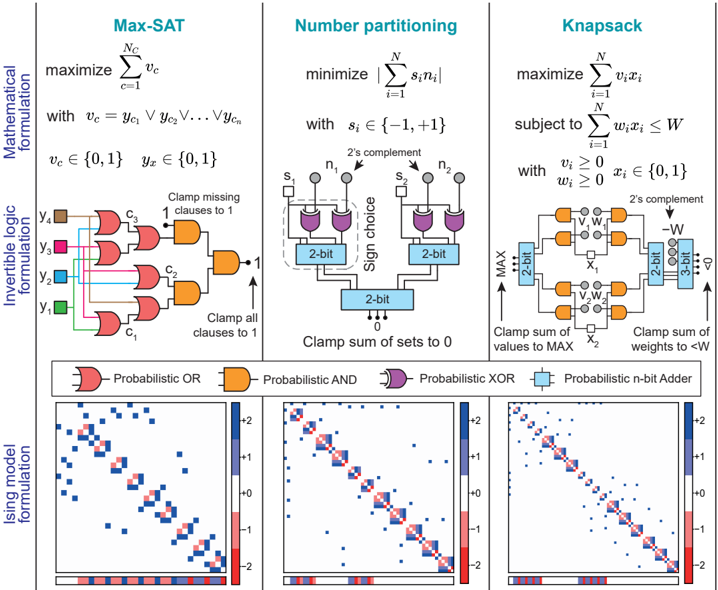
The image is a **comparative technical diagram** illustrating three classic optimization problems—**Max-SAT**, **Number Partitioning**, and **Knapsack**—across three formulation layers: *Mathematical*, *Invertible Logic*, and *Ising Model*. Each problem is presented in a vertical column, with horizontal rows for each formulation type. A legend defines logic gate symbols used in the Invertible Logic layer.
### Components/Axes
- **Columns (Problems):**
- Left: *Max-SAT* (maximizing clause satisfaction).
- Middle: *Number Partitioning* (minimizing partition imbalance).
- Right: *Knapsack* (maximizing value under weight constraints).
- **Rows (Formulations):**
- **Top:** *Mathematical Formulation* (formulas, variable definitions).
- **Middle:** *Invertible Logic Formulation* (logic gates, clamping operations).
- **Bottom:** *Ising Model Formulation* (heatmaps with color bars).
- **Legend (Bottom Middle):**
- Red: *Probabilistic OR*
- Orange: *Probabilistic AND*
- Purple: *Probabilistic XOR*
- Blue: *Probabilistic n-bit Adder*
- **Color Bars (Bottom Row):** Each heatmap has a vertical color bar (blue → red) labeled with values `-2, -1, 0, +1, +2` (indicating Ising model spin interactions/energy terms).
### Detailed Analysis
#### 1. Mathematical Formulation (Top Row)
- **Max-SAT (Left):**
- Objective: Maximize \( \sum_{c=1}^{N_c} v_c \), where \( v_c = y_{c1} \lor y_{c2} \lor \dots \lor y_{cn} \) (logical OR of binary variables \( y_x \in \{0,1\} \)).
- Variables: \( v_c \in \{0,1\} \), \( y_x \in \{0,1\} \).
- **Number Partitioning (Middle):**
- Objective: Minimize \( \sum_{i=1}^{N} |s_i n_i| \), where \( s_i \in \{-1, +1\} \) (signs for partitioning).
- **Knapsack (Right):**
- Objective: Maximize \( \sum_{i=1}^{N} v_i x_i \), subject to \( \sum_{i=1}^{N} w_i x_i \leq W \) (weight constraint).
- Variables: \( v_i \geq 0 \), \( w_i \geq 0 \), \( x_i \in \{0,1\} \) (binary selection).
#### 2. Invertible Logic Formulation (Middle Row)
- **Max-SAT (Left):**
- Logic Gates: *Probabilistic OR* (red) for clause satisfaction, *Probabilistic AND* (orange) for combining clauses.
- Clamping: “Clamp missing clauses to 1” (top), “Clamp all clauses to 1” (bottom).
- Flow: Inputs \( y_{c1}, y_{c2}, y_{c3} \) → OR gates → AND gate → clamping.
- **Number Partitioning (Middle):**
- Logic Gates: *Probabilistic XOR* (purple) for sign handling, *Probabilistic n-bit Adder* (blue) for summing.
- Clamping: “2’s complement” (top), “Clamp sum of sets to 0” (bottom).
- Flow: Signs \( s_1, s_2 \) and numbers \( n_1, n_2 \) → XOR → Adder → clamping.
- **Knapsack (Right):**
- Logic Gates: *Probabilistic XOR* (purple) for value/weight handling, *Probabilistic n-bit Adders* (blue) for summing values/weights.
- Clamping: “2’s complement” (top), “Clamp sum of values to MAX” (left), “Clamp sum of weights to <W” (bottom).
- Flow: Values \( v_i \), weights \( w_i \), and selections \( x_i \) → XOR → Adders → clamping.
#### 3. Ising Model Formulation (Bottom Row, Heatmaps)
Each heatmap (Max-SAT, Number Partitioning, Knapsack) uses a color scale from **blue (-2)** to **red (+2)**, representing Ising model spin interactions or energy terms.
- **Max-SAT Heatmap (Left):** Diagonal/off-diagonal elements with red (positive) and blue (negative) squares (clause-variable interactions).
- **Number Partitioning Heatmap (Middle):** Symmetric diagonal pattern (balanced partitioning interactions).
- **Knapsack Heatmap (Right):** Diagonal structure (value-weight tradeoff interactions).
### Key Observations
- **Formulation Consistency:** Each problem is mapped across mathematical, logic, and Ising layers, showing cross-paradigm representation.
- **Logic Gate Usage:** Probabilistic gates (OR, AND, XOR, Adder) model constraints/objectives, with clamping enforcing feasibility.
- **Ising Model Patterns:** Heatmaps show distinct diagonal structures (e.g., Max-SAT: clause-variable; Number Partitioning: sign-number balance; Knapsack: value-weight tradeoffs).
- **Color Coding:** Legend colors (red=OR, orange=AND, purple=XOR, blue=Adder) are consistent across the Invertible Logic row.
### Interpretation
This diagram demonstrates how three classic optimization problems can be reformulated across **mathematical**, **logic-based**, and **Ising model** frameworks:
- The *mathematical layer* defines the problem’s objective/constraints.
- The *logic layer* uses probabilistic gates to encode logical/arithmetic operations (e.g., clause satisfaction, partition signs, knapsack selection) with clamping for feasibility.
- The *Ising layer* visualizes the problem’s energy landscape (via heatmaps) to show interaction strengths (e.g., Max-SAT’s clause-variable interactions, Knapsack’s value-weight tradeoffs).
This multi-formulation approach highlights the versatility of optimization problems and their representation in different computational paradigms (e.g., quantum-inspired Ising models, probabilistic logic gates), aiding in solver development and problem structure analysis.
(Note: All text is in English; no non-English text is present.)