## Screenshot: Code Snippet in a Programming Environment
### Overview
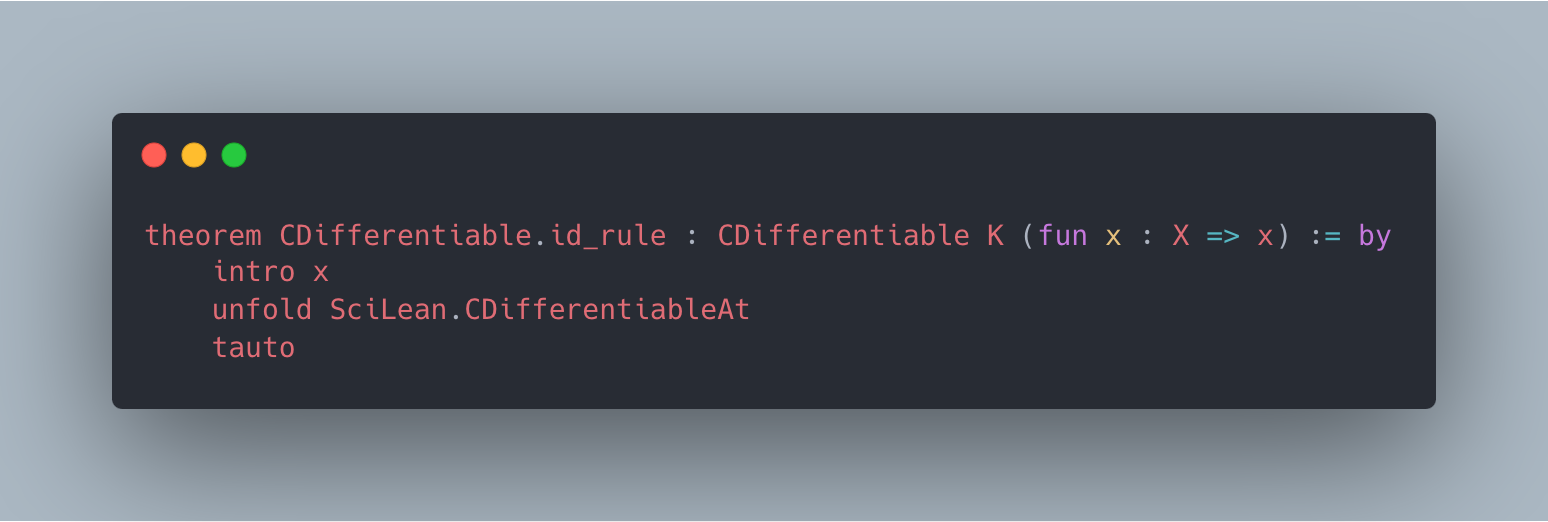
The image shows a code snippet in a dark-themed code editor with syntax highlighting. The code defines a theorem related to differentiability, using a formal proof structure. Key elements include window control buttons (red, yellow, green circles) and a block of code with color-coded syntax.
### Components/Axes
- **Window Controls**: Top-left corner with three circular buttons (red, yellow, green) for window management.
- **Code Block**:
- **Syntax Highlighting**:
- Keywords (`theorem`, `intro`, `unfold`, `tauto`, `by`) in **red**.
- Function definition (`fun x : X => x`) in **purple**.
- Variables (`x`, `X`) in **blue**.
- Operators (`:=`, `=>`, `:`) in **green**.
- **Text Content**:
- Theorem declaration: `theorem CDifferentiable.id_rule : CDifferentiable K (fun x : X => x) := by`
- Proof steps:
- `intro x`
- `unfold SciLean.CDifferentiableAt`
- `tauto`
### Detailed Analysis
1. **Theorem Declaration**:
- `theorem CDifferentiable.id_rule : CDifferentiable K (fun x : X => x) := by`
- Declares a theorem named `CDifferentiable.id_rule` asserting that the function `fun x : X => x` (identity function) is `CDifferentiable` under type `K`.
- `:= by` initiates the proof.
2. **Proof Steps**:
- `intro x`: Introduces a variable `x` into the proof context.
- `unfold SciLean.CDifferentiableAt`: Expands the definition of `CDifferentiableAt` (likely a predicate for differentiability at a point).
- `tauto`: Applies automatic theorem proving to complete the proof.
### Key Observations
- The code uses a **proof-by-unfolding** strategy, common in formal verification tools like Lean or Coq.
- `tauto` suggests the proof relies on automated tactics to discharge obligations, implying the identity function’s differentiability is derivable from existing axioms.
- No numerical data or visual trends; focus is on logical structure and syntax.
### Interpretation
This code snippet demonstrates a formal proof in a dependent type theory or proof assistant environment. The theorem `CDifferentiable.id_rule` establishes that the identity function `fun x : X => x` is differentiable (under type `K`). The proof unfolds the definition of differentiability (`CDifferentiableAt`) and uses `tauto` to leverage automated reasoning, indicating the result follows from foundational axioms.
The use of `by` and `tauto` reflects a declarative style, where the programmer specifies the logical steps, and the tool fills in the mechanical details. This aligns with practices in formal methods for verifying software correctness.