## Diagram: Neural Network and SK Spin Glass
### Overview
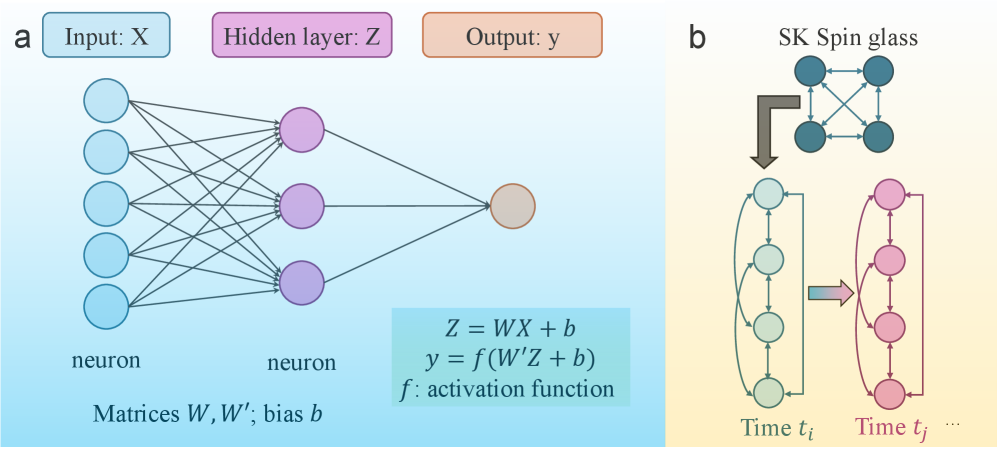
The image presents two diagrams side-by-side. Diagram 'a' illustrates a basic neural network architecture, showing input, hidden, and output layers with interconnected neurons. Diagram 'b' depicts an SK Spin glass model and its evolution over time.
### Components/Axes
**Diagram a (Neural Network):**
* **Title:** Input: X, Hidden layer: Z, Output: y (located at the top)
* **Layers:**
* Input Layer: Contains 5 blue neurons, labeled "neuron" below.
* Hidden Layer: Contains 3 purple neurons, labeled "neuron" below.
* Output Layer: Contains 1 orange neuron.
* **Connections:** Lines connecting each neuron in the input layer to every neuron in the hidden layer, and each neuron in the hidden layer to the output neuron.
* **Equations:**
* Z = WX + b
* y = f(W'Z + b)
* f: activation function
* **Labels:** Matrices W, W'; bias b (located at the bottom)
**Diagram b (SK Spin Glass):**
* **Title:** SK Spin glass (located at the top)
* **Top Section:** A network of 4 blue neurons, each connected to all others with double-headed arrows.
* **Middle Section:** Two vertical chains of 4 neurons each. The left chain is light blue, and the right chain is light purple.
* **Connections:**
* The top network connects to the top neuron of the left chain via a thick gray arrow pointing downwards.
* Each neuron in the left chain is connected to the neuron above and below it with double-headed arrows. There are also curved arrows connecting the top and bottom neurons, and the second and third neurons.
* The left chain transitions to the right chain via a gradient arrow.
* Each neuron in the right chain is connected to the neuron above and below it with double-headed arrows. There are also curved arrows connecting the top and bottom neurons, and the second and third neurons.
* **Labels:**
* Time t<sub>i</sub> (below the left chain)
* Time t<sub>j</sub> ... (below the right chain)
### Detailed Analysis or ### Content Details
**Diagram a (Neural Network):**
* The input layer has 5 neurons, the hidden layer has 3 neurons, and the output layer has 1 neuron.
* The connections between layers are fully connected, meaning each neuron in one layer is connected to every neuron in the next layer.
* The equations describe the mathematical operations performed in the network. Z represents the output of the hidden layer, calculated as the matrix product of the input X and weight matrix W, plus a bias term b. The output y is calculated by applying an activation function f to the matrix product of the hidden layer output Z and weight matrix W', plus a bias term b.
**Diagram b (SK Spin Glass):**
* The top section represents a fully connected spin glass network.
* The middle section shows the evolution of the spin glass state over time. The left chain represents the state at time t<sub>i</sub>, and the right chain represents the state at time t<sub>j</sub>.
* The transition from the left chain to the right chain represents the change in the spin glass state over time.
### Key Observations
* Diagram 'a' illustrates a feedforward neural network, a common architecture in machine learning.
* Diagram 'b' visualizes the concept of a spin glass, a disordered magnetic system, and its temporal evolution.
* The diagrams use color to distinguish different layers/states (blue, purple, orange in the neural network; blue, light blue, light purple in the spin glass).
### Interpretation
The image juxtaposes a neural network with an SK Spin glass model, suggesting a potential analogy or connection between these two complex systems. The neural network diagram illustrates a computational model used for learning and prediction, while the SK Spin glass diagram represents a physical system with disordered interactions. The evolution of the spin glass state over time could be analogous to the learning process in a neural network, where the network's parameters are adjusted to minimize error. The image may be intended to highlight the potential for applying concepts from statistical physics, such as spin glasses, to understand and improve machine learning algorithms.