## Neural Network and Spin Glass Model Diagram
### Overview
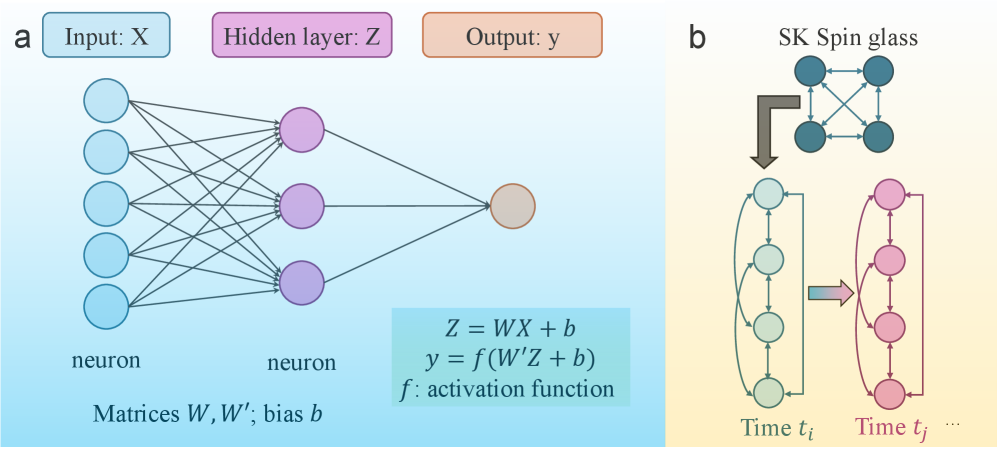
The image presents two interconnected technical diagrams:
1. **Neural Network Architecture** (Left): A feedforward network with input, hidden, and output layers.
2. **Spin Glass Dynamics** (Right): A temporal evolution of a spin glass network.
---
### Components/Axes
#### Neural Network (a)
- **Input Layer**:
- Labeled "Input: X" with 5 blue nodes (neurons).
- Connected to hidden layer via matrix **W** and bias **b**.
- **Hidden Layer**:
- Labeled "Hidden layer: Z" with 3 purple nodes.
- Equations:
- **Z = WX + b** (linear transformation).
- **y = f(W'Z + b)** (output with activation function **f**).
- **Output Layer**:
- Single orange node labeled "Output: y".
- **Matrices**:
- **W** (input→hidden weights), **W'** (hidden→output weights).
#### Spin Glass (b)
- **Initial Network**:
- 4 blue nodes (time **t_i**) connected in a fully linked "SK Spin glass" topology.
- **Temporal Evolution**:
- Arrows indicate transformation to a vertical chain of 4 red nodes (time **t_j**).
- Represents dynamic reconfiguration over time.
---
### Detailed Analysis
#### Neural Network
- **Flow**:
- Input **X** → Hidden **Z** via **W** and **b** → Output **y** via **W'** and **b**.
- Activation function **f** (e.g., ReLU, sigmoid) applied at output.
- **Color Coding**:
- Blue (input), Purple (hidden), Orange (output) for clarity.
#### Spin Glass
- **Structure**:
- Initial fully connected network (blue nodes) evolves into a linear chain (red nodes) over time.
- Arrows suggest stochastic or deterministic transitions between states.
---
### Key Observations
1. **Neural Network**:
- Standard feedforward architecture with explicit weight matrices and biases.
- No explicit activation function specified for hidden layer (only output).
2. **Spin Glass**:
- Temporal evolution implies time-dependent interactions (e.g., Ising model dynamics).
- Color shift (blue→red) may denote state changes (e.g., spin polarization).
---
### Interpretation
- **Neural Network**:
- Illustrates forward propagation: data flows from input to output through weighted sums and nonlinear activation.
- Matrices **W**, **W'** and biases **b** define learnable parameters.
- **Spin Glass**:
- Represents a physical system (e.g., magnetic spins) evolving over time with complex interactions.
- The transition from a fully connected network to a linear chain may model phase transitions or critical dynamics.
- **Connection**:
- Both diagrams emphasize network topology and transformations (linear vs. temporal).
- The spin glass model could metaphorically represent the "hidden layer" dynamics in neural networks, where interactions evolve over training iterations.
---
**Note**: No numerical data or explicit values provided; focus is on structural and conceptual relationships.