## Diagram: Spurious Correlation and Environment Shift
### Overview
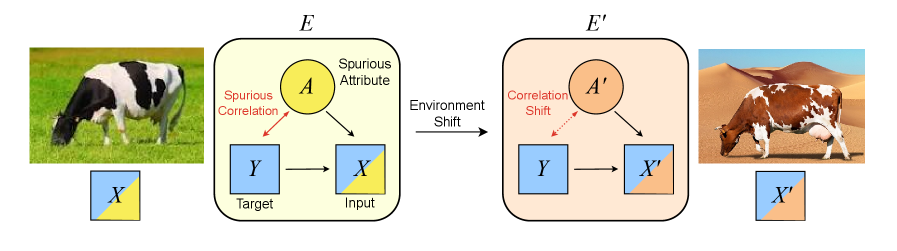
The image is a diagram illustrating the concept of spurious correlation and how it shifts with a change in the environment. It depicts two scenarios, labeled E and E', showing the relationships between input (X), target (Y), and a spurious attribute (A). The diagram highlights how the correlation between these elements changes when the environment shifts.
### Components/Axes
* **E**: Represents the initial environment.
* **A**: A yellow circle labeled "Spurious Attribute".
* **Y**: A blue square labeled "Target".
* **X**: A square, blue on the top-left and yellow on the bottom-right, labeled "Input".
* **Spurious Correlation**: A red arrow pointing from Y to A, labeled "Spurious Correlation".
* An arrow points from A to X.
* An arrow points from Y to X.
* **E'**: Represents the environment after a shift.
* **A'**: An orange circle labeled "Spurious Attribute".
* **Y**: A blue square labeled "Target".
* **X'**: A square, blue on the top-left and orange on the bottom-right, labeled "Input".
* **Correlation Shift**: A dotted red arrow pointing from Y to A', labeled "Correlation Shift".
* An arrow points from A' to X'.
* An arrow points from Y to X'.
* **Environment Shift**: A horizontal arrow pointing from E to E', labeled "Environment Shift".
* **Images**:
* Left: A photograph of a black and white cow grazing in a green field.
* Right: A photograph of a brown and white cow grazing in a desert landscape.
### Detailed Analysis
* **Environment E**:
* The "Spurious Attribute" (A) is yellow.
* The "Input" (X) is blue and yellow.
* There is a "Spurious Correlation" between the "Target" (Y) and the "Spurious Attribute" (A).
* The cow is in a green field.
* **Environment E'**:
* The "Spurious Attribute" (A') is orange.
* The "Input" (X') is blue and orange.
* There is a "Correlation Shift" between the "Target" (Y) and the "Spurious Attribute" (A').
* The cow is in a desert.
* **Arrows**:
* Solid arrows indicate a direct influence or relationship.
* Dotted arrows indicate a shift or change in correlation.
### Key Observations
* The color of the "Spurious Attribute" and the bottom-right portion of the "Input" changes from yellow to orange after the environment shift.
* The background of the cow image changes from a green field to a desert.
* The correlation between the target and the spurious attribute shifts with the environment.
### Interpretation
The diagram illustrates how a spurious correlation can be influenced by the environment. In the initial environment (E), the target (Y) is spuriously correlated with a yellow attribute (A), which influences the input (X). When the environment shifts (E'), the spurious attribute changes to orange (A'), and the correlation between the target and the spurious attribute also shifts. This suggests that the model might be learning to associate the target with the spurious attribute rather than the true underlying features, leading to poor generalization when the environment changes. The cow images exemplify this: the model might associate "cow" with "green field" in environment E, and fail to recognize a cow in a desert environment (E').