## Diagram: Spurious Correlation and Environment Shift in Machine Learning Models
### Overview
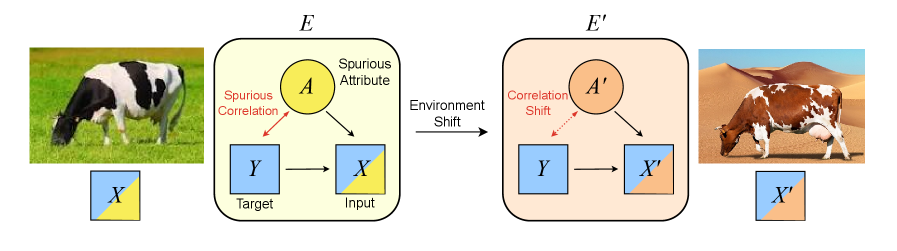
The diagram illustrates how spurious correlations in a machine learning model's training environment (E) can lead to performance degradation when the environment shifts (E'). It uses two cow images to represent different environments and visualizes the flow of data through the model.
### Components/Axes
1. **Environments**:
- **E (Original Environment)**: Left side, grassy field with a black-and-white cow.
- **E' (Shifted Environment)**: Right side, desert with a brown-and-white cow.
2. **Data Elements**:
- **Input (X/X')**: Blue squares (X in E, X' in E').
- **Target (Y)**: Yellow squares (constant across both environments).
- **Spurious Attribute (A/A')**: Yellow/orange circles connected to inputs and targets.
3. **Arrows**:
- Red arrows labeled "Spurious Correlation" (E) and "Correlation Shift" (E').
- Black arrows indicating data flow (Input → Target via Spurious Attribute).
### Detailed Analysis
- **Environment E**:
- Input (X) and Target (Y) are connected via Spurious Attribute (A).
- The black-and-white cow represents the original data distribution.
- **Environment E'**:
- Input shifts to X' (orange-blue gradient), while Target (Y) remains unchanged.
- Spurious Attribute becomes A', reflecting the environment shift.
- The brown-and-white cow represents the new, shifted data distribution.
- **Key Relationships**:
- Spurious correlations (A) in E create misleading input-target relationships.
- Environment shift (E → E') alters the spurious attribute (A → A'), potentially breaking the model's learned patterns.
### Key Observations
1. The spurious attribute (A) in E is visually dominant (larger circle) compared to A' in E'.
2. The desert environment (E') has a more fragmented input (X') compared to the uniform X in E.
3. The target (Y) remains constant, suggesting the model's objective doesn't change despite environmental shifts.
### Interpretation
This diagram highlights the **fragility of models trained on spurious correlations**. In E, the model learns to associate the spurious attribute (A) with the target (Y), but when the environment shifts to E', the altered spurious attribute (A') may no longer correlate with Y. This mismatch can cause:
- **Performance degradation**: The model fails to generalize to new environments.
- **Bias amplification**: Spurious features dominate decision-making, ignoring true causal relationships.
- **Need for domain adaptation**: Techniques like invariant feature learning or adversarial training may be required to mitigate this issue.
The cow imagery metaphorically represents how real-world data distributions (e.g., agricultural vs. arid environments) can shift, requiring models to adapt beyond superficial correlations.