## Diagram: Optical Computing Architecture with Metasurfaces
### Overview
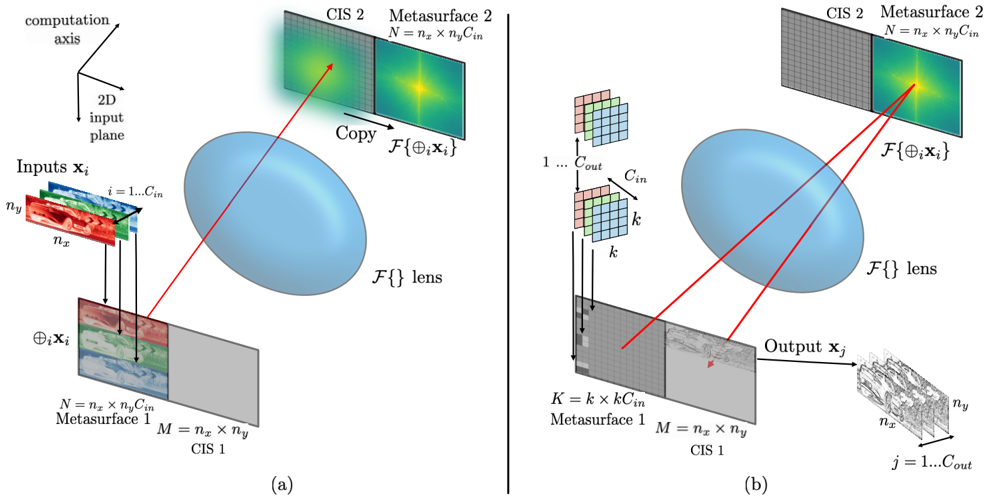
The image presents a diagram illustrating an optical computing architecture utilizing two metasurfaces (Metasurface 1 and Metasurface 2) and a lens (F{} lens) to process optical inputs. The diagram is split into two parts, (a) and (b), demonstrating different aspects of the computation. Both parts share a similar structure, with inputs entering through Metasurface 1, being processed by the lens, and outputs emerging from Metasurface 2. Red arrows indicate the path of light.
### Components/Axes
* **Metasurface 1:** Labeled with "Metasurface 1" and dimensions "M = nx x ny". A color gradient is visible, suggesting varying properties across the surface.
* **Metasurface 2:** Labeled with "Metasurface 2" and dimensions "N = nx x ny". Also displays a color gradient.
* **F{} lens:** A large, circular lens positioned between the two metasurfaces, labeled "F{} lens".
* **Inputs (xᵢ):** Labeled "Inputs xᵢ" with the index "i = 1...Cᵢₙ". Represented by a color gradient bar on the left side of (a).
* **Output (xⱼ):** Labeled "Output xⱼ" with the index "j = 1...Cout". Represented by a color gradient bar on the right side of (b).
* **Computation Axis:** A 3D axis labeled "computation axis" is shown on the top-left of (a).
* **2D Input Plane:** A plane labeled "2D input plane" is shown next to the computation axis.
* **CIS 1 & CIS 2:** Labeled "CIS 1" and "CIS 2" respectively, positioned behind Metasurface 1 and Metasurface 2.
* **Copy:** The word "Copy" is written above the lens in (a).
* **k:** A variable "k" is shown in (b) with the label "k = k x kCᵢₙ".
* **Cout & Cin:** Variables "Cout" and "Cin" are shown in (b) above the grid.
### Detailed Analysis or Content Details
**(a) Input Processing:**
* Inputs xᵢ (i ranging from 1 to Cᵢₙ) are directed towards Metasurface 1.
* The light passes through the F{} lens, which appears to transform the input.
* The output of the lens is labeled as F{Φ}xᵢ.
* A "Copy" operation is indicated above the lens.
**(b) Output Generation:**
* A grid representing a set of inputs is shown before Metasurface 1. The grid is labeled with "1...Cout" and "Cin".
* The light passes through the F{} lens.
* Outputs xⱼ (j ranging from 1 to Cout) emerge from Metasurface 2.
* The dimensions of Metasurface 1 are given as M = nx x ny, and Metasurface 2 as N = nx x ny.
* The relationship between the grid dimensions is given as K = k x kCᵢₙ.
### Key Observations
* The diagram illustrates a system where optical inputs are transformed by a lens after interacting with a metasurface.
* The use of color gradients on the metasurfaces suggests spatially varying optical properties.
* The two parts (a) and (b) highlight different aspects of the computation: (a) shows the processing of a single input, while (b) shows the processing of multiple inputs simultaneously.
* The dimensions of the metasurfaces are related by the variables nx and ny.
* The variable 'k' and the grid structure in (b) suggest a parallel processing architecture.
### Interpretation
The diagram depicts an optical computing system leveraging metasurfaces and a lens to perform computations on optical signals. The metasurfaces likely modulate the incoming light, and the lens focuses or transforms the light to achieve the desired computation. The "Copy" operation in (a) suggests a potential duplication or branching of the optical signal. The grid structure in (b) and the variables Cout and Cin indicate a parallel processing capability, where multiple inputs are processed simultaneously to generate multiple outputs. The dimensions nx and ny likely represent the number of elements or pixels within the metasurfaces, defining their resolution. The overall architecture suggests a potential for efficient and high-speed optical computation. The use of CIS (likely Computational Imaging System) indicates that the system is designed for image processing or similar tasks. The diagram is a conceptual illustration of the architecture, and does not provide specific numerical data about the optical properties or performance of the system.