\n
## Image: Multiple Choice Question with Images
### Overview
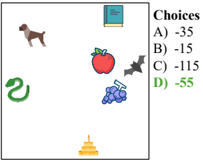
The image presents a multiple-choice question with images as visual cues. The question itself is not explicitly stated, but the answer choices are numerical values. The images appear to be unrelated objects.
### Components/Axes
The image contains the following elements:
* **Images:** Dog, Book, Apple, Bat, Grapes, Snake, Pagoda.
* **Choices:** A) -35, B) -15, C) -115, D) -55.
* **Layout:** The images are scattered across the image. The choices are listed in the top-right corner.
### Detailed Analysis or Content Details
The image does not contain any data points or trends to analyze. It is a visual representation of a multiple-choice question. The images are positioned as follows:
* Dog: Top-left
* Book: Top-center
* Apple: Center
* Bat: Top-right, next to the choices
* Grapes: Center-bottom
* Snake: Bottom-left
* Pagoda: Bottom-center
The choices are listed vertically:
* A) -35
* B) -15
* C) -115
* D) -55
### Key Observations
The image is a static representation of a question. There are no numerical trends or data distributions to observe. The question is likely designed to test a conceptual understanding or association between the images and the numerical choices.
### Interpretation
The image presents a multiple-choice question where the correct answer is likely linked to the images provided. Without the question itself, it is impossible to determine the logic behind the association. The negative values in the choices suggest the question might involve subtraction, temperature, or some other concept where negative numbers are relevant. The images are seemingly random, and their connection to the numerical choices is unknown without the question statement. The image is a visual aid for a question, not a data representation in itself.