## Diagram: Visual Puzzle with Color-Coded Numerical Choices
### Overview
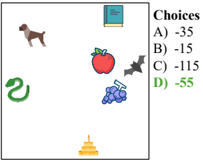
The image displays a visual puzzle or educational diagram contained within a black rectangular border. Inside the border, seven distinct illustrated objects are scattered. To the right of the border, a vertical list of four multiple-choice options is presented, each consisting of a letter, a negative number, and a colored square. The puzzle likely requires matching an object or a property of the objects to one of the numerical choices based on color association.
### Components/Axes
**Main Diagram Area (Left):**
* A rectangular frame with a black border.
* Contains seven discrete, colorful illustrations of common objects.
**Choices List (Right):**
* A vertical list labeled "Choices" at the top.
* Four options, each with a letter (A, B, C, D), a negative integer, and a colored square acting as a legend key.
* **Spatial Grounding:** The list is positioned to the right of the main diagram frame, aligned vertically.
### Detailed Analysis
**1. Objects within the Diagram (Listed roughly top to bottom, left to right):**
* **Dog:** A brown silhouette of a dog, facing left. Positioned in the upper-left quadrant.
* **Book:** A closed book with a blue cover and white pages, shown at an angle. Positioned in the top-center.
* **Tomato:** A red, round tomato with a green stem. Positioned near the center.
* **Mouse:** A gray silhouette of a mouse, facing right. Positioned to the right of the tomato.
* **Grapes:** A cluster of purple grapes with a green leaf. Positioned below the tomato and mouse.
* **Snake:** A green snake coiled in an 'S' shape. Positioned on the left side, below the dog.
* **Cake:** A yellow, two-tiered cake with a single candle on top. Positioned at the bottom-center.
**2. Choices List (Transcribed with Color Matching):**
* **A) -35** - Accompanied by a **brown** square. (Color matches the Dog).
* **B) -15** - Accompanied by a **red** square. (Color matches the Tomato).
* **C) -115** - Accompanied by a **blue** square. (Color matches the Book).
* **D) -55** - Accompanied by a **green** square. (Color matches the Snake and the stems/leaves of the Tomato and Grapes).
### Key Observations
* **Color-Number Association:** The primary logical link appears to be between the color of the square in the choice and the color of specific objects in the diagram.
* **Unmatched Objects:** Three objects (Mouse/gray, Grapes/purple, Cake/yellow) do not have a corresponding color in the choices list. This suggests they may be distractors or part of a secondary, unstated rule.
* **Negative Values:** All numerical choices are negative integers, which is an unusual property for a simple matching puzzle and may imply a context like scores, penalties, or coded values.
* **Spatial Layout:** The objects are arranged without a clear grid or order, suggesting the puzzle is about identification rather than sequence or position.
### Interpretation
This image presents a **color-matching logic puzzle**. The core task is to associate an object in the diagram with a numerical value from the choices list based on shared color.
**Peircean Investigative Reading:**
* **Sign (Representamen):** The colored square next to each choice.
* **Object:** The corresponding colored object in the diagram (e.g., the brown square signifies the brown dog).
* **Interpretant:** The negative number assigned to that color/object pair. The meaning of the number itself (why -35 for brown?) is not provided within the image, making it an **unresolved code**. It could represent a weight, a point deduction, an arbitrary code, or a value from an external system.
**Why it Matters / Underlying Logic:**
The puzzle tests observational skill and the ability to follow a simple rule (color matching). The presence of unmatched objects adds a layer of complexity, requiring the solver to ignore irrelevant information. The negative numbers introduce an abstract element, moving the puzzle beyond simple identification into the realm of assigning meaning to symbols. The most direct interpretation is that the solver must select the choice whose color matches a *specific, intended* object. Without additional instructions, the brown dog (A) or green snake (D) are the strongest candidates due to their clear, dominant color matches. The blue book (C) is also a strong match. The red tomato (B) is a match, but its green stem could create minor ambiguity with the green choice. The puzzle's design implies there is one correct answer, likely determined by a rule not visible in the image (e.g., "choose the animal," "choose the food," or "choose the object with the highest value").