## Diagram: Neural Network Architecture for Lyrics and VQ Codes
### Overview
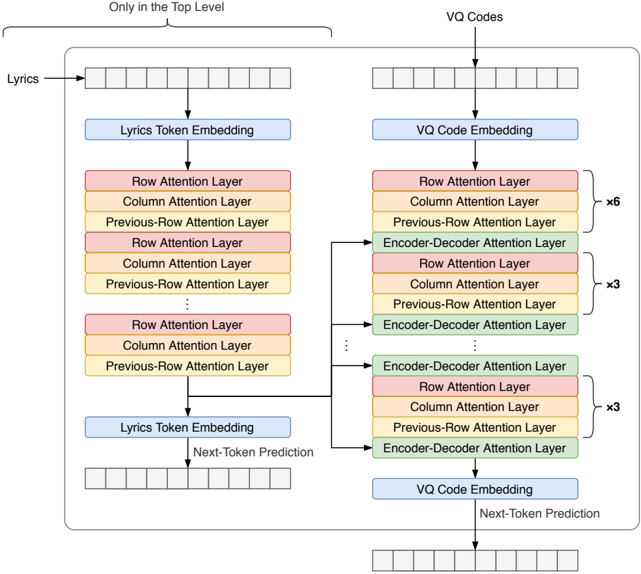
The image displays a dual-stream neural network architecture designed for sequence generation, likely for music or audio synthesis. The architecture consists of two parallel processing streams: a "Lyrics" stream on the left and a "VQ Codes" (Vector Quantized Codes) stream on the right. The entire structure is enclosed within a bracket labeled "Only in the Top Level," suggesting this is a component of a larger, hierarchical model. The two streams interact via cross-attention mechanisms, allowing the VQ Code stream to condition its output on the Lyrics stream.
### Components/Axes
The diagram uses a color-coded system to represent different types of neural network layers:
* **Blue:** Embedding layers ("Lyrics Token Embedding", "VQ Code Embedding").
* **Red:** "Row Attention Layer".
* **Orange:** "Column Attention Layer".
* **Yellow:** "Previous-Row Attention Layer".
* **Green:** "Encoder-Decoder Attention Layer".
**Structural Elements:**
* **Input/Output:** Represented by arrays of empty boxes at the top and bottom of each stream.
* **Flow:** Indicated by vertical arrows connecting the layers.
* **Multipliers:** Annotations like "x6" and "x3" indicate the repetition of specific layer blocks.
* **Cross-Connection:** A horizontal arrow connects the output of the first set of attention layers in the Lyrics stream to the Encoder-Decoder layers in the VQ Codes stream.
### Detailed Analysis
#### Left Stream (Lyrics)
* **Input:** Starts with an input array labeled "Lyrics".
* **Embedding:** Passes through a "Lyrics Token Embedding" layer.
* **Processing Blocks:** A repeating sequence of [Row Attention Layer, Column Attention Layer, Previous-Row Attention Layer].
* **Output:** The stream concludes with a "Lyrics Token Embedding" layer, followed by a "Next-Token Prediction" step, leading to an output array.
* **Connection:** A branch line exits the stream after the first set of attention layers and connects to the right stream.
#### Right Stream (VQ Codes)
* **Input:** Starts with an input array labeled "VQ Codes".
* **Embedding:** Passes through a "VQ Code Embedding" layer.
* **Top Block:** A stack of [Row Attention Layer, Column Attention Layer, Previous-Row Attention Layer] repeated **x6** times.
* **Middle/Bottom Blocks:**
* The stream incorporates "Encoder-Decoder Attention Layer" blocks.
* The structure follows a pattern: [Encoder-Decoder Attention Layer] -> [Row, Column, Previous-Row] (repeated **x3** times) -> [Encoder-Decoder Attention Layer].
* An ellipsis (...) indicates this pattern repeats.
* The bottom section mirrors the middle: [Encoder-Decoder Attention Layer] -> [Row, Column, Previous-Row] (repeated **x3** times) -> [Encoder-Decoder Attention Layer].
* **Output:** Concludes with a "VQ Code Embedding" layer, followed by a "Next-Token Prediction" step, leading to an output array.
### Key Observations
* **Asymmetry:** The Lyrics stream is significantly simpler and lacks the Encoder-Decoder layers found in the VQ Codes stream.
* **Conditioning:** The VQ Codes stream is the primary generator, which is conditioned on the Lyrics stream via the Encoder-Decoder Attention Layers.
* **Hierarchical Attention:** The use of "Row," "Column," and "Previous-Row" attention layers suggests the model is processing data that has a 2D structure (like a spectrogram or a grid of audio tokens), allowing the model to attend to spatial relationships within the data.
* **Repetition:** The "x6" and "x3" multipliers indicate a deep architecture, likely a Transformer-based variant designed to handle long-range dependencies in audio generation.
### Interpretation
This architecture represents a conditional generative model. The "Lyrics" stream acts as an encoder that processes textual input, while the "VQ Codes" stream acts as a decoder that generates audio tokens (VQ codes).
The "Encoder-Decoder Attention Layers" in the right stream are the critical interface; they allow the model to align the generated audio tokens with the specific lyrics provided. The "Row," "Column," and "Previous-Row" attention layers suggest that the VQ codes are arranged in a grid (likely representing time and frequency or temporal chunks), and the model uses these specific attention mechanisms to capture the structure of the audio signal effectively. The "Only in the Top Level" label implies that this diagram describes a specific stage of a multi-stage generation process, where this module is responsible for high-level or final-stage synthesis.