## Grid of Binary Arrays: Array Pieces and Four Choices
### Overview
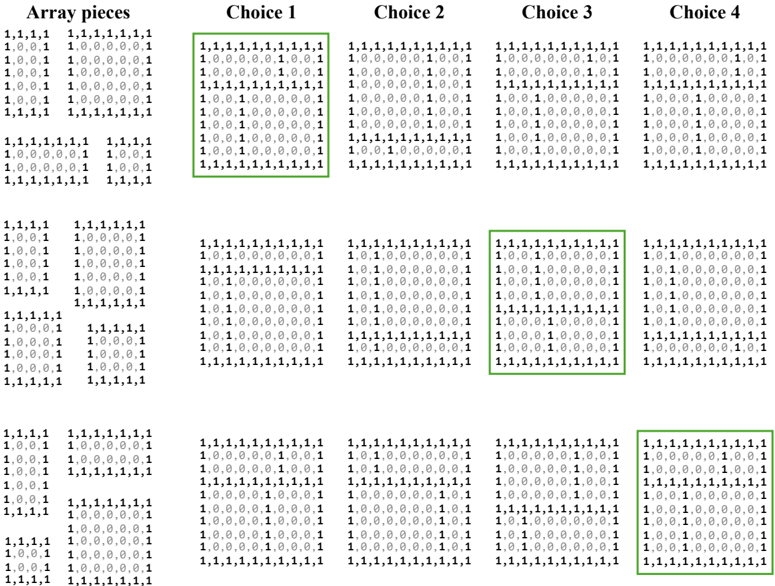
The image displays a structured grid of binary arrays (1s and 0s) organized into **Array pieces** and **Four Choices** (Choice 1–4). Each "Choice" contains a 12x12 grid of 1s and 0s, while the "Array pieces" are smaller 4x4 matrices arranged in a 6x2 layout. The first row of each "Choice" grid is highlighted in green, suggesting a specific focus or selection.
### Components/Axes
- **Labels**:
- **Array pieces**: A 6x2 grid of 4x4 binary matrices.
- **Choice 1–4**: Four 12x12 grids of 1s and 0s, each with the first row highlighted in green.
- **Structure**:
- **Array pieces**: 24 total matrices (6 rows × 2 columns), each 4x4.
- **Choices**: 4 distinct 12x12 grids, each with a consistent first-row highlight.
### Detailed Analysis
#### Array Pieces
- The 6x2 grid of 4x4 matrices contains repeated patterns of 1s and 0s. For example:
- Top-left matrix: `1,1,1,1` (row 1), `1,0,0,1` (row 2), `1,0,0,1` (row 3), `1,1,1,1` (row 4).
- Other matrices show variations, such as `1,0,0,1` repeated in multiple rows.
#### Choices 1–4
- **Choice 1**:
- 12x12 grid with the first row (`1,1,1,1,1,1,1,1,1,1,1,1`) highlighted in green.
- Subsequent rows show a mix of 1s and 0s, with some rows containing all 1s (e.g., row 1, 7, 12).
- **Choice 2**:
- First row: `1,1,1,1,1,1,1,1,1,1,1,1` (green).
- Rows 2–12 alternate between 1s and 0s, with some rows having all 0s (e.g., row 2, 6).
- **Choice 3**:
- First row: `1,1,1,1,1,1,1,1,1,1,1,1` (green).
- Rows 2–12 show a mix of 1s and 0s, with some rows having all 0s (e.g., row 2, 6).
- **Choice 4**:
- First row: `1,1,1,1,1,1,1,1,1,1,1,1` (green).
- Rows 2–12 alternate between 1s and 0s, with some rows having all 0s (e.g., row 2, 6).
### Key Observations
1. **Highlighted Rows**: The first row of each "Choice" grid is consistently `1,1,1,1,1,1,1,1,1,1,1,1` (all 1s), suggesting a deliberate selection or priority.
2. **Repetition**: The "Array pieces" contain repeated 4x4 patterns (e.g., `1,0,0,1`), which may indicate modular or reusable components.
3. **Symmetry**: Choices 2–4 share similar structures, with alternating 1s and 0s in rows, while Choice 1 has more 1s in later rows.
### Interpretation
- The **highlighted first rows** across all choices likely represent a critical or foundational element (e.g., a header, key data row, or activation signal).
- The **array pieces** may serve as building blocks for constructing the larger "Choice" grids, with their 4x4 patterns potentially encoding specific functionalities or constraints.
- The **repetition of 1s and 0s** in the "Choice" grids could imply a binary encoding system, where 1s denote active states and 0s denote inactive states. The green highlights might indicate a default or primary configuration.
- **Anomalies**: No clear outliers are observed, but the uniformity of the first rows across all choices suggests a standardized design principle.
### Conclusion
The image appears to represent a structured binary system, possibly for data encoding, configuration settings, or modular design. The "Array pieces" and "Choices" likely interact to form a larger framework, with the highlighted rows acting as anchors or reference points. Further analysis would require understanding the context of the 1s/0s (e.g., binary data, logic gates, or access permissions).