## Diagram: Kepler Agent System Architecture
### Overview
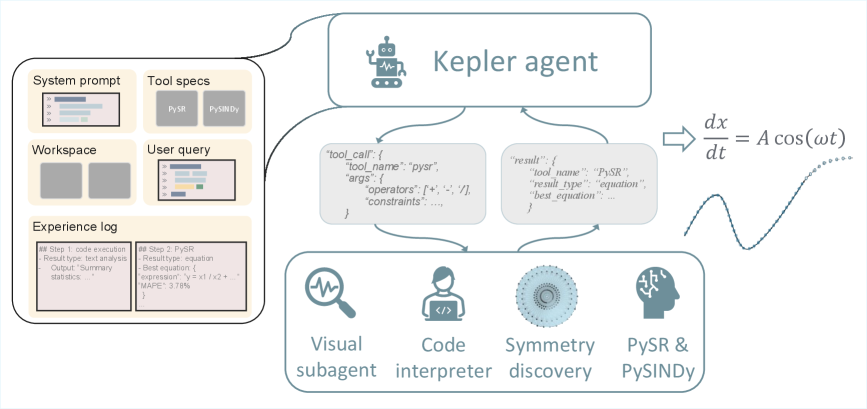
The diagram illustrates a technical system architecture centered around a "Kepler agent" that processes user queries through a multi-step workflow. It integrates tools like PySR and PySINDy, visual subagents, and mathematical modeling. The flow includes user input, tool specification, code execution, and result generation, with an emphasis on symmetry discovery and equation optimization.
### Components/Axes
1. **Top Section**:
- **Kepler agent**: Central processing unit labeled with a robot icon.
- **Tool specs**: Includes "PySR" and "PySINDy" as tool specifications.
- **System prompt**: Contains a bar chart (labeled "System prompt") and two gray boxes (labeled "Workspace").
- **User query**: Features a bar chart with color-coded segments (blue, yellow, green).
2. **Middle Section**:
- **Experience log**: Two steps:
- **Step 1**: "code execution" with result type "text analysis" and output "Summary statistics...".
- **Step 2**: "PySR" with result type "equation" and expression "y = x1 / x2 + ...".
3. **Bottom Section**:
- **Visual subagent**: Icon of a person with a magnifying glass.
- **Code interpreter**: Icon of a person with a computer.
- **Symmetry discovery**: Icon of a spiral.
- **PySR & PySINDy**: Icon of a brain.
4. **Mathematical Model**:
- Equation: `dx/dt = A cos(ωt)` (differential equation with sinusoidal trend).
### Detailed Analysis
- **Kepler agent workflow**:
- User queries are processed by the Kepler agent, which calls tools like PySR.
- Tool calls include parameters:
- `"tool_name": "pySR"`,
- `"args": ["x1", "x2", "x3"]`,
- `"operators": ["+", "-", "*", "/"]`,
- `"constraints": "..."`.
- Results include:
- `"result_type": "equation"`,
- `"best_equation": "..."`.
- **Experience log**:
- Step 1: Code execution analyzes data, producing a summary.
- Step 2: PySR generates an equation with 37.8% MAPE (Mean Absolute Percentage Error).
- **Mathematical model**:
- The equation `dx/dt = A cos(ωt)` suggests a sinusoidal relationship between variables, with amplitude `A` and angular frequency `ω`.
### Key Observations
1. The system emphasizes iterative processing: user input → tool execution → result refinement.
2. PySR and PySINDy are central to equation discovery, with PySR showing a 37.8% error rate in the example.
3. The mathematical model implies periodic behavior, possibly for dynamic systems.
4. The "Experience log" visually separates code execution from symbolic computation (PySR).
### Interpretation
This architecture demonstrates a hybrid system combining code execution (PySR/PySINDy) with symbolic mathematics for equation discovery. The Kepler agent acts as an orchestrator, integrating user queries, tool specifications, and iterative refinement. The inclusion of symmetry discovery and visual subagents suggests a focus on pattern recognition and interpretability. The 37.8% MAPE in the PySR step highlights a trade-off between model complexity and accuracy, while the sinusoidal equation hints at applications in physics or engineering. The system’s modular design allows scalability but may require careful tuning of constraints and operators for optimal performance.