## Heatmap: Classification Accuracies
### Overview
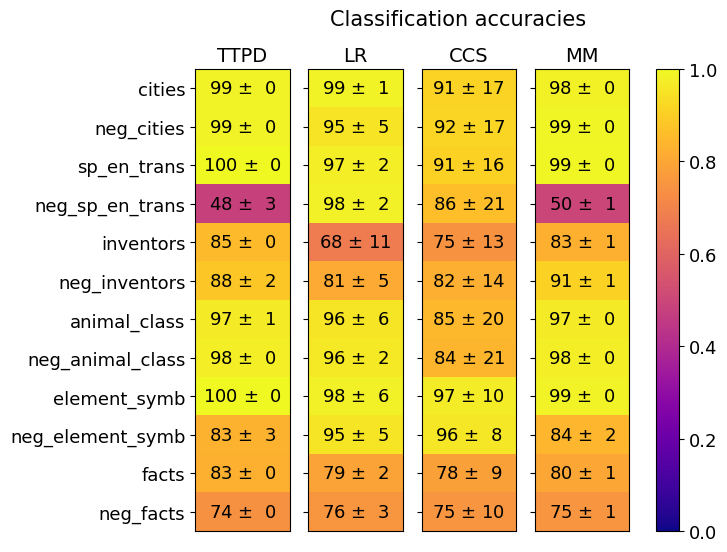
This image presents a heatmap displaying classification accuracies for different categories across four models: TTPD, LR, CCS, and MM. The heatmap uses a color gradient from dark blue (low accuracy) to yellow (high accuracy) to represent the accuracy values. Each cell in the heatmap corresponds to a specific category and model combination, with the accuracy value and its standard deviation displayed within the cell.
### Components/Axes
* **Title:** "Classification accuracies" - positioned at the top-center of the image.
* **Columns (Models):** TTPD, LR, CCS, MM - positioned horizontally across the top.
* **Rows (Categories):** cities, neg\_cities, sp\_en\_trans, neg\_sp\_en\_trans, inventors, neg\_inventors, animal\_class, neg\_animal\_class, element\_symb, neg\_element\_symb, facts, neg\_facts - positioned vertically along the left side.
* **Color Scale:** A vertical color bar on the right side, ranging from dark blue (0.0) to yellow (1.0), representing the accuracy scale.
* **Data Labels:** Each cell contains a value in the format "X ± Y", where X is the accuracy and Y is the standard deviation.
### Detailed Analysis
The heatmap displays the following accuracy values (approximated from the image):
* **cities:**
* TTPD: 99 ± 0
* LR: 99 ± 1
* CCS: 91 ± 17
* MM: 98 ± 0
* **neg\_cities:**
* TTPD: 99 ± 0
* LR: 95 ± 5
* CCS: 92 ± 17
* MM: 99 ± 0
* **sp\_en\_trans:**
* TTPD: 100 ± 0
* LR: 97 ± 2
* CCS: 91 ± 16
* MM: 99 ± 0
* **neg\_sp\_en\_trans:**
* TTPD: 48 ± 3
* LR: 98 ± 2
* CCS: 86 ± 21
* MM: 50 ± 1
* **inventors:**
* TTPD: 85 ± 0
* LR: 68 ± 11
* CCS: 75 ± 13
* MM: 83 ± 1
* **neg\_inventors:**
* TTPD: 88 ± 2
* LR: 81 ± 5
* CCS: 82 ± 14
* MM: 91 ± 1
* **animal\_class:**
* TTPD: 97 ± 1
* LR: 96 ± 6
* CCS: 85 ± 20
* MM: 97 ± 0
* **neg\_animal\_class:**
* TTPD: 98 ± 0
* LR: 96 ± 2
* CCS: 84 ± 21
* MM: 98 ± 0
* **element\_symb:**
* TTPD: 100 ± 0
* LR: 98 ± 6
* CCS: 97 ± 10
* MM: 99 ± 0
* **neg\_element\_symb:**
* TTPD: 83 ± 3
* LR: 95 ± 5
* CCS: 96 ± 8
* MM: 84 ± 2
* **facts:**
* TTPD: 83 ± 0
* LR: 79 ± 2
* CCS: 78 ± 9
* MM: 80 ± 1
* **neg\_facts:**
* TTPD: 74 ± 0
* LR: 76 ± 3
* CCS: 75 ± 10
* MM: 75 ± 1
**Trends:**
* **TTPD** generally exhibits very high accuracy (close to 1.0) across most categories, with minimal standard deviation.
* **LR** shows consistently high accuracy, but with some variability (standard deviation) in certain categories.
* **CCS** generally has lower accuracy compared to TTPD and LR, and exhibits the highest standard deviations, indicating less consistent performance.
* **MM** performs well, often comparable to TTPD and LR, but shows lower accuracy for "neg\_sp\_en\_trans".
* The "neg\_" categories (neg\_cities, neg\_sp\_en\_trans, etc.) generally have lower accuracies than their corresponding positive categories (cities, sp\_en\_trans, etc.).
* "neg\_sp\_en\_trans" has particularly low accuracy for TTPD and MM.
### Key Observations
* TTPD consistently outperforms other models across most categories.
* The CCS model demonstrates the most variability in its performance.
* Negative examples ("neg\_" categories) are more challenging to classify accurately than positive examples.
* The accuracy for "neg\_sp\_en\_trans" is notably low for both TTPD and MM.
### Interpretation
The heatmap demonstrates the performance of four different classification models on a set of categories and their negated counterparts. The consistently high accuracy of the TTPD model suggests it is the most robust and effective model for this classification task. The lower accuracy observed for negative examples indicates that distinguishing between the presence and absence of certain features is more difficult for all models. The poor performance of TTPD and MM on "neg\_sp\_en\_trans" suggests that this specific category requires further investigation or model refinement. The large standard deviations for CCS indicate that its performance is less reliable and more sensitive to variations in the data. This data could be used to inform model selection and identify areas where further training or feature engineering could improve classification accuracy. The heatmap provides a clear visual representation of model strengths and weaknesses, facilitating informed decision-making.