## Flowchart: Token Generation and Verification Process
### Overview
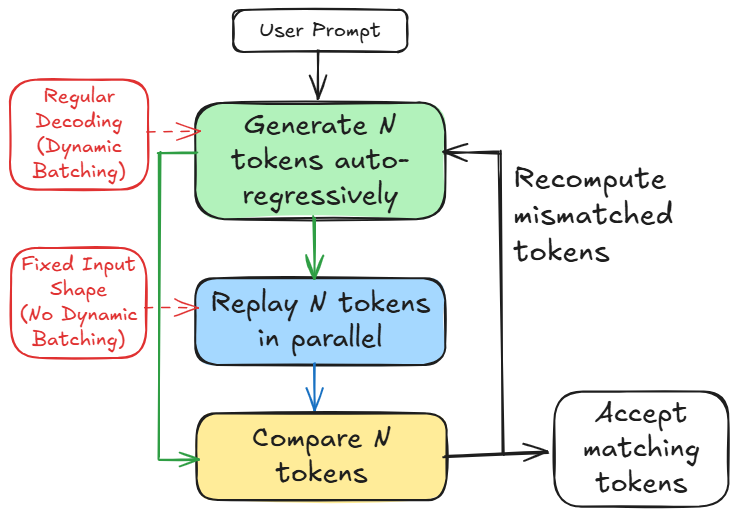
This image is a process flow diagram illustrating an iterative token generation and verification mechanism, likely representing a "Speculative Decoding" or "Draft-Verify" architecture used in Large Language Models (LLMs). The diagram contrasts two operational modes—Regular Decoding and Fixed Input Shape—and depicts the cycle of generating, replaying, comparing, and accepting or recomputing tokens.
### Components/Axes
The diagram is composed of several distinct nodes and labels:
**Main Process Nodes (Center Column):**
* **Top:** "User Prompt" (Black-bordered box).
* **Upper-Center:** "Generate N tokens auto-regressively" (Green-filled box).
* **Middle:** "Replay N tokens in parallel" (Blue-filled box).
* **Lower-Center:** "Compare N tokens" (Yellow-filled box).
* **Right:** "Accept matching tokens" (Black-bordered box).
**Side Labels (Left Column):**
* **Top-Left:** "Regular Decoding (Dynamic Batching)" (Red-bordered box).
* **Bottom-Left:** "Fixed Input Shape (No Dynamic Batching)" (Red-bordered box).
**Flow Indicators:**
* **Black Arrows:** Represent the primary sequential flow of the process.
* **Green Arrow:** Represents a secondary or conditional path originating from the "Generate" node to the "Compare" node.
* **Dashed Red Arrows:** Indicate the application of the side labels to specific process nodes.
### Detailed Analysis
The process follows a logical sequence with a feedback loop:
1. **Initialization:** The process begins with a "User Prompt."
2. **Generation Phase:** The prompt enters the "Generate N tokens auto-regressively" node. This node is associated with "Regular Decoding (Dynamic Batching)."
3. **Replay Phase:** The output from the generation phase flows into the "Replay N tokens in parallel" node. This node is associated with "Fixed Input Shape (No Dynamic Batching)."
4. **Comparison Phase:** The output from the replay phase flows into the "Compare N tokens" node.
5. **Outcome/Loop:**
* **Success:** If tokens match, the flow proceeds to the right to "Accept matching tokens."
* **Failure:** If tokens do not match, a feedback loop labeled "Recompute mismatched tokens" returns the process to the "Generate N tokens auto-regressively" node.
6. **Bypass Path:** A green arrow connects the "Generate N tokens auto-regressively" node directly to the "Compare N tokens" node, bypassing the "Replay" step.
### Key Observations
* **Iterative Feedback:** The most critical component is the loop labeled "Recompute mismatched tokens," which indicates that the system is self-correcting; it does not simply discard errors but re-processes them.
* **Operational Contrast:** The diagram explicitly separates "Regular Decoding" (associated with the generation step) from "Fixed Input Shape" (associated with the replay step), suggesting that the system handles these two phases with different computational constraints.
* **Parallelism:** The "Replay" step is explicitly noted as occurring "in parallel," which is a hallmark of speculative decoding techniques designed to increase throughput.
### Interpretation
This diagram demonstrates an optimization strategy for LLM inference.
* **The Logic:** The system generates a draft of $N$ tokens (the "Generate" step). It then verifies these tokens by running them through a model (the "Replay" step) to see if they match the model's actual output.
* **Efficiency:** By using "Fixed Input Shape" for the replay step, the system likely leverages hardware acceleration (like GPUs) more effectively than the variable-length "Regular Decoding" used in the generation step.
* **The "Why":** The "Recompute mismatched tokens" loop is the mechanism that ensures accuracy. If the draft tokens (generated by a potentially faster, smaller model) are incorrect, the system identifies the mismatch and recomputes only the necessary parts. This architecture allows the model to output multiple tokens per step, significantly reducing latency compared to standard auto-regressive decoding, provided the draft model is reasonably accurate.