## Flowchart: Token Generation and Processing Workflow
### Overview
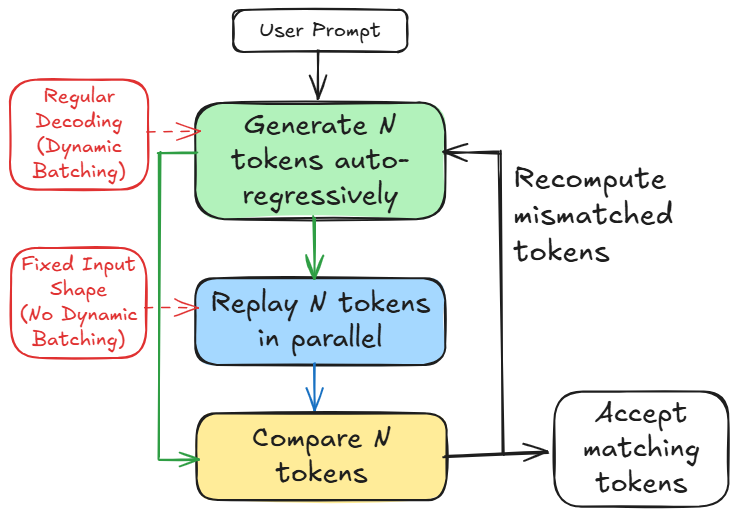
The diagram illustrates a workflow for processing user prompts through token generation, parallel replay, comparison, and acceptance. It includes two alternative decoding methods (dynamic vs. fixed batching) and a recomputation step for mismatched tokens.
### Components/Axes
- **Nodes**:
- **User Prompt** (topmost input)
- **Generate N tokens auto-regressively** (green box)
- **Replay N tokens in parallel** (blue box)
- **Compare N tokens** (yellow box)
- **Accept matching tokens** (final output)
- **Regular Decoding (Dynamic Batching)** (red box, left)
- **Fixed Input Shape (No Dynamic Batching)** (red box, right)
- **Arrows**:
- Solid arrows indicate primary flow.
- Dashed arrows represent alternative paths.
- Feedback loop for recomputing mismatched tokens.
### Detailed Analysis
1. **User Prompt** → **Generate N tokens auto-regressively** (green):
- Initial step where tokens are generated based on the prompt.
2. **Branching Paths**:
- **Regular Decoding (Dynamic Batching)** (red, left):
- Tokens are processed with dynamic batching for efficiency.
- **Fixed Input Shape (No Dynamic Batching)** (red, right):
- Tokens are processed with a fixed input shape, avoiding dynamic batching.
3. **Replay N tokens in parallel** (blue):
- Tokens are replayed in parallel, likely for optimization or redundancy.
4. **Compare N tokens** (yellow):
- Tokens are compared, possibly for consistency or error-checking.
5. **Accept matching tokens** (final step):
- Only tokens that match criteria are accepted.
6. **Recompute mismatched tokens**:
- A feedback loop ensures mismatched tokens are reprocessed.
### Key Observations
- **Dynamic vs. Fixed Batching**: The red boxes highlight two decoding strategies, suggesting trade-offs between flexibility (dynamic) and stability (fixed).
- **Parallel Replay**: The blue box emphasizes parallelism, likely to reduce latency or improve throughput.
- **Feedback Mechanism**: The recomputation step ensures robustness by addressing mismatches.
### Interpretation
This workflow optimizes token processing by balancing efficiency (dynamic batching) and reliability (fixed input shape). Parallel replay and comparison steps suggest a focus on scalability and accuracy. The recomputation loop indicates a system designed to handle errors iteratively, ensuring only validated tokens are accepted. The diagram likely represents a machine learning or NLP pipeline where token generation and validation are critical for downstream tasks like text generation or translation.